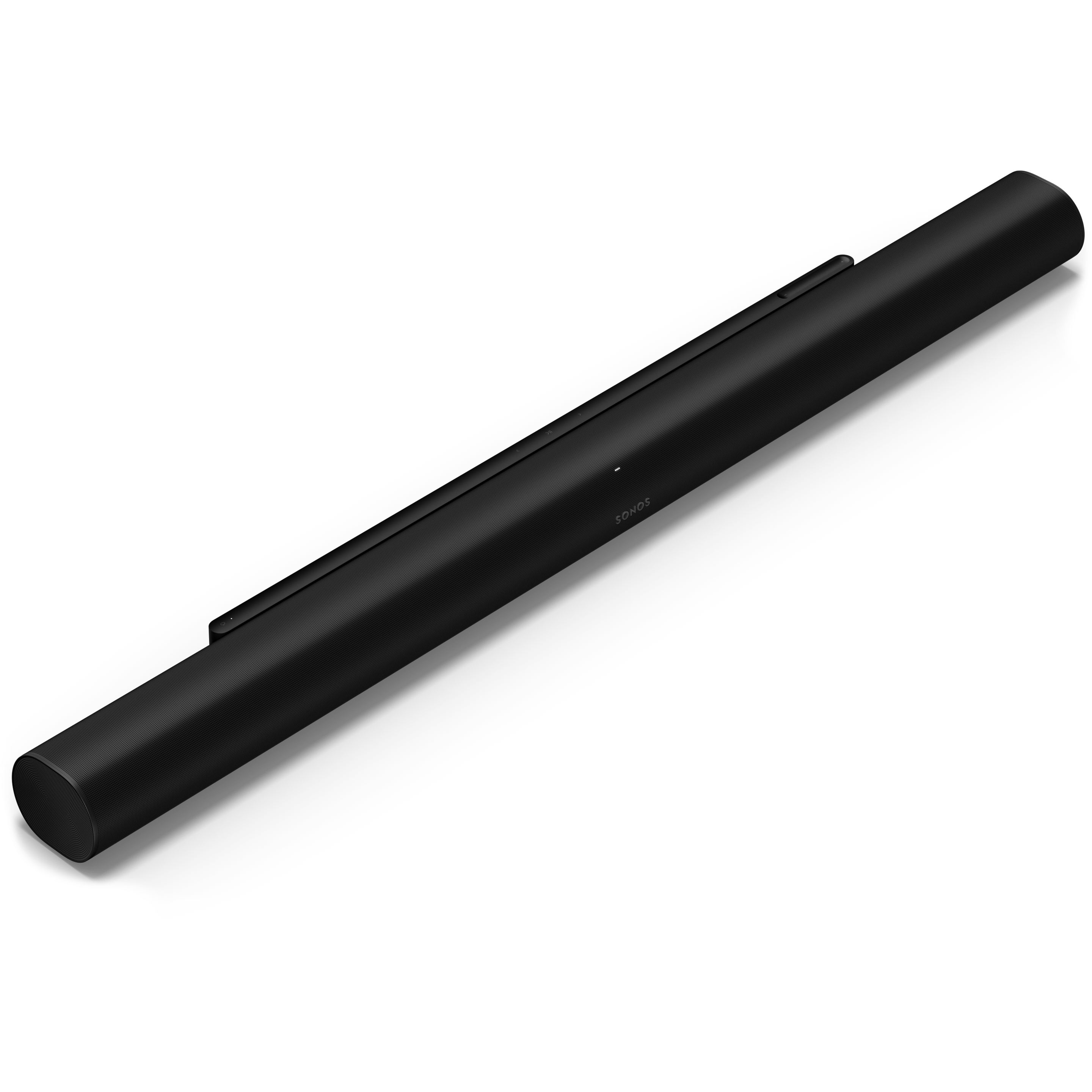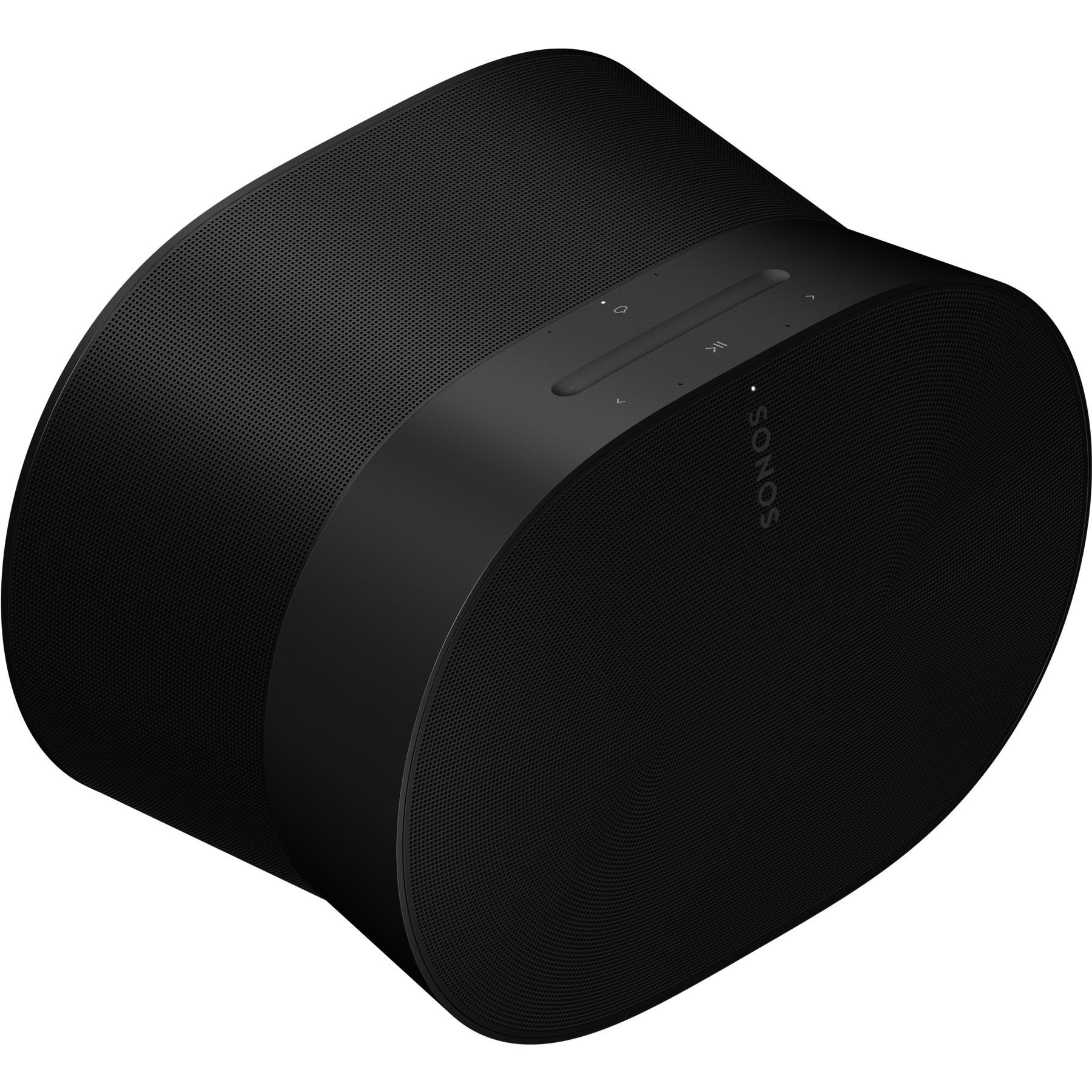
Product image supplied by the brand
In this guide
Sonos lists the Era 300 at $499 in black or white, both marked InStock at Sonos on November 6, 2026; shipping is free, and Amazon has the same $499. Inside a 160 x 260 x 185 mm cabinet sit six Class-D amplifiers, four tweeters and two woofers; one tweeter fires upward and reflects Dolby Atmos sound off the ceiling, while two mid tweeters fire sideways to spread the image from a single box. At 9.75 lb it is more than twice the Era 100's weight, and the price asks a pointed question: does one spatial-audio cabinet cover a room better than two cheaper speakers?
The answer depends on the room before the speaker. Sonos's placement rules ask for roughly 2 feet of overhead clearance and 8 inches on each side, and warn against enclosed shelving, because the design spends its budget on reflections. The wireless side is current — Wi-Fi 6, Bluetooth 5.3 and AirPlay 2 — but those inputs go quiet when the speaker is bonded as a home-theater surround. Setup still requires the Sonos app and an account, and the Era 300 lives on the S2 side of the ecosystem, which owners of older S1 gear will feel as a second system.
Our verdict
Buy the $499 Era 300 when one cabinet must carry music and Dolby Atmos in a room with a ceiling to reflect from. On TV duty it works only as surrounds behind a soundbar.
- A good fit for
- One room that plays Dolby Atmos Music and needs a single speaker to cover it, or a home theater that will add two Era 300s as surrounds behind a Sonos soundbar.
- We would skip it if
- A TV-first room where dialogue is the priority, a bookshelf or alcove that blocks the upward-firing tweeter, or an owner of two Era 100s who wants width rather than height.
Reasons to consider it
- Six Class-D amplifiers drive four tweeters and two woofers, and the upward-firing tweeter adds a Dolby Atmos height channel from one cabinet rather than a second speaker behind the couch.
- Wi-Fi 6, Bluetooth 5.3 and AirPlay 2 on board, plus USB-C for the $19 Line-In Adapter or the $39 Combo Adapter.
- The internal supply auto-switches across 100-240 V and 50/60 Hz, and two units bond as a stereo pair or as surrounds behind a compatible soundbar.
The compromises
- Placement rules ship with the cabinet: about 2 feet of overhead clearance and 8 inches at each side, and Sonos advises against enclosed shelving.
- Bonded as surrounds, the speaker loses Bluetooth, line-in and AirPlay at once, which is every input that made it convenient on its own.
- $499 costs $61 more than two Era 100s, and the documented Atmos surround plan runs to $1,497 with Beam (Gen 2) before any subwoofer.
What we have not verified: Sonos publishes no wattage and no frequency response for the Era 300, and no lab comparison of one Era 300 against a stereo pair of Era 100s was found on 2026-11-06; the height channel depends on a flat ceiling the guide describes only as 2 feet of clearance. The reason the US list price now reads $499 is not documented on the store or newsroom pages checked that day, and a published measurement would move the $499-versus-$438 call off driver layouts.
The things in this guide
A closer look at the products, who they may suit, and what to check before buying.
Sonos Era 300
$499 at Sonos and Amazon on 2026-11-06 with both colors in stock: six Class-D amplifiers, four tweeters including one upward-firing for Dolby Atmos, two angled woofers, Wi-Fi 6, Bluetooth 5.3 and AirPlay 2 in a 9.75 lb cabinet with a 100-240 V supply.
Before you buy: Needs roughly 2 ft of overhead clearance and 8 inches at each side; Bluetooth, line-in and AirPlay are disabled while it serves as a surround; setup requires the Sonos app and an account.
Price checked November 8, 2026. Retailer prices can change.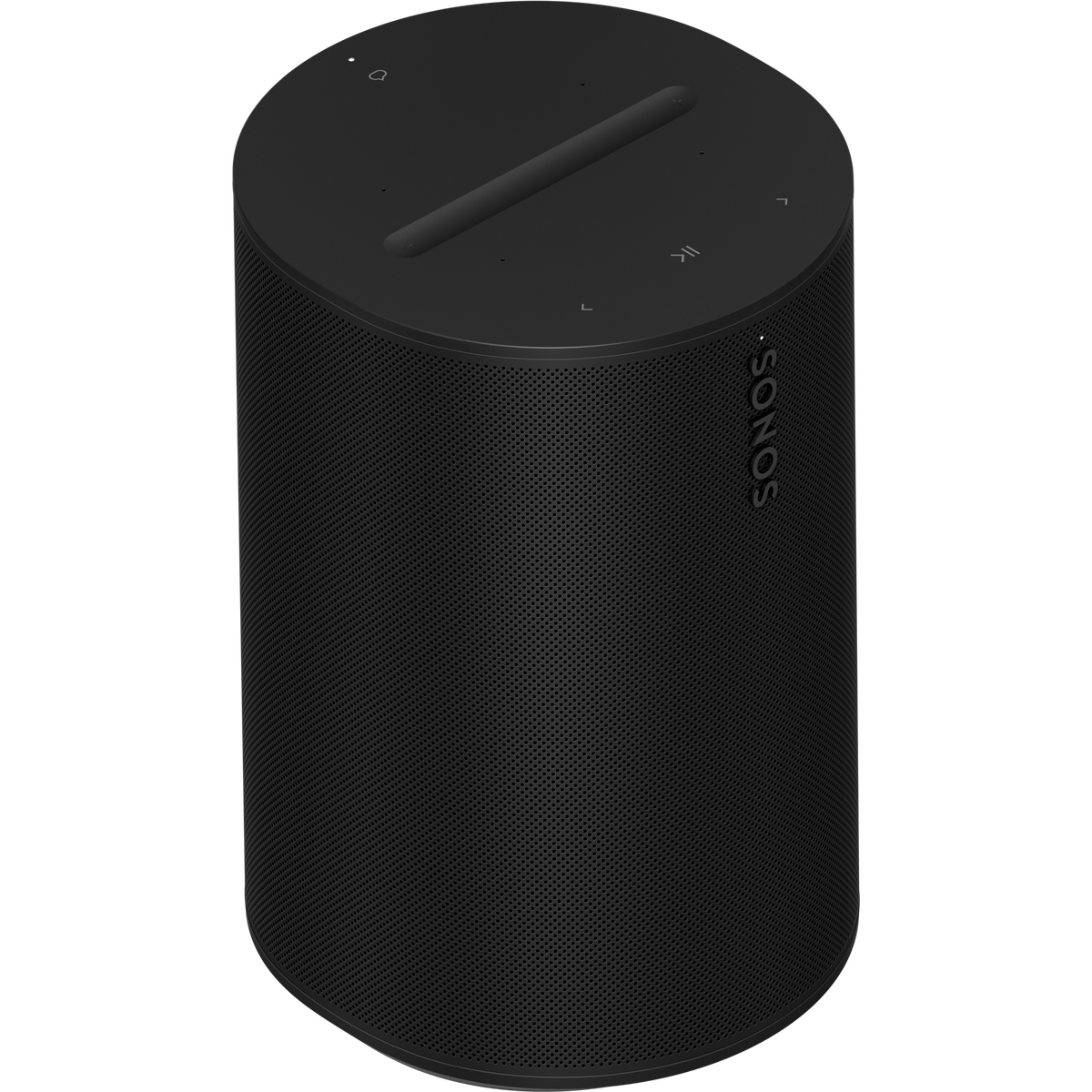
Sonos Era 100
Two Era 100s list at $219 each, $438 together on 2026-11-06, and bond as a same-model stereo pair with Sonos's recommended 8 to 10 feet between cabinets.
Before you buy: Neither unit has an upward-firing tweeter, so Dolby Atmos Music gets no height channel in this plan.
Price checked November 8, 2026. Retailer prices can change.Six drivers, one of them aimed at your ceiling
The guide lists six Class-D amplifiers, four tweeters and two woofers. The tweeters split into roles: one forward unit carries the center image, two side-firing units do the widening from a single box, and one upward-firing unit reflects Dolby Atmos content off the ceiling. The woofers angle left and right. Sonos publishes no wattage per channel and no frequency response, so loudness claims would be guesses. What the layout does establish is that height arrives through a ceiling reflection, not through speakers behind the couch.
Placement is where that design bills you. Sonos asks for roughly 2 feet of overhead clearance, 8 inches at each side and 1 inch behind, and warns that an enclosed bookshelf hurts dispersion and clarity. That suits a floor or a credenza and rules out most entertainment-center nooks. The electrical side is simpler: the guide prints an internal auto-switching 100-240 V, 50/60 Hz supply, so the electronics are not tied to US mains; the store SKU (E30G1US1 here) changes from region to region, and nothing read here says how warranty service treats a unit carried abroad.
$499 in one cabinet against $438 in two
Two Era 100s cost 2 x $219 = $438, which is $61 under a single Era 300, and Sonos recommends bonding a pair 8 to 10 feet apart with the listening seat 8 to 12 feet back. Two real cabinets at that spacing put instruments left and right through separate boxes; the Era 300 builds its spread from side-firing drivers inside one 260 mm cabinet. On separation, the pair has the stronger claim. On height it has none: only the Era 300 carries the upward-firing tweeter that plays Dolby Atmos Music.
So the choice sorts rooms, not budgets. A desk, kitchen or wide bedroom fed mostly by playlists is a two-cabinet job: $438 of Era 100s. In a room that plays Atmos masters, one cabinet does a job two cannot. The ceiling of the single-room plan is higher too: two Era 300s bond as a stereo pair at $998. No published lab comparison of one Era 300 against a stereo pair of Era 100s was found on 2026-11-06, so this ranking rests on driver layouts and Sonos's own placement advice.
As surrounds, the inputs go quiet
The Era 300 carries no HDMI input and cannot take the TV as a source on its own. Sonos's home-theater plan bonds a matched pair as rear surrounds behind a compatible soundbar, with the Arc and Beam (Gen 2) named on that listing; Dolby Atmos then sends lateral and overhead channels through each unit while dialogue stays in the soundbar. Beam's own page sells that center with an HDMI input, eARC and a speech-tuned mode. In that layout the Era 300s handle ambience behind the couch, and the soundbar keeps the words.
The role costs flexibility. Sonos disables Bluetooth for a speaker set up as a surround, disables line-in in the same situation, and keeps AirPlay away from surround speakers, so the inputs that make a standalone Era 300 convenient in a mixed household all fall silent in theater duty. On today's list prices the full plan is a $499 Beam (Gen 2) plus 2 x $499 = $998 of surrounds, $1,497 before any subwoofer; the Arc Ultra lists at $1,099 and the Sub 4 at $899. Someone who mainly wants clearer speech starts with the soundbar, not with $998 of speakers.
An app, an account, and tuning that depends on your phone
Era 300 requires the latest Sonos app and sits on the S2 side of the ecosystem: it cannot join S1-era systems, and owners who run both end up with two apps and two room groups that cannot play the same audio. Nothing plays before a phone and a network; Bluetooth pairs only after that setup, and an idle auto-disconnect timer exists but ships switched off.
Tuning no longer demands an iPhone. Quick Trueplay runs on Android and iOS through the speaker's own microphones with the microphone switch on, and Sonos lists Era 300 among the quick-tuning models. Advanced Trueplay, the walk-the-room pass, stays iOS-only. In a household where nobody carries an iPhone, the quick pass still covers a normal room, and either way tuning is a setup step rather than a daily routine.
What the order costs beyond $499
Sonos packs the speaker with the quickstart guide and a 6 ft (2 m) power cable. The add-ons that change the bill are Sonos's own: $19 for the Line-In Adapter, $39 for the Combo Adapter that adds Ethernet, both at those prices in Sonos's own store. Amazon sells and ships the black Era 300 at the same $499, so a buyer who prefers an existing Amazon account loses nothing on price.
Protection is Sonos's one-year warranty for defects in materials and workmanship, counted from shipment or from purchase at an authorized dealer, and direct orders add a 30-day mail return with Sonos paying return shipping. No subscription attaches to the speaker; streaming services bill separately. The larger commitments come later: another $499 bonds a second Era 300 into a stereo pair, and the surround plan needs a soundbar that may not be in the cart yet.
Skip it when the ceiling or the TV says no
Skip the Era 300 when the job is louder TV dialogue. The speaker takes TV sound only through a Sonos soundbar, and Beam (Gen 2) costs the same $499 with the HDMI input and speech tuning built for that job. Skip it for an enclosed bookshelf or a room where the 2-foot overhead rule cannot be met; without a ceiling to reflect from, the upward-firing tweeter cannot work as designed.
Buy it when one speaker should carry a room and the material is music: the upward tweeter is a height channel that no pair of Era 100s can supply, and the side drivers do the widening that two boxes would otherwise need. An owner of an Era 100 pair faces the blunt version of the question: $499 buys the height channel, not more left-right separation than the pair already delivers.
How we put this together
Built from the product pages and listings below, without test scores or results we have not measured. Specifications and prices change, so check the original page for the exact model, current price, delivery, and returns.
- Sonos: Era 300 product page (opens in a new tab)
- Sonos: Era 300 product guide (opens in a new tab)
- Sonos: Era 100 product page (opens in a new tab)
- Sonos: Line-In Adapter product page (opens in a new tab)
- Sonos: Combo Adapter product page (opens in a new tab)
- Sonos: Terms of Sale (US) (opens in a new tab)
- Sonos: Beam (Gen 2) product page (opens in a new tab)
- Sonos: Arc Ultra product page (opens in a new tab)
- Sonos: Sub 4 product page (opens in a new tab)
- Sonos Support: Pair Sonos Era 300 with Bluetooth (opens in a new tab)
- Sonos Support: Play Line-In on your Era 300 (opens in a new tab)
- Sonos Support: Stream AirPlay audio to Sonos (opens in a new tab)
- Sonos Support: Trueplay-compatible devices and Sonos products (opens in a new tab)
- Sonos Support: Sonos app version compatibility (opens in a new tab)
- Sonos Support: Known limitations with separate S1 and S2 Sonos systems (opens in a new tab)
- Sonos Support: Create a stereo pair (opens in a new tab)
- Amazon: Sonos Era 300 (Black) product page (opens in a new tab)