Product image supplied by the brand
In this guide
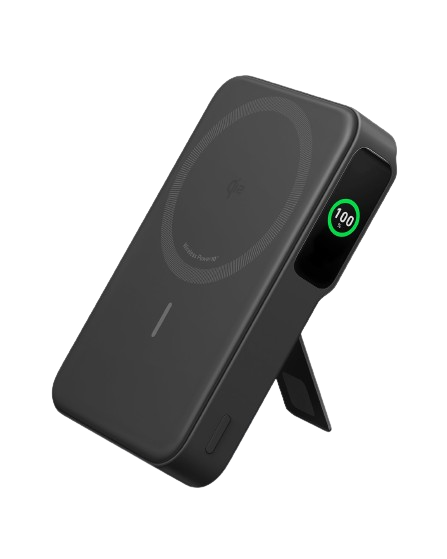
Anker sells several 10,000 mAh banks, and the MagGo A1654 is the one built around a magnet. The page leads with Qi2 certification, 15 W wireless output and a smart display, then adds a fold-out stand, a single USB-C port that works in both directions, and pass-through charging so the phone keeps charging while the bank refills.
The catch is printed in the FAQ, not the headline: the bank is not compatible with Android, and the full 15 W needs an iPhone 12 on iOS 17.4 or an iPhone 13 or later on iOS 17.2. Read that way, this is an $89.99 accessory for one phone family, and the sections below weigh it on those terms.
Our verdict
A justified $89.99 for an iPhone 12 or later owner who values a magnetic stand and 15 W wireless over raw capacity. For anyone else the magnet and the Qi2 coil are dead weight, and the same money buys far more milliamp-hours through a cable.
- A good fit for
- An iPhone 12 or later user who wants the battery to snap on, prop the phone up and keep charging without a cable in the way.
- We would skip it if
- You carry an Android phone, you want more than about one and a half phone charges, or you already carry a cable and see no value in the magnet.
Reasons to consider it
- Qi2 certified, with a stated 15 W wireless ceiling and a display that shows the percentage and time to full
- The single USB-C port does 27 W out and 20 W in, so it doubles as a wired bank when the magnet is not needed
- A fold-out stand, pass-through charging, and 24 months of warranty under Anker's US policy for MagGo power banks
The compromises
- Anker's FAQ states it is not compatible with Android and that an iPhone 12 needs iOS 17.4 or later for full 15 W
- Wireless output drops to 5 W whenever the USB-C port is charging a device
- Anker's own 30 to 45 percent loss estimate puts usable capacity at 6,000 to 7,000 mAh, carried at 250 g
What we have not verified: No iPhone has been charged from this bank in preparing this review, and the 15 W, 27 W and 165 minute figures are Anker's stated maximums. The compatibility line names iPhone 12 through 15 only, so newer iPhones are unconfirmed here, and the page shows a $14 saving badge next to the $89.99 price without saying what it is measured against.
The things in this guide
A closer look at the products, who they may suit, and what to check before buying.
MagGo Power Bank · 10K, Qi2, 15W Magnetic
Qi2 alignment, a 15 W wireless ceiling, a 27 W USB-C port and a stand in one 250 g block, backed by 24 months of warranty under Anker's US policy for MagGo power banks.
Before you buy: Usable capacity is 6,000 to 7,000 mAh by Anker's own estimate, and the wireless side falls to 5 W the moment the USB-C port is also charging something.
Price checked September 11, 2026. Retailer prices can change.Qi2 certification and what 15 W means on this bank
Anker lists the wireless output as 15 W maximum and describes the bank as Qi2 certified, with a display that shows the battery percentage and the time to a full recharge. The page also spells out the phone-side requirements: iPhone 12 on iOS 17.4 or later, iPhone 13 or later on iOS 17.2 or later, and a case no thicker than 2.5 mm, with Apple's own magnetic cases recommended.
Fifteen watts is modest next to the 27 W the USB-C port can deliver, and Anker's own comparison footnote measures the speed claim against a 7.5 W wireless bank, not against a cable. So the wireless path is the convenient one, not the fast one. The magnet is what justifies the price: the phone stays attached in a pocket or on the stand, which a loose wireless pad cannot promise.
One USB-C port, 27 W out and 20 W in
The single USB-C port is rated 5 V at 3 A or 9 V at 3 A on output, which works out to 27 W, and 5 V at 3 A or 9 V at 2.22 A on input, which is 20 W. Anker's overview repeats those as 27 W maximum output and 20 W maximum recharging, and quotes 165 minutes to refill the bank. A 60 cm USB-C to USB-C cable is included.
The asymmetry is worth noticing. The bank pushes power out faster than it takes it in, so one drained overnight on the stand needs close to three hours on a 20 W or better charger before a trip. Pass-through charging, per the overview, keeps the phone charging while the bank refills. Separately, the FAQ says wireless output drops to 5 W when the USB-C port is charging a second device, so feeding a phone and earbuds at once turns the magnetic side into a trickle.
Capacity by Anker's own arithmetic, and the weight it costs
The cell is rated 10,000 mAh at 3.85 V, or 38.5 Wh, and Anker's FAQ attributes a 30 to 45 percent loss to the cells and conversion circuitry, leaving an estimated 6,000 to 7,000 mAh delivered to a device. The FAQ does not split that estimate between wired and wireless use, so a buyer who lives on the magnet should plan around the low end of the range.
For that energy the bank weighs 250 g (8.82 oz) and measures 107.3 by 68.8 by 19.8 mm, or 4.22 by 2.71 by 0.78 inches in the Specs section, while the summary block higher on the same page lists 0.87 inches for the thickness. Stuck to the back of a phone, a quarter kilogram changes how the phone sits in a hand, which is why the fold-out stand matters: it gives the pair somewhere to rest.
The stand, the colors, and the 24 month warranty
The Specs section lists a bracket, which the overview calls a built-in foldable stand, and marks the flashlight and trickle charging mode as absent. Five colors are offered at the same $89.99: Black Stone (SKU A1654011), Shell White, Ice Lake Blue, Lotus Pink and Buds Green. The page shows a 30-day refund promise and a free shipping line above the price.
Anker's US policy page puts MagGo power banks in the 24 month warranty tier, alongside its Prime and GaNPrime lines, while other power banks get 18 months. Six extra months is a real difference on a battery that will be cycled daily, and it is one of the few places the MagGo premium shows up as something other than a magnet.
When to skip the MagGo 10K
Skip it with an Android phone. Anker's FAQ says so directly, and a Qi2 bank with no phone to align to is an expensive 27 W wired bank. Skip it if capacity is the goal, since the magnet and coil add cost and weight without adding a single milliamp-hour over a wired 10K bank with the same 6,000 to 7,000 mAh usable estimate.
Skip it if the phone usually charges from a cable anyway. The USB-C port here is good, but it is one port, and a wired bank with two ports and no coil serves a phone plus earbuds without the 5 W wireless penalty. The case for the MagGo rests on the magnet and the stand; a buyer who will not use either is paying for the Qi2 logo.
How we put this together
Built from the product pages and listings below, without test scores or results we have not measured. Specifications and prices change, so check the original page for the exact model, current price, delivery, and returns.
- Anker: MagGo Power Bank (10K), model A1654 (opens in a new tab)
- Anker: US refund and warranty policy (opens in a new tab)