Product image supplied by the brand
In this guide
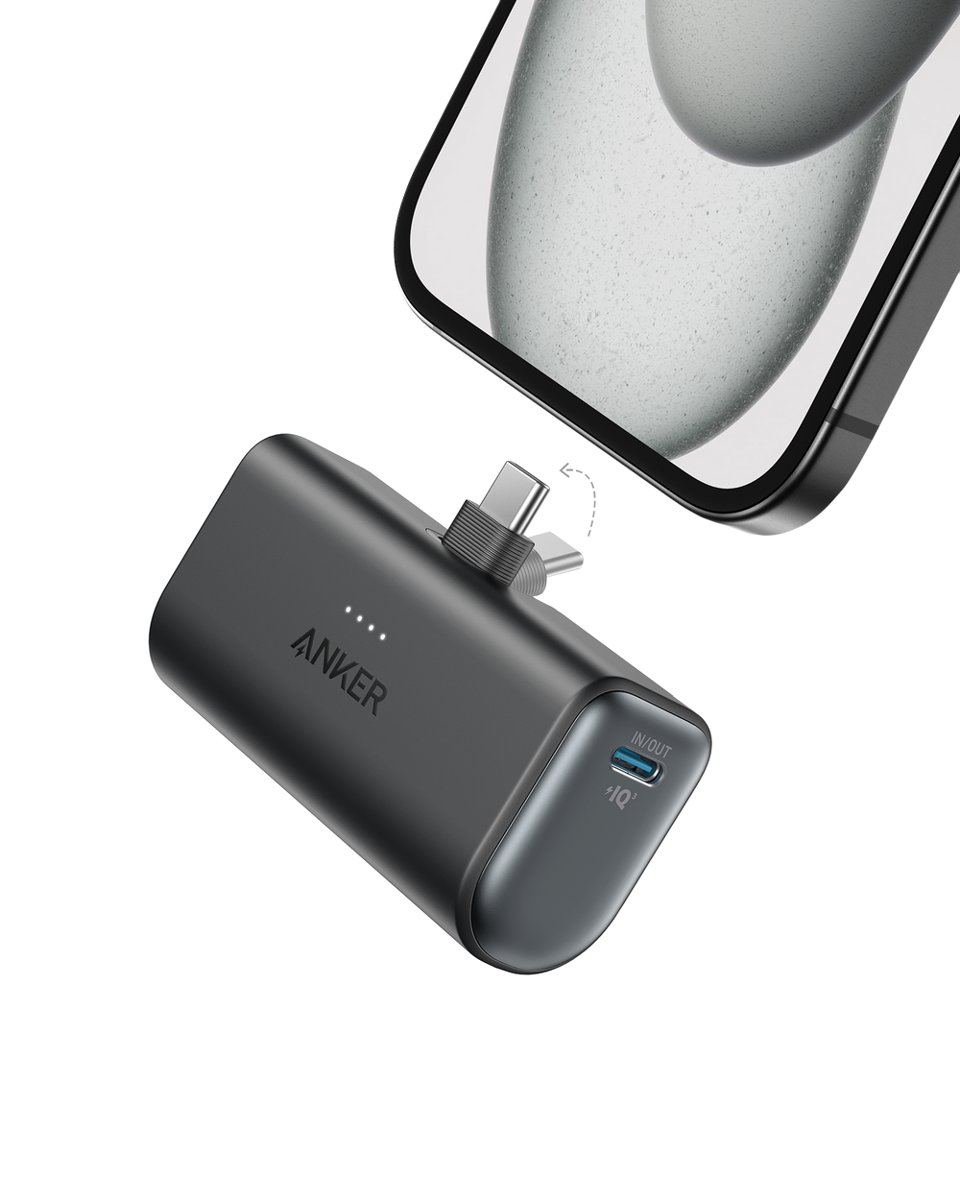
Small power banks are sold on capacity, but the number that settles whether one gets used is how much friction stands between it and the phone. A 5,000 mAh bank that needs a cable you left at home charges nothing. Anker's answer on the Nano Power Bank with a built-in USB-C connector, model A1653, is a plug that folds out of the top edge and goes straight into the phone.
That design choice sets every other spec. The bank is 3.5 oz and just over three inches long because it has to hang off a phone without tipping it. The 22.5 W figure on the box applies to one port at a time, and the total drops to 18 W when both ports are working. This review reads the page Anker publishes, including what it leaves out, and puts the $26.99 price next to the 10K banks the same brand sells for a few dollars more.
Our verdict
A sensible $26.99 buy for one narrow job: topping up one USB-C phone from a pocket without carrying a cable. The 5,000 mAh cell, the 22.5 W per-port ceiling and the 3.5 oz weight all fit that job. It stops making sense the moment you want a second full charge, a tablet, or a bank that rides in a bag next to a cable anyway.
- A good fit for
- A commuter or traveler carrying one USB-C phone who keeps losing cables and needs one partial charge a day, not two.
- We would skip it if
- Your phone still has a Lightning port, your case is thicker than 4.9 mm, or you need more than one charge between outlets, where Anker's Zolo 10K costs $3 more.
Reasons to consider it
- The plug folds into the body, so there is no cable to forget and no cap to lose
- A second USB-C socket on the end, so the bank recharges and charges through either the plug or the included 2 ft cable
- 3.5 oz and 3.03 by 1.45 by 0.98 inches, with a 24-month term printed in the box contents
The compromises
- Anker states 22.5 W per port but 18 W total output, and the 9 V / 2 A input means the refill is capped at 18 W too
- No watt-hour rating, no usable-capacity estimate and no airline wording appear on Anker's page
- Anker advises holding both phone and bank during charging, and cases over 4.9 mm block the connector
What we have not verified: We have not charged a phone with this bank or measured its output. Anker does not publish the watt-hour rating, the recharge time, how much of the 5,000 mAh reaches a phone, or a cycle rating for the folding hinge. The compatibility list on the page stops at the iPhone 14 and leaves out USB-C iPhones.
The things in this guide
A closer look at the products, who they may suit, and what to check before buying.
Nano Power Bank · 5K, 22.5W, Built-In USB-C Connector
The fold-out plug, 100 g weight and 22.5 W single-port output are the right shape for one partial charge a day on any USB-C phone.
Before you buy: 5,000 mAh is one top-up, not a full day, and Anker's Zolo 10K with a built-in cable is only $3 more if capacity matters more than size.
Price checked September 11, 2026. Retailer prices can change.22.5 W on the box, 18 W in the table
Anker's specification list gives the output of each USB-C socket as 5 V at 3 A, 9 V at 2.22 A, or 10 V at 2.25 A. The last pair multiplies to 22.5 W, which is where the name on the box comes from. One line above it, the same table gives total output as 18 W max at 5 V and 3.6 A. Both numbers are correct; they describe different situations. Charge one phone through the plug and you can reach 22.5 W. Plug a second device into the port on the end and the two share 18 W at 5 V.
The input side is 5 V at 3 A or 9 V at 2 A, so the bank refills at 18 W at best from a charger that supports 9 V. Anker does not state a refill time. For a 5,000 mAh cell the ceiling is modest and unlikely to be the bottleneck in daily use, but it means a 30 W or 45 W charger buys nothing here. The page mentions PowerIQ 3.0 for the port, which is Anker's name for its protocol negotiation, and gives no separate figure for the plug versus the port.
A hinge in place of a cable
The built-in plug folds flat against the body and swings out to meet the phone, which means the bank hangs off the bottom of the handset while it charges. Anker adds two notes that are easy to skim past. Cases thicker than 0.19 inches (4.9 mm) will not let the plug seat, and the page names OtterBox Defender cases as an example. Anker also suggests holding both the phone and the bank while charging because of the foldable design, which is a quiet admission that the hinge is not meant to carry the phone's weight in a pocket.
The second port on the end of the bank is marked in and out. It recharges the bank from the included 2 ft (0.6 m) C-to-C cable and can also charge a device, so a Lightning iPhone can still use the bank through the C-to-C to Lightning cable that Anker sells separately. The exterior is 75 percent post-consumer recycled plastic by Anker's count, and the bank carries what Anker calls ActiveShield 2.0, a temperature monitor. None of that changes the charging numbers; it is context for the price.
What 5,000 mAh weighs, and what Anker does not say
The bank is 3.5 oz (100 g) and 3.03 by 1.45 by 0.98 inches, which is the size of a small box of matches with a plug on top. Anker publishes no watt-hour rating for this model. At the 3.7 V nominal that most lithium cells use, 5,000 mAh works out to about 18.5 Wh, and that arithmetic is ours, not Anker's. The page also carries no airline or carry-on language of the kind Anker prints on its larger banks, so travelers who want that reassurance in writing will not find it here.
Usable capacity is the bigger omission. On the Zolo 10K page, Anker's FAQ says that conversion losses of 30 to 45 percent leave roughly 5,500 to 7,000 mAh of a 10,000 mAh bank for the phone. The Nano page has no equivalent line, so the same losses applied to 5,000 mAh would leave something like 2,750 to 3,500 mAh if the cell behaves the same way. Whether that is one full charge or most of one depends on the phone, and Anker's page does not answer the question for any specific model.
Three dollars from a 10K
On September 11, Black Stone and Sprout Green listed at $26.99 and the Shell White, Ice Lake Blue and Lotus Pink versions at $29.99. Anker's own Zolo Power Bank 10K, with twice the capacity, a 30 W port and a 5.4 inch built-in cable, is $29.99. The MagGo 10K with Qi2 magnetic charging sits at $89.99. The Nano 5K is therefore three dollars below the Zolo in its cheapest colors and level with it in the others.
What the Nano buys for that money is size and the plug, not capacity or speed. The Zolo is a bigger object with a cable that dangles; the Nano is a block that clips onto the phone. If the bank rides in a bag and gets used on a table, the Zolo's extra 5,000 mAh and higher output are worth more than the Nano's smaller footprint. If the bank rides in a pocket and gets used while walking, the Nano's shape is the point and the capacity gap is the price of it.
24 months on the page, 18 in the policy table
Anker's US policy page holds a table of standard warranty periods. Power banks in the GaNPrime, Prime and MagGo families get 24 months; PowerCore Reserve gets 36; everything else under power banks gets 18. The Nano name does not appear in that table, so by the table alone this bank would fall into the 18-month row. The A1653 page, though, lists a 24-month term in its box contents, and the table itself says some models carry extended terms and that the individual page or the invoice states the exact duration.
Read together, the 24-month term on the A1653 page governs, and it is worth keeping a screenshot of that line with the order confirmation. Anker's returns section allows an undamaged product to be sent back for a full refund inside 30 days of purchase, with the buyer paying return shipping for non-quality returns. Anker also states the warranty is void if the product leaves the country of purchase, which matters for a bank designed to travel.
When to skip it
Skip this bank if your phone charges over Lightning. The built-in plug is USB-C only, and the Lightning path runs through the end port and a separate cable, at which point a bank with a built-in Lightning cable is the better shape. Skip it if your case is thicker than 4.9 mm, because the plug will not reach the port. Skip it if you routinely need two charges between outlets; the Zolo 10K at $29.99 gives twice the cell for three dollars more.
It is also a poor match for tablets and anything larger. The per-port ceiling of 22.5 W and the 18 W total mean an iPad will charge, slowly, and a laptop will barely register it. The design assumes one USB-C phone, a partial top-up, and a pocket. Inside that assumption the $26.99 price is fair. Outside it, most of the money is paying for a hinge you will not use.
How we put this together
Built from the product pages and listings below, without test scores or results we have not measured. Specifications and prices change, so check the original page for the exact model, current price, delivery, and returns.
- Anker: Nano Power Bank (22.5W, Built-In USB-C Connector), model A1653 (opens in a new tab)
- Anker: Return and Refund Policy, standard warranty period table (opens in a new tab)
- Anker: Zolo Power Bank (10K, 30W) with built-in USB-C cable, model A1688 (opens in a new tab)
- Anker: MagGo Power Bank (10K), Qi2 magnetic, model A1654 (opens in a new tab)