Product image supplied by the brand
In this guide
Anker sells two kilowatt-hour stations, and which one costs more depends on the store. The SOLIX C1000 Gen 2, model A1763, holds 1,024Wh of LiFePO4, puts out 2,000W continuous across ten ports and weighs 24.9 lb. The original C1000 holds 1,056Wh, puts out 1,800W over eleven ports and weighs 28.44 lb. On 2026-09-25 AnkerDirect's Amazon listings had them at $499.99 and $449.98, while Anker's own US store asked $529.99 and $599.99.
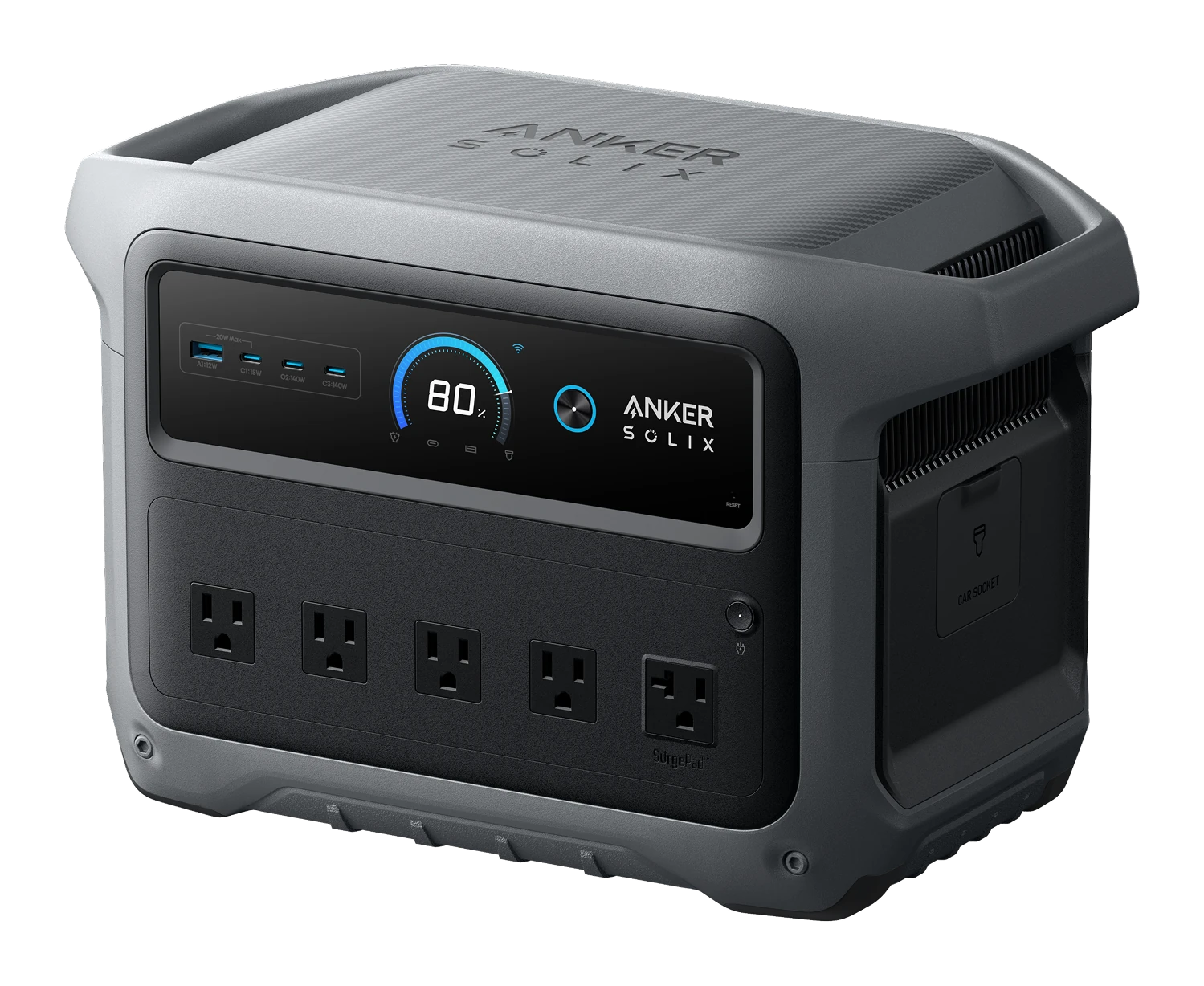
The newer station is not the bigger one. It carries 32Wh less, and Anker's product photo shows one fewer AC outlet than the C1000's. What the Gen 2's extra $50 on Amazon buys is wall-socket speed, a lighter case, an LCD in place of a light bar, and a UPS switchover Anker rates at 10 ms rather than 20 ms.
That exchange suits a particular buyer. If a second battery might enter the picture, or the 32Wh matters, the C1000 is the more capable station, and on Amazon the cheaper one. If the plan is a 24.9 lb box on a shelf, refilled from a wall socket between storms, the Gen 2 is the version Anker built for it.
Our verdict
Buy the C1000 Gen 2 at $499.99 from AnkerDirect on Amazon for the fastest refill and the lightest case; take the $449.98 C1000 instead if a second battery is ever part of the plan, since its $399.99 BP1000 is on sale now.
- A good fit for
- For anyone after about 1 kWh that refills from a wall socket in under an hour with UltraFast on and weighs 24.9 lb: a CPAP user, a desk at home, a fridge circuit.
- We would skip it if
- Skip this station if you may add a second battery later or need a sixth AC outlet: Anker's own FAQ names the C1000 for expandable capacity.
Reasons to consider it
- Anker's comparison table puts the Gen 2 at 49 minutes to full against the C1000's 58, on a maximum AC input of 1,600W against 1,300W, and its 24.9 lb case is 3.54 lb lighter than the C1000's 28.44 lb
- The 10 ms UPS switchover is half the C1000's figure, and the user guide's conditions fit a desk: connect to a wall socket with the supplied AC charging cable, press the AC output button, then plug devices in
- Anker rates the LiFePO4 cells for 4,000 cycles to 80 percent against 3,000 for the C1000, and the LCD shows charge level, input and output power without opening the app
The compromises
- No expansion battery anywhere in the line: the Gen 2 FAQ rules out an expansion feature and points capacity seekers to the C1000, whose $399.99 BP1000 expansion battery takes it to 2,112Wh
- The 49-minute refill is UltraFast mode, switched on in the Anker app and active only above 20 °C / 68 °F; unplugging the AC cable turns it off again, and standard charging runs at 1,200W
- Capacity falls to 1,024Wh from 1,056Wh and the product shot on Anker's listing shows five AC outlets against the C1000's six; at 2026-09-25 Amazon prices the Gen 2 costs 49 cents a watt-hour against 43 cents
What we have not verified: Open: the Gen 2 page credits the C1000 with a 3,000W surge where the C1000's page and the Gen 2 manual say 2,400W; box contents are listed three ways; Amazon marks both stations non-returnable; no outside measurement exists.
The things in this guide
A closer look at the products, who they may suit, and what to check before buying.
SOLIX C1000 Gen 2 Portable Power Station · A1763
AnkerDirect sold it on Amazon at $499.99 on 2026-09-25 ($529.99 on Anker's own store): 1,024Wh of LiFePO4 rated for 4,000 cycles to 80 percent, 2,000W continuous and a claimed 3,000W peak over ten ports, a 10 ms UPS switchover, an LCD, and a 24.9 lb case 3.54 lb lighter than the C1000's.
Before you buy: Anker's FAQ rules out an expansion battery, the listing's main photo shows five AC outlets against the C1000's six, capacity is 32Wh smaller, and the 49-minute refill needs the app's UltraFast mode and a battery above 20 °C.
Price checked September 25, 2026. Retailer prices can change.What the extra $50 buys, and what it takes back
Anker's own comparison, printed on the C1000 Gen 2 page, sets the two stations against each other. Recharge to full: 49 minutes against 58. Maximum AC input: 1,600W against 1,300W. Continuous output: 2,000W against 1,800W. UPS switchover: 10 ms against 20 ms.
The Gen 2 pays for them elsewhere on the same shelf. It holds 1,024Wh against the C1000's 1,056Wh, 32Wh less, and Anker's US shop counts ten ports against the older station's eleven, swapping the C1000's light bar for an LCD. At the 2026-09-25 Amazon prices each watt-hour costs 49 cents for the Gen 2 against 43 cents for the C1000; at Anker's own store it is 52 cents against 57.
The weight difference carries the remaining pitch. The Gen 2 lists at 24.9 lb and 15.12 x 8.19 x 9.61 in, the C1000 at 28.44 lb and 14.8 x 8.07 x 10.5 in. Anker describes the newer enclosure as 14 percent smaller and 11 percent lighter than similar models, and that same reduction in size and weight is what the FAQ gives for dropping expansion.
The 49 minutes is a mode you switch on, not the default
Standard AC charging tops out at 1,200W. The 1,600W figure belongs to UltraFast charging, which the user guide describes as enabled or disabled in the Anker app, with the recommendation to use it only when necessary because recharging at normal speed best protects the battery. As shipped, the station charges at the slower rate.
UltraFast also wants warmth. Anker's FAQ states it activates above 20 °C (68 °F), and that charging between 0 and 20 °C significantly reduces the speed, which puts 49 minutes out of reach in an unheated garage in January. The user guide notes a condition that recurs in practice: each time the AC charging cable is unplugged, UltraFast switches itself off and has to be re-enabled in the app.
Anker dates its own headline. A note on the Gen 2 page says 100 percent recharging in 49 minutes was the fastest charging time among all portable power stations as of April 2025. Read that as a claim about a moment, and treat 1,200W with a longer wait as what the station does unless the app is opened first.
No second battery: the fork that decides the purchase
Anker answers the expansion question in the Gen 2's own FAQ. To improve portability by reducing weight and size, the reply says, the station does not include an expansion feature; that job stays with the C1000. That single answer removes the Gen 2 from consideration for anyone who plans to grow the system rather than replace it.
The C1000's US page advertises scalability to a maximum 2,112Wh with the Expansion Battery and still tags that line coming soon, but the battery is on sale: Anker's store listed the BP1000 (1,056Wh, for the C1000) at $399.99, open to orders, on 2026-09-25, beside a C1000 plus Expansion Battery bundle. The C1000's route to 2,112Wh costs $399.99 on top of the station.
The charging paths differ as well. The C1000's FAQ rules out recharging from AC and DC together, with AC input taking priority. The Gen 2's FAQ allows grid and solar at once, solar first and AC supplying the remainder. For a solar panel and a wall socket at once, only one of these two stations does both.
Where Anker's own pages disagree
Peak output carries two different figures across Anker's pages. The Gen 2 comparison table gives both stations a 3,000W peak. The C1000's own spec table puts its AC surge output at 2,400W. The Gen 2 user guide caps SurgePad at 2,400W of AC output and adds that SurgePad does not function in bypass mode. The three statements cannot be reconciled from Anker's own documents, so nothing here rests on the peak number.
Box contents appear three times, each differently. The Gen 2 page's description bullet names the station, a safety and warranty card, and the AC charging cable; the same page's What's in the Box block swaps the card for a user manual; the US user guide's inventory shows an AC charging cable plus a car charging cable. Compare the three lists against the cables you may already own.
The price order flips between stores. Anker's own US store showed the Gen 2 at $529.99 and the C1000 at $599.99 on 2026-09-25, with no discount; AnkerDirect's Amazon listings had $499.99 and $449.98 the same day, both marked non-returnable there because the batteries ship as hazardous materials, while Anker's store lists a 30-day money-back guarantee.
Which station, and the setup details that matter before an outage
Take the C1000 when expandability, the extra 32Wh or that sixth AC outlet outweighs speed, weight and a screen; on Amazon it is also $50 cheaper, though at Anker's own store it costs $70 more. Take the Gen 2 when the station will live on a shelf, be carried at 24.9 lb and refill from a wall socket, where its 1,600W UltraFast input does its work.
The Gen 2 guide conditions the backup on three things. The 10 ms UPS switchover needs the station plugged into a wall socket with the supplied AC charging cable. The station should be given one full charge before its first use, and the AC outputs switch off after 15 minutes without detecting a plug.
Warranty terms sit unevenly across the two listings. The C1000's US page states a 5-year warranty; the Gen 2's lists none at all, while Anker's Australian family page for this same station states five years. Regional specification lines differ too: that Australian page counts four AC outlets and 2,250W maximum bypass where the American page counts ten ports in total and 1,800W bypass.
How we put this together
Built from the product pages and listings below, without test scores or results we have not measured. Specifications and prices change, so check the original page for the exact model, current price, delivery, and returns.
- Anker SOLIX: C1000 Gen 2 Portable Power Station product page (US store) (opens in a new tab)
- Anker SOLIX: C1000 Portable Power Station product page, original generation (US store) (opens in a new tab)
- Anker SOLIX: C1000 Gen 2 user guide (US edition, A17631A1, V2, 2025-07-18, PDF) (opens in a new tab)
- Anker SOLIX: C1000 Gen 2 and C2000 Gen 2 family page (Australian store) (opens in a new tab)
- Amazon: Anker SOLIX C1000 Gen 2 Portable Power Station (ASIN B0FN7MSY4L) (opens in a new tab)
- Amazon: Anker SOLIX C1000 Portable Power Station with Car Charging Cable (ASIN B0C5C89QKZ) (opens in a new tab)
- Anker SOLIX: BP1000 Expansion Battery (For C1000) product page (opens in a new tab)