Product image supplied by the brand
In this guide
Power bank labels are written in milliamp-hours at the cell voltage, not at the voltage your phone charges at, and the conversion loses a third of the number before any cable or circuitry gets involved. Most makers let the label do the talking. Anker, on the Zolo 10K listing, puts the arithmetic in its own FAQ.
The formula is capacity times 0.65 divided by the phone's battery, and the stated result for a 10,000 mAh bank is 5,500 to 7,000 mAh of usable output. Treat that as the specification. Everything else on the page, the 30 W output and the built-in cable, is a question of how conveniently that usable energy gets into a phone.
Our verdict
A sensible $29.99 for a phone-only power bank, judged by the usable figure Anker itself publishes rather than the label. The built-in cable is the convenience you are paying for and the part most likely to end the product's life.
- A good fit for
- Someone who wants one object in a pocket, no separate cable to forget, and roughly one and a half phone charges of real capacity.
- We would skip it if
- You expect three full charges from 10,000 mAh, you want to charge a laptop, or you already carry a cable and would rather have a second port.
Reasons to consider it
- Anker publishes an honest capacity formula and a usable range of 5,500 to 7,000 mAh
- 30 W in both directions, so a 20 W charger refills it in about 2.5 hours by Anker's figure
- A low-current mode for earbuds and a digital display that shows a percentage rather than four lights
The compromises
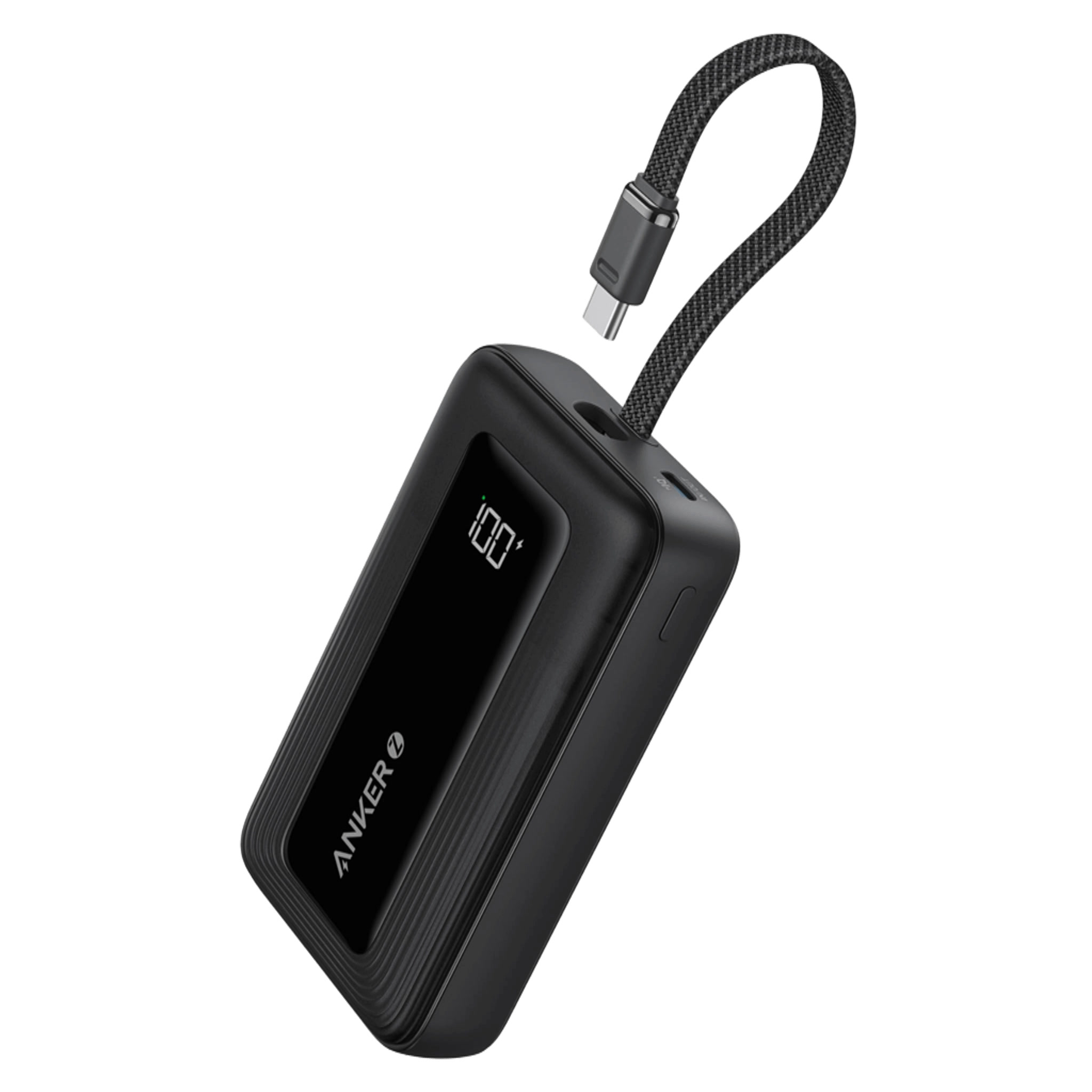
- The 5.4 inch built-in cable is the primary connector; if it fails the bank loses its main use
- Pass-through charging is capped at 5 V / 3 A and does not work for laptops at all
- Anker publishes no weight or dimensions on the listing
What we have not verified: We have not charged a device from this bank, measured delivered capacity, or cycled the built-in cable. Weight and dimensions are absent from the page, and the 0.65 efficiency figure is Anker's estimate rather than a measurement we have reproduced.
The things in this guide
A closer look at the products, who they may suit, and what to check before buying.
Zolo Power Bank · 10K, 30W, Built-In Cable
The built-in cable removes the failure that strands most power banks, which is arriving without a cable, and Anker's published usable range sets an honest expectation.
Before you buy: Budget for about 1.5 phone charges rather than three, and treat the short attached cable as the component that decides how long the bank stays useful.
Price checked September 11, 2026. Retailer prices can change.The FAQ contains the only capacity number that matters
Anker's FAQ answers the question of why a bank delivers fewer charges than expected by citing energy loss in cells and circuitry of 30 to 45 percent, and states that a fully charged Zolo 10,000 mAh bank typically provides about 5,500 to 7,000 mAh. It offers a formula: bank capacity times 0.65, divided by the device battery, giving about 1.67 charges for a phone with a 3,877 mAh battery.
A maker publishing a discount on its own headline figure is rare and worth rewarding with attention. Someone buying for a weekend away can plan on one full charge and a comfortable top-up, not three charges. Someone buying for a tablet should run the formula against the tablet's battery before assuming the bank covers it once.
A built-in cable is a convenience and a single point of failure
The bank carries a 5.4 inch USB-C cable permanently attached, and Anker's description positions this as the point of the product: nothing separate to pack or lose. The listing also describes bi-directional 30 W charging, meaning the same cable refills the bank from a wall charger.
The convenience is real and daily. The cost shows up later, because an attached cable that frays at the strain relief cannot be swapped like a loose one, and at that point the bank's main output is compromised. Someone who is hard on cables should weigh a bank with ports instead. Someone who has lost more cables than they have broken is the customer this design was made for.
Thirty watts covers phones and stops well short of laptops
Anker lists 30 W output, a 20 W charger refilling the bank in about 2.5 hours, and pass-through charging capped at 5 V / 3 A with an explicit note that simultaneous charge and discharge does not work for laptops. A double tap on the button enters a low-current mode for earbuds and small accessories.
For a phone, 30 W is more than most handsets will accept and the display showing a percentage is a real improvement over four LEDs. For a laptop the picture is different: even a small notebook wants more than 30 W to charge while running, and the pass-through exclusion means the bank cannot sit between a wall charger and a laptop as a buffer. This is a phone product and Anker says so in its own terms.
No weight, no dimensions, no cell chemistry
The listing publishes capacity, output, cable length and the efficiency formula, and stops there. There is no weight, no set of dimensions and no statement of cell type, all of which appear on Anker's older PowerCore pages and none of which appear here.
Weight is the omission that bites. A 10,000 mAh bank commonly lands somewhere near half a pound, and whether this one is lighter or heavier decides whether it lives in a jacket pocket or a bag. Anyone for whom that matters should check the figure at a retailer that lists it, since Anker's page currently does not.
When a port beats a cable
Skip it if you already carry a good cable everywhere, because a bank with two ports lets you charge two things and swap a damaged cable for a dollar. The built-in design trades that flexibility for never forgetting, and the trade only pays for people who forget.
A laptop on the list of things to charge is the other reason to pass. The 30 W ceiling and the pass-through exclusion make that a poor fit, and the money is better spent stepping up to a bank that publishes a laptop-class output figure and a weight to go with it.
How we put this together
Built from the product pages and listings below, without test scores or results we have not measured. Specifications and prices change, so check the original page for the exact model, current price, delivery, and returns.
About our shopping links