Product image supplied by the brand
In this guide
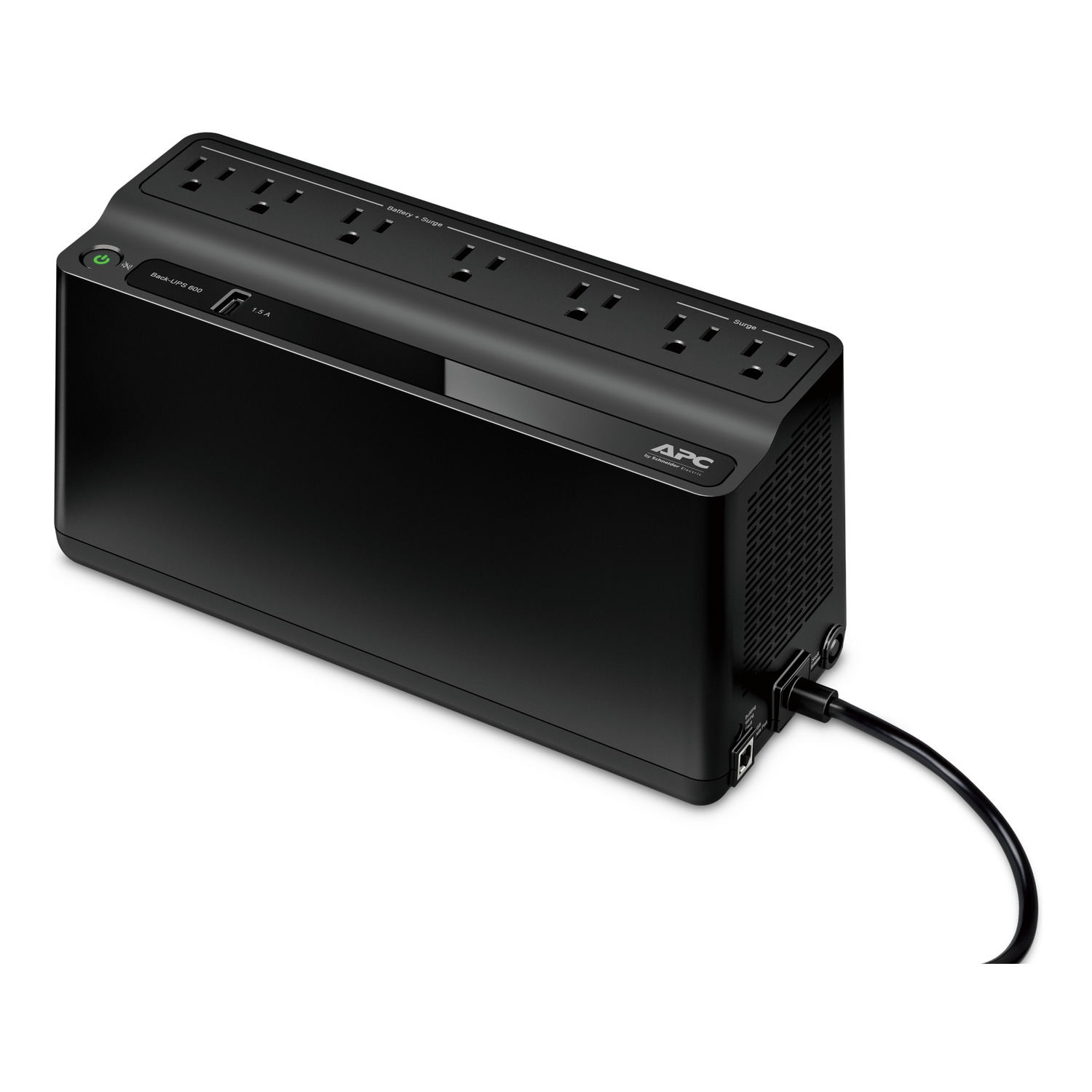
The APC Back-UPS BE600M1 is a 600-volt-ampere, 330-watt standby UPS in a low box about the footprint of two stacked hardbacks, with seven NEMA 5-15R outlets, a 1.5-amp USB-A charging port, and a single 12-volt lead-acid cartridge behind a slide-off cover. Amazon carried it at $83.99 on 2026-09-21, in stock and sold by the retailer itself. APC's pure-sine models sit a tier up; the tier below is the $62.50 BE425M, which trades 75 watts, a data port, and a cleaner waveform for the saving.
For the desk in question, a router, a cable or fiber modem, and one ordinary desktop, the purchase turns on three questions the spec pages answer unevenly. How long 330 watts of capacity keeps that gear alive, which shows up at three load points on retail spec lines. How the stepped-sine output gets along with a computer power supply, which APC's manual addresses in one guarded sentence. And what the battery costs to renew, where the answer, $81.68 for the genuine cartridge, reshapes the ownership math more than any feature on the box.
Our verdict
Buy the BE600M1 at $83.99 (Amazon, 2026-09-21) to ride out short outages on a router, modem, and one modest desktop, and plan on a new battery, or a new unit, around year four. Skip it above 330 watts.
- A good fit for
- A modest desktop and home network under roughly 165 watts combined, with USB-connected shutdown configured before an outage.
- We would skip it if
- Skip it for a gaming PC or workstation that can exceed 330 watts, for anything needing a true sine wave, or for a laptop-and-router desk where the $62.50 BE425M already covers the job.
Reasons to consider it
- The runtime figures on the retail spec lines fit a real desk: about 23 minutes at 100 watts, 11.75 minutes at half load, 3.2 minutes at the full 330 watts, with a 6-millisecond typical transfer designed for computer power supplies to ride through
- Five outlets provide battery backup and two provide surge protection only; the unit has a 490-joule surge rating, with separate sockets for devices that do not need backup power
- The battery is a user-swappable 12-volt 6.5-amp-hour cartridge, APCRBC154, with an average life APC's manual puts at 3 to 5 years and a two-year warranty of its own, and the unit itself carries a three-year warranty, 12 months of it on the battery inside, plus a $75,000 connected-equipment policy
The compromises
- Output on battery is a stepped approximation of a sine wave, and APC's own manual concedes some connected equipment does not accept it; APC reserves its pure-sine models for what it calls sensitive high-end electronics
- The genuine replacement battery, $81.68 at Staples, sits $2.31 under the complete UPS, so when the battery fades somewhere between year three and year five the choice is a new UPS with a fresh three-year term, 12 months of it on the battery, or a cartridge with two years of its own
- PowerChute Serial Shutdown serves Windows; Mac desktops use native UPS shutdown settings over USB. The manual inventory depicts the USB lead, although Schneider's current data sheet lists only a user manual
What we have not verified: Runtime figures remain retailer specifications: Amazon lists 23 minutes at 100 watts, and Newegg lists 11.75 minutes at half load and 3.2 minutes at full load. No manufacturer runtime point for a 30-watt network was verified, so that example is a load assumption, not a runtime promise. Compatibility with a particular active-PFC supply still needs confirmation. The manual inventory pictures the USB lead, while the older data sheet omits it; confirm the current package with the seller. Prices are dated snapshots, especially the genuine battery price that nearly matches the complete unit.
The things in this guide
A closer look at the products, who they may suit, and what to check before buying.
Back-UPS BE600M1 600VA Battery Backup and Surge Protector
$83.99 on Amazon on 2026-09-21, Amazon's own stock, buys 330 watts of standby backup on five outlets, two more with surge only, a 1.5-amp USB charging port that stays live on battery, a USB data port for PowerChute shutdown, a three-year warranty, and a $75,000 equipment protection policy tied to registration and a grounded receptacle.
Before you buy: The genuine APCRBC154 battery was $81.68 at Staples, close to the $83.99 UPS snapshot. Stepped-sine output needs compatible equipment, and retailer-listed full-load runtime is only 3.2 minutes.
Price checked September 21, 2026. Retailer prices can change.Three runtime points, and where a router lands on them
Retailer runtime figures give three useful reference loads. Amazon lists about 23 minutes at 100 watts; Newegg lists 11.75 minutes at half load, or 165 watts, and 3.2 minutes at 330 watts. These are specifications, not measurements of your desk. They show why the wattage of everything connected to the battery outlets matters more than the number of spare sockets.
Take a 30-watt router-and-modem combination as an example, not a measured load. It should outlast a 100-watt load under comparable battery conditions, but there is no verified runtime figure here for that setup. Adding a desktop and monitor does not automatically put the total between 100 and 165 watts: check their combined draw under the work you intend to run. Keeping the router powered also cannot keep an internet provider's unpowered equipment online.
APC warns that battery aging reduces runtime. Configure shutdown with a margin instead of waiting for the quoted runtime to expire. A desk drawing 200 watts leaves substantially less time than the 100-watt example; use that interval to finish saving and shut down, not to assume another 23 minutes of work.
Standby topology, six milliseconds, and a waveform APC hedges on
The BE600M1 is a standby UPS. At its default sensitivity it transfers to battery around the manual's 92-volt and 139-volt thresholds, with a typical transfer of 6 milliseconds and a maximum of 10. Those are device specifications, not a guarantee that every power supply will ride through. The low and high sensitivity settings change the accepted voltage ranges to 88-142 and 96-136 volts respectively.
On battery the output is a stepped approximation of a sine wave, the data sheet's phrase, and APC's manual is candid in one troubleshooting row: 'Connected equipment does not accept the step-approximated sine waveform from the Back-UPS,' with the note that the output is intended for computers and peripherals, not motor-driven equipment. APC markets its pure-sine models for 'sensitive high-end electronics' and nowhere in this model's documents says which computer power supplies land past that line.
Choose by measured load and equipment compatibility, not the label gaming PC or workstation. A system that can exceed 330 watts needs more capacity; a lower-power system still needs a supply that accepts stepped-sine output. Pure-sine alternatives address that waveform concern but must also have enough capacity. The cheaper BE425M lists square-wave output, rather than this model's stepped approximation.
Battery replacement can cost almost as much as the UPS
The single 12-volt cartridge is the consumable, and APC is specific about its life: 'Average Life 3 - 5 years, the number of discharge cycles and environmental temperature,' says the manual, and the battery FAQ adds the rule that every 8 degrees Celsius above the 20-to-25-degree optimum halves that life. APC's own example has a battery good for four years lasting two at 33 C, which is a warm closet or a shelf above a game console. The FAQ closes with advice most owners skip: replace before year five, not after the beeping starts.
Replacement is a slide-off cover and one cable, and APC lists the BE600M1 as user-replaceable with cartridge APCRBC154, a 12-volt, 6.5-amp-hour sealed lead-acid pack carrying a two-year warranty. Staples listed the genuine part at $81.68 on 2026-09-21. The complete UPS was $83.99 the same day. That $2.31 gap is the arithmetic that governs ownership: a new unit brings a fresh battery, a fresh three-year term on the UPS and a fresh equipment-protection term, though Schneider's data sheet covers the battery inside it for 12 months; the cartridge carries two years of its own.
The equipment policy excludes damage caused by non-APC batteries or accessories; it does not say that merely fitting another brand cancels every claim. Ask APC about a proposed replacement if that coverage matters to you. Compare the genuine cartridge with a complete UPS at the time replacement is needed, and recycle the old lead-acid battery. APC gives a typical life of 3-5 years, not a guarantee of four years between purchases.
USB shutdown on Windows and Mac
The two USB connections have different jobs. USB-A charges a device at up to 1.5 amps, including while on battery. The data connection reports UPS status to a computer so a configured shutdown can begin before backup power runs out. Keep documents saved rather than assuming shutdown software can handle every application's unsaved work.
PowerChute Serial Shutdown replaces Personal Edition for supported Windows systems. A Mac desktop can instead use macOS UPS shutdown controls over USB: APC explicitly points Mac users to that option. Connect the data cable and confirm that UPS controls appear in Energy settings, then choose a shutdown threshold with time to spare. PowerChute not supporting macOS does not make the USB port Windows-only.
The manual's illustrated inventory shows a USB data cable alongside the UPS and documentation, although Schneider's current data sheet lists only a user manual as provided equipment. Ask the seller what ships before ordering an extra lead. APC specifies a 24-hour initial charge for full runtime and about 10 hours for recharging; USB charging can lengthen that. The 7.7-pound unit supports wall mounting with screws spaced 8.43 inches apart; the manual does not establish an overhead mounting arrangement.
Warranty, the $75,000 policy read closely, and who should skip
The three-year warranty, which Schneider's data sheet limits to 12 months for the battery, normally provides a factory-reconditioned replacement, with the customer paying inbound freight. The separate $75,000 equipment policy has additional conditions: register the unit, use an appropriately grounded installation, and follow its connection restrictions. Report alleged damage within 10 days; APC then supplies a questionnaire that must be completed and filed within 30 days. Do not treat that as an extra 30 days automatically added to the first deadline. Coverage is conditional reimbursement or repair, not an automatic $75,000 payment.
Against the $62.50 BE425M snapshot, the $21.49 difference adds 75 watts of capacity, a higher surge rating, stepped rather than square-wave output, a USB data port, and longer listed runtime at 100 watts. A laptop already has a battery, so a buyer backing up only a router may prefer the cheaper model. A desktop needing USB-triggered shutdown has a stronger reason to choose the BE600M1. Confirm that the smaller UPS still meets the intended load and outage duration.
Skip this unit for loads above its 330-watt limit, equipment requiring true-sine output, or motors. Put peripherals that do not need backup on the surge-only sockets and follow the total outlet-current limit. The Isobar6Ultra article covers a different purchase: surge suppression without a battery. For this UPS, the useful starting point is a measured modest load, a configured shutdown, and regular attention to battery condition.
How we put this together
Built from the product pages and listings below, without test scores or results we have not measured. Specifications and prices change, so check the original page for the exact model, current price, delivery, and returns.
- APC by Schneider Electric: Back-UPS BE600M1 product page (opens in a new tab)
- APC by Schneider Electric: Back-UPS BE600M1 / BN650M1 / BE670M1 user manual (990-5679E, 11/2019, PDF) (opens in a new tab)
- APC by Schneider Electric: BE600M1 product data sheet (generated by se.com, September 28, 2026) (opens in a new tab)
- Schneider Electric FAQ FA158934: What is the expected life of my APC UPS VRLA battery? (opens in a new tab)
- Schneider Electric: Our Equipment Protection Policy (APC 120 V products) (opens in a new tab)
- APC by Schneider Electric: APCRBC154 replacement battery cartridge product page (opens in a new tab)
- Staples: APC UPS Replacement Battery APCRBC154 listing (opens in a new tab)
- Amazon: APC Back-UPS BE600M1 listing (ASIN B01FWAZEIU) (opens in a new tab)
- Amazon: APC Back-UPS BE425M listing (ASIN B01HDC236Q) (opens in a new tab)
- APC by Schneider Electric: BE425M product data sheet (Oct 3, 2023, maker document, copy hosted by a reseller) (opens in a new tab)
- Newegg: APC BE600M1 Back-UPS listing (opens in a new tab)
- Schneider Electric: UPS management software guide (PowerChute for Back-UPS) (opens in a new tab)
- APC by Schneider Electric: Sine wave for aPFC compatibility (gaming UPS page) (opens in a new tab)
- Schneider Electric: Configuring native shutdown on Mac OS X (opens in a new tab)
- Apple: Set when your Mac shuts down while using a UPS (opens in a new tab)