Product image supplied by the brand
In this guide
The step into vinyl usually stalls on one practical problem: the speakers and the amp already in the room have no input marked PHONO. The AT-LP60X is Audio-Technica's deck for exactly that buyer — a fully automatic belt-drive turntable with a built-in, switchable phono preamp, listed at $179.00 for the black unit on the maker's US store (checked September 14, 2026). It plays 33-1/3 and 45 RPM records, ships with its own output cable, and comes with a published consumables schedule: a stylus to replace every few hundred hours, a belt to replace about once a year.
The company positions it as the update of the long-running AT-LP60, with a redesigned tonearm base and headshell and the power conversion moved out of the chassis into an external 12 V adapter. The numbers a first-deck decision needs are all public — a die-cast aluminum platter, wow and flutter under 0.25% (WTD at 3 kHz), signal-to-noise above 50 dB (DIN-B), a 2.6 kg body about 14 inches square, and a $36 replacement needle the maker rates at 300 to 500 hours of life. Those published figures, the warranty terms, and the upkeep schedule carry the whole decision.
Our verdict
For $179 the black AT-LP60X is the first turntable to buy when you want to press start and plug straight into powered speakers; it is the wrong deck for 78 RPM, DJ handling, or an arm you can adjust.
- A good fit for
- First-time vinyl buyers whose speakers are powered or whose amp has a spare AUX or line input, and who want the tonearm to start and park itself — $179 buys the black unit.
- We would skip it if
- Anyone after an adjustable arm — counterweight, tracking force, anti-skate, cartridge swaps — plus DJs, 78 RPM collectors, and anyone whose only speakers are passive with nothing to drive them.
Reasons to consider it
- Built-in switchable RIAA preamp with a 150 mV line output and the cable included — no separate phono stage to buy
- Fully automatic operation: START cues the arm, and it lifts and returns by itself at the end of a side
- The ATN3600LC replacement stylus costs $36 and clicks in by hand, with a documented 300–500 hour life
The compromises
- The tonearm is factory-preset — the manual's parts list includes no counterweight, tracking-force, or anti-skate adjustment
- Consumables sit with the owner: a $36 stylus every 300–500 hours (400 by the manual's rule of thumb) and a belt replaced about once a year
- No power switch — a 1.0 W standby draw runs whenever the 12 V adapter is plugged in
What we have not verified: Every performance figure traces to Audio-Technica itself — wow and flutter under 0.25%, signal-to-noise above 50 dB, line level 150 mV — with no independent measurement cited; dealer pricing went unchecked, and a street price well under $179 would move the value verdict.
The things in this guide
A closer look at the products, who they may suit, and what to check before buying.
AT-LP60X Fully Automatic Belt-Drive Turntable · Black
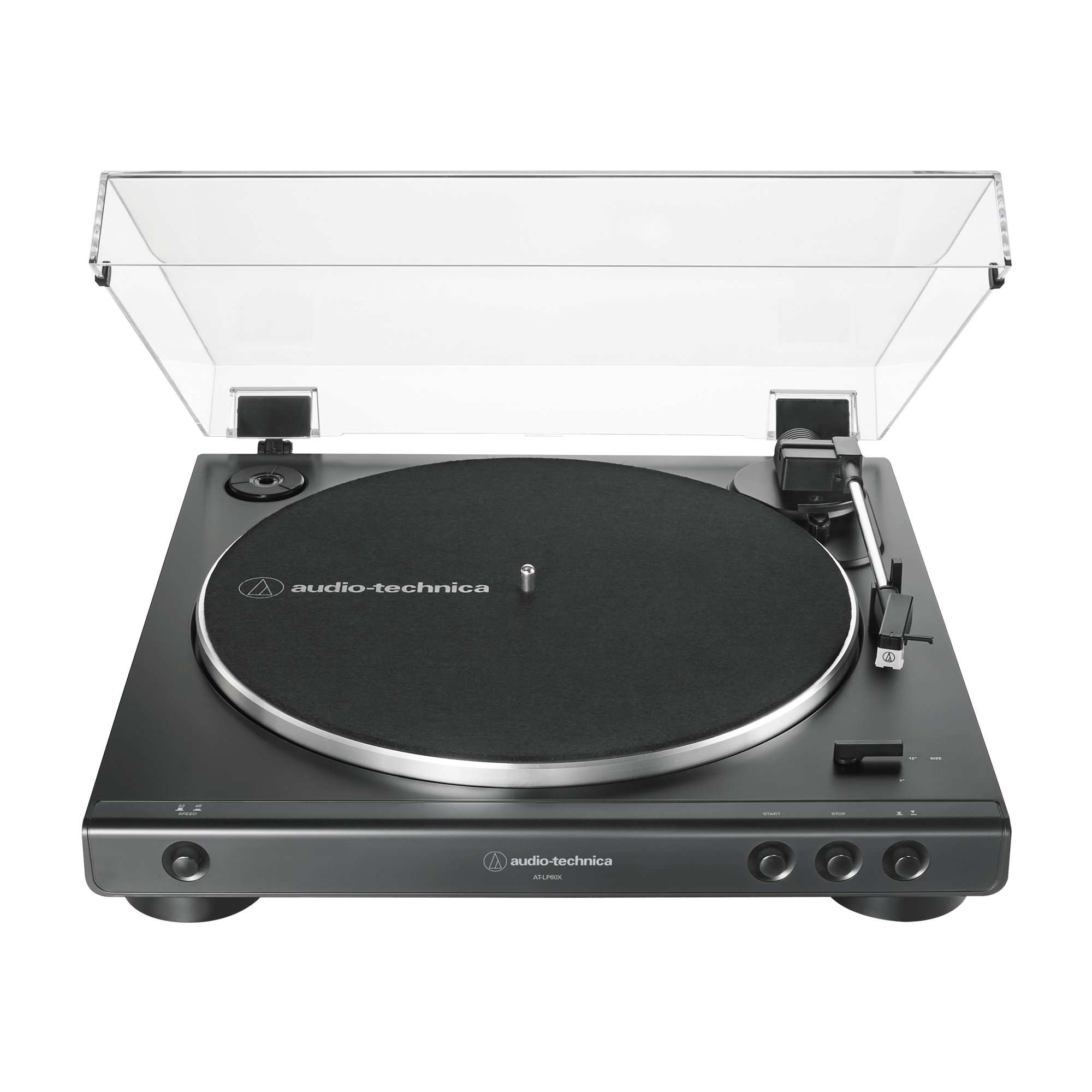
A switchable built-in preamp (150 mV line out), the included 3.5 mm-to-dual-RCA cable, and automatic arm return at both ends of a side — the black unit lists $179 on Audio-Technica's US store.
Before you buy: The arm has no user adjustments and the cartridge is integrated into the headshell; expect a $36 stylus every 300–500 hours and a belt swapped about once a year.
Price checked September 14, 2026. Retailer prices can change.The mechanics $179 buys
Belt drive, a DC servo-controlled motor, two speeds, and full automation: the START button spins the platter and moves the tonearm out over the record, and at the end of a side the arm lifts and returns to its rest without help — a STOP button does the same thing mid-record. A size selector (12 or 7 inch) tells the automatics where to park, and switching it mid-side is one of the manual's stated don'ts. The platter is die-cast aluminum, it spans 359.5 x 97.5 x 373.3 mm (14.15 x 3.84 x 14.70 inches) at 2.6 kg (5.73 lb), and the deck is built for a shelf, not a cabinet. Audio-Technica pitches the deck as the update of the AT-LP60, with a redesigned tonearm base and headshell for improved tracking and reduced resonance, and with the AC/DC conversion moved out of the chassis into the external adapter to keep noise away from the signal chain.
It arrives as parts, not a working deck. The manual's assembly sequence: seat the platter on the spindle, hook the belt over the brass motor pulley using the red ribbon that ships attached to it, lay the felt mat, drop the 45 RPM adapter into its slot, then rotate the platter ten times by hand to reset the automatic mechanism. The manual has the AC adapter stay unplugged until all of that is done. Two factory figures describe the running gear once it is — wow and flutter below 0.25% (WTD at 3 kHz) and signal-to-noise above 50 dB (DIN-B) — and both are Audio-Technica's own numbers, which sets the ceiling on what anyone can claim about how the deck sounds.
One switch decides what it plugs into
On the back, next to the output jack and the power input, sits the pre-amplifier selector: PHONO or LINE. Switched to LINE, the built-in RIAA equalizer does the work an external phono stage would, at a nominal 150 mV output at 1 kHz (5 cm/sec) with 36 dB of gain. The manual's compatibility list is written for this exact buyer: amplifiers and receivers without a phono input, active (powered) speakers, and PC sound cards — the last possibly needing a small adapter for a 3.5 mm line-in jack, sold separately. The deck ships with a detachable cable — 3.5 mm male to dual RCA male, about 1.2 m long, red to the right channel and white to the left.
Powered speakers make this a one-cable setup: their line-in is exactly what the LINE position feeds. Passive speakers are a different case — no preamp, built-in or external, replaces an amplifier, so a pair of unpowered bookshelf speakers still needs something with watts and a volume knob between the deck and the drivers. And if the amplifier in the house does have a PHONO input, the selector flips to PHONO (2.5 mV nominal output) and hands the equalizing to that circuit instead. The manual's troubleshooting table documents both ways to get it backwards: no sound or thin volume when PHONO feeds an AUX input, loud distortion when LINE feeds a phono stage.
One detail the box contents make plain: no separate ground wire ships with the deck, and the included cable carries signal only. The manual's PHONO instructions point to the ground terminal on the amplifier side. For the LINE setups most buyers will use, that is trivia; for anyone feeding a traditional phono stage, it is the detail to have in hand before the plugs go in.
The needle bill: $36 on a published clock
The cartridge is an AT3600L — a VM Dual Magnet design, integrated into the headshell, so the upgrade path stops at the stylus, which pulls off and clicks back on by hand. The current factory replacement is the ATN3600LC at $36.00, a 0.6 mil conical bonded stylus whose life Audio-Technica rates at approximately 300 to 500 hours. The manual gives the same instruction as a single number — replace after 400 hours, as a rule of thumb — and adds the reason to take the schedule seriously: a worn stylus doesn't only sound worse, it damages the records playing under it.
Set the hours against a listening habit and the cost lands where you would expect. An hour a day is about 365 hours a year, which puts a daily listener on a roughly annual $36 needle; two hours a week adds up to about a hundred hours a year, so one stylus spans 3–5 years at the rated life. The elliptical ATN3600LE at $46.00 is the one documented upgrade — a finer polish on the same click-in mount, nothing more.
The drive belt is the second consumable. Replace it about once a year on the manual's schedule, sooner if playback slows or the rotation goes uneven, and it must be bought separately as an AT-LP60X-specific part with no price posted on the maker's store when checked. Between needle and belt, the yearly outlay is a line item measured in tens of dollars — real, but priced and scheduled by the maker in advance.
Where a manual deck earns the extra work
Everything about the tonearm here is decided at the factory. The manual's parts list runs seventeen items — platter, spindle, size selector, lift button, and so on — and contains no counterweight, no tracking-force scale, no anti-skate dial; nothing in the upkeep routine ever asks the owner to set or check the arm. The cartridge is integrated into the headshell for assured performance and ease of setup (the maker's phrasing), and between the belt's yearly changes the stylus is the only part an owner swaps. For a listener, that fixed tuning is the point — nothing to misadjust on the way in. For a hobbyist who wants to balance an arm, audition cartridges, or learn cueing as a craft, this deck has nothing to offer, and a manual turntable with an adjustable arm is the product that does.
The manual also states the boundaries in its own words: this product is not intended for DJs — no scratching, no back-cueing — and neither a disc stabilizer nor a substitute platter is permitted. Speeds stop at 33-1/3 and 45, so a 78 RPM collection needs different hardware. Two smaller habits round out the ownership picture: the dust cover should stay closed during playback, and the chassis has no power switch at all — the rated draw is 1.0 W, a standby current runs whenever the adapter is in the wall, and the advice is to pull the plug for long idle stretches.
Four colors, three prices, two siblings, one year
The four finishes do not share one sticker. Black lists at $179.00; brown and gun-metal at $189.00; red appears at $199.00 in the page's variant data but carried no orderable entry when checked. The $179 quoted here refers to the black unit — the cheapest variant actually purchasable on the maker's store that day, and the one the page displays by default. These are list prices straight off Audio-Technica's own store, with no discounting implied.
Two siblings share the LP60X name and not much more. The AT-LP60XBT adds Bluetooth and lists at $259.00 for black on the same store — $80 over the wired deck. The AT-LP60XUSB adds a USB output for digitizing records; when checked, its maker-store page carried a $0.00 price placeholder rather than an orderable figure, so its price needs a dealer quote. Neither wireless nor recording exists on the base model, and each sibling is its own purchase decision, not an option to tick.
The warranty runs one year from purchase for US buyers through authorized dealers, covering defects in materials and workmanship, with repair, refund, or replacement at Audio-Technica U.S.'s election. The exclusions matter more than the length here: normal wear is not covered, and stylus wear is the definition of normal wear — the 400-hour replacement schedule is an owner's cost from day one. Unauthorized repair voids the warranty, which mostly touches the electronics, since the owner-serviceable parts are exactly the stylus and belt the manual walks through.
What the spec sheet cannot settle
Every performance figure behind this deck is the manufacturer's own: the 0.25% wow-and-flutter ceiling, the 50 dB signal-to-noise floor, the 150 mV line level. Independent speed or noise measurements sit nowhere alongside the maker's specifications, so the sonic judgment rests on them — and they describe a coherent $179 package, with nothing in the maker's numbers contradicting the price. The manual's placement notes are the practical reminder attached to all of it: keep the deck away from speakers, away from radios, and away from phones and other radio-wave emitters, because an analog signal chain picks up its room.
The money side, by contrast, is fully answerable today: $179 for the black deck, a $36 ATN3600LC stylus every 300–500 hours (400 by the manual's rule of thumb), a belt swapped about once a year, its price not yet posted, and one year of warranty on the electronics. If that ledger fits the listening habit, the decision is done. If the goal from the start was the tunable arm and the cartridge experiments, put the same budget toward a manual deck with a counterweight — no replacement part adds one to this chassis.
How we put this together
Built from the product pages and listings below, without test scores or results we have not measured. Specifications and prices change, so check the original page for the exact model, current price, delivery, and returns.
- Audio-Technica: AT-LP60X product listing (US) (opens in a new tab)
- Audio-Technica: AT-LP60X user manual (PDF) (opens in a new tab)
- Audio-Technica: ATN3600LC replacement stylus listing (US) (opens in a new tab)
- Audio-Technica: US one-year limited end-user warranty (opens in a new tab)
- Audio-Technica: AT-LP60XBT product listing (US) (opens in a new tab)
- Audio-Technica: AT-LP60XUSB product listing (US) (opens in a new tab)