Product image supplied by the brand
In this guide
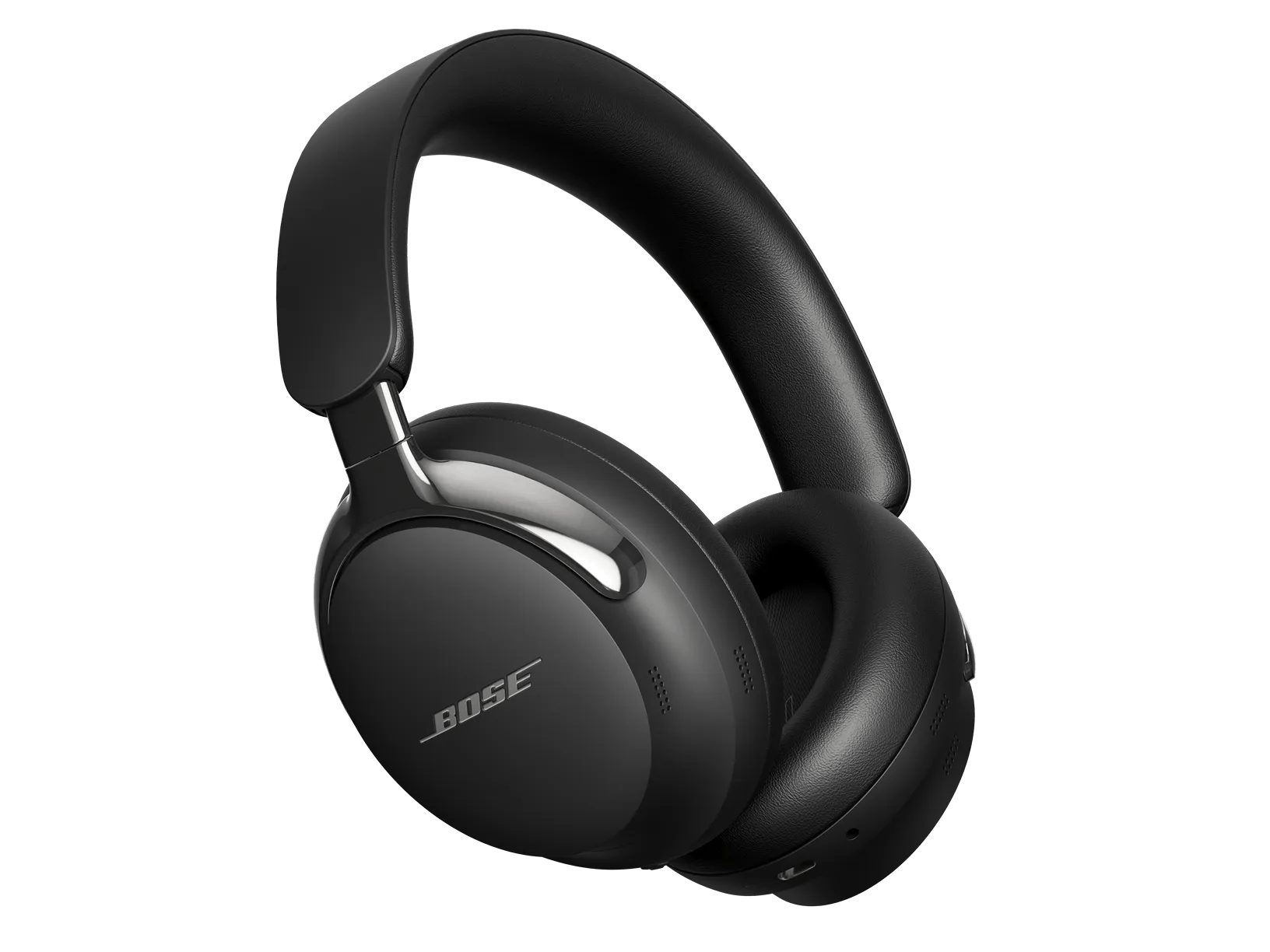
Bose lists the QuietComfort Ultra Headphones (2nd Gen) at $449.00 in its American store, with the same price on all four colors — Cherry Chocolate, Black, Driftwood Sand, White. Inside the carton: the headphones, a hard carry case, a 2.5 mm-to-3.5 mm audio cable, and a 39-inch USB-C cable; a power adapter is explicitly not among them. Bose's own headline parts for this generation are a lossless USB-C audio mode, an all-new Cinema Mode that spatializes video, and a next-generation ActiveSense that smooths spikes in noise when you let the outside in.
Sony's WH-1000XM6 is the second half of this decision, and it lists at $459.99. The two over-ears connect to two devices simultaneously, both claim 30 hours with cancelling on, both charge over USB-C in roughly three to three-and-a-half hours, and both carry a one-year US warranty. The separation sits in three places — what each adds for video and wired listening, what each publishes about codecs, and how each treats water — and each difference is documented on a page you can open.
Our verdict
Buy it at the $449.00 list when lossless USB-C audio, Cinema Mode and aptX Adaptive from a Snapdragon Sound phone are the point; for listening alone, Sony's WH-1000XM6, at a list $10.99 higher, publishes LDAC and AAC.
- A good fit for
- A commuter or flyer who wears headphones for hours, takes calls on them, watches video on the move, and can use aptX Adaptive from a Snapdragon Sound-certified Android phone.
- We would skip it if
- You want a published codec for an iPhone or a non-Snapdragon Android, plan to sweat in them, or only need cancelling for a commute, where the $99.99 Space One rates 40 hours.
Reasons to consider it
- Lossless USB-C audio at 16-bit/44.1 kHz or 48 kHz that keeps working while the headphones charge over the same cable
- aptX Adaptive streaming from Snapdragon Sound-certified devices, with a lower-latency gaming mode, on Bluetooth 5.4 — and multipoint to two devices on by default
- 45 hours with cancelling off and 30 with it on, a 3-hour full charge, and a 15-minute top-up rated for up to 3 hours
The compromises
- No water or sweat rating of any kind; Bose's FAQ says avoid situations where they may get wet, and the US warranty excludes damage from liquids
- Bose publishes no full codec list, no decibel reading for the cancelling, and no driver size; outside Snapdragon Sound sources, no hi-res codec is documented at all
- At 0.583 lb — 264 g at 453.59 g to the pound — they sit about ten grams over the WH-1000XM6's published 254 g, and replacement parts carry only a 90-day warranty
What we have not verified: How much quieter the second generation runs than whatever sits beside it is a claim, not a number: neither Bose's product page nor its guide prints a decibel figure or a method, and the storefront's own battery footnote still prints 24 and 18 hours from a test described under the first-generation name while the guide prints 30 and 23. One published lab measurement of cancelling depth would move this verdict more than any specification above it.
The things in this guide
A closer look at the products, who they may suit, and what to check before buying.
Bose QuietComfort Ultra Headphones (2nd Gen)
Ten microphones feed the cancelling and CustomTune calibration; Bluetooth 5.4 carries aptX Adaptive from Snapdragon Sound sources with a lower-latency gaming mode; multipoint to two devices is on by default; and 45 hours with cancelling off covers the longest travel days, from a 3-hour charge with a 15-minute top-up rated for up to 3 hours.
Before you buy: No water or sweat rating and no liquid coverage in the warranty, no decibel number behind the best-cancelling claim, and no documented hi-res codec for a phone that is not Snapdragon Sound-certified.
Price checked October 10, 2026. Retailer prices can change.What the second generation actually adds
Bose's own list of deltas is concrete. Bose's product page credits this generation with improved noise cancellation, a next-generation ActiveSense that smooths spikes in noise in Aware Mode, an all-new Cinema Mode that spatializes video, Immersive Audio extended to both music and movies, refined materials with polished metal, better head detection, quicker startup, and new power-saving behavior. The printed guide fills in the modes behind those words: Quiet for full cancellation, Aware with ActiveSense adjusting as the room changes, Immersion for full cancellation plus Immersive Audio in Motion, and Cinema for full cancellation plus Immersive Audio in Still, alongside up to seven custom modes.
The wired side is where the generation is least ambiguous. The headphones take lossless audio over USB-C at 16-bit, 44.1 kHz or 48 kHz from a compatible source, keep playing while they charge over the same cable, and the guide notes Immersive Audio temporarily switches off for phone calls and returns afterward. CustomTune sounds a tone through each ear cup to tailor the sound to your ears, and up to ten favorite modes can cycle from the multi-function button.
What Bose does not put a number on is the part the marketing leads with. No page quantifies the cancellation improvement over the first generation, prints a decibel figure, or names the driver size, and the word for all of it is 'better': better noise cancellation, better head detection, a smoother Aware mode. The additions a buyer can verify on paper are the wired lossless input, the video mode, and the power-saving behavior — the rest is a claim with no baseline printed beside it.
Ten microphones, four for calls, and no published number
The cancelling hardware that Bose does document is a microphone layout: one microphone inside and four outside each ear cup, five per side, ten in total. Four of those — two on the front of each cup — are dedicated to phone calls, where they feed the multi-function button's answer, decline and call-holding controls. Bose's specification block lists the noise control type as adjustable noise cancelling, active noise cancelling, and echo reduction, and CustomTune calibrates the sound to the shape of your ears each time you put them on.
The claims sit above that hardware without a measurement under them. Quiet Mode is described as Bose's best around-ear cancellation, ActiveSense keeps Aware Mode's surrounding noise constant when a coffee grinder or a bus interrupts, and none of Bose's three documents — the storefront, the variant data, the printed guide — attaches a decibel figure, a percentage, or a test method to any of it. The buyer is being asked to trust a parts count and a superlative.
30, 23, and 45 hours — and a codec list that stops at aptX
Bose's guide prints three battery numbers: up to 30 hours with cancelling on and Immersive Audio off, 23 hours with both on, and 45 hours with both off. The conditions are printed too — Bose's April 2025 test on production-representative 2nd Gen units, A2DP streaming, 75 dB SPL playback loudness, the three-band EQ at zero, Quiet Mode. The product page's headline rounds the same cell to 30 hours, or 23 with Immersive Audio. One oddity follows the page around: its footnote still prints 24 and 18 hours from tests described under the first-generation product name, which the guide's 30 and 23 contradict.
Charging is specified tightly. A charge from empty takes up to 3 hours over any USB-C source, slower if you keep listening; the 15-minute top-up is rated for up to 3 hours with cancelling on and Immersive off, and the guide's own footnote test measured that at up to 2.5 hours. The headphones accept Bluetooth, AUX or USB audio while charging, and the wall adapter is the one box item Bose omits, so the charger already in your drawer belongs in the price math.
The wireless spec is Bluetooth 5.4 with a 30-foot range and the A2DP, HFP, AVRCP and Low Energy profiles. On a Snapdragon Sound-certified device — Bose names compatible Android phones — the pair switches to aptX Adaptive automatically, and a gaming mode trades some stability for lower latency. Multipoint is on by default: up to six devices in the list, two actively connected, one audio source at a time, and the app can disable it. What the documents never say is at least as important: no SBC, AAC or LDAC entry appears anywhere, so a buyer on an iPhone or a non-Snapdragon Android is choosing a flagship whose published codec story ends at aptX Adaptive and the Bluetooth profiles.
264 grams, removable cushions, and no water rating
Bose's variant data lists the unpackaged headphone at 1.772 by 6.299 by 8.071 inches and 0.583 lb — 264 g at 453.59 g to the pound, about ten grams over the WH-1000XM6's published 254 g — with the whole system in its case at 1.061 lb and 2.185 by 6.122 by 8.406 inches. The materials are plastic, aluminum and protein leather on removable cushions, in an around-ear, adjustable-band fit. The guide's storing steps state the fold plainly: rotate both earcups inward to lie flat, slide them up into the headband, fold the left earcup toward the headband.
Care is the part most likely to bite. The FAQ's answer to the water question is a bare no — no IP rating, and avoid situations where they may get wet. The US warranty agrees by exclusion: it excludes damage from liquids, from normal wear, and the normal depletion of consumable parts such as batteries unless a defect caused it. Cleaning runs to a cloth that is dry or water-dampened, with no cleaning products. Replacement parts — Bose's term covers cushions and batteries — carry their own 90-day warranty, and the cushion kit and carry case are extra purchases through Bose's support store.
The power behavior is documented down to the timers. Off your head, the headphones disconnect after 10 minutes and drop to low power after 30 in total; laid flat on a table, they disconnect within seconds.
Two lists, one promo, and a 30-day return window
The price has one state. The list is $449.00, ten dollars under the $459.99 list Sony prints for the WH-1000XM6. All four colors carry the same price, and Bose lists a Thom Browne edition of this same generation separately.
Direct purchase adds free shipping on in-stock orders of $49 or more, a price-match promise, shipping restricted to the United States, the US Virgin Islands and Puerto Rico, and a return window of 30 days the Terms of Sale spell out: a return authorization first, the product and every accessory back in good condition within thirty days, and Bose reserving the right to refuse a return or charge a restocking fee of up to 15 percent otherwise. The page's JSON-LD declares a 90-day window, which both the buy panel and the terms contradict at 30 days.
The warranty is the same length on both flagships. Bose covers the headphones for one year from purchase — the current US warranty document applies to products bought from August 8, 2025 — against defects in materials and workmanship, with proof of purchase required and liquid damage excluded; replacement parts get 90 days. Sony's one-year US terms need a dated purchase receipt. With the warranties level, the dollar difference buys the documented feature delta: Bose's lossless USB-C input, Cinema and Immersion modes, and aptX Adaptive on Snapdragon Sound phones against Sony's published SBC, AAC, LDAC and LC3 list — and the two lists sit $10.99 apart.
Where the second generation loses its argument
Skip them for anything wet. No IP rating, an explicit warning against situations where they may get wet, and a warranty that excludes liquid damage add up to a headphone for desks, cabins and trains — not for gyms or rain. The $99.99 soundcore Space One is rated for 40 hours with cancelling on, carries an 18-month warranty, and sells for under a quarter of the $449 list; a listener whose main requirement is quiet on a commute is not the buyer Bose needs at $449.
Skip them as well when codec paperwork matters. An iPhone or a non-Snapdragon Android gets no published hi-res codec here, where Sony documents SBC, AAC, LDAC and LC3 on the XM6 — and an owner of a first-generation pair should weigh how little of the new is quantified: the documented additions are a video mode, a lossless wired input, smoother Aware handling and polished metal, while the cancelling improvement and the 24-to-30-hour battery story rest on pages that do not fully agree with each other. Anyone outside those groups who carries a Snapdragon Sound phone and wants the video and wired modes gets the whole of this headphone's pitch.
How we put this together
Built from the product pages and listings below, without test scores or results we have not measured. Specifications and prices change, so check the original page for the exact model, current price, delivery, and returns.
- Bose: QuietComfort Ultra Headphones (2nd Gen) product page (US store) (opens in a new tab)
- Bose: QuietComfort Ultra Headphones (2nd Gen) Black variant data (US store product API) (opens in a new tab)
- Bose: QuietComfort Ultra Headphones (2nd Gen) Owner's Guide (PDF) (opens in a new tab)
- Bose: US limited warranty (PDF) (opens in a new tab)
- Bose: Terms of Sale (US) (opens in a new tab)
- Bose: Product support page, QuietComfort Ultra Headphones (2nd Gen) (opens in a new tab)
- Sony: WH-1000XM6 product page (US store) (opens in a new tab)
- soundcore: Space One product page (US) (opens in a new tab)