Product image supplied by the brand
In this guide
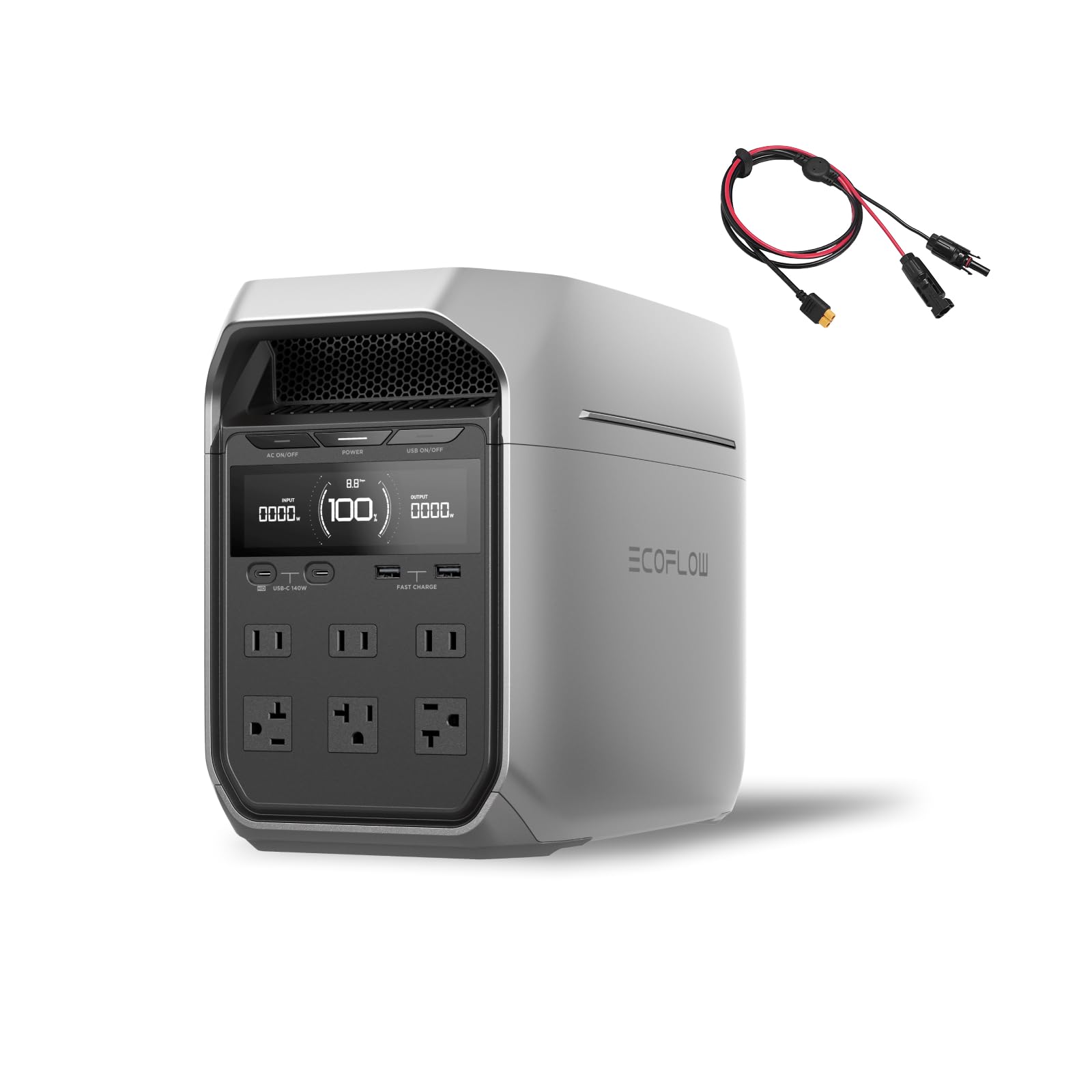
EcoFlow's DELTA 3 Plus, SKU EFDELTA3P-US and model EF-DL-H10-4 in the manual, holds 1,024Wh of LiFePO4 in a 27.6 lb case and puts out 1,800W across six AC outlets, 3,600W for a surge. Each of two USB-C outputs reaches 140W, and the case carries thirteen outputs in all. On 2026-11-05 and again on 2026-11-06 EcoFlow's US store asked $719 against a $799 comparison price. Amazon's buy box on 2026-11-06 was Amazon.com's own offer at $729.69 against an $899 list, with EcoFlow Inc. selling it for $719 under other sellers.
The two stations that compete with it hold about the same charge for less. Anker's C1000 Gen 2 ran $549.99 with a $150 discount at Anker's store, and Jackery's Explorer 1000 v2 lists $559, with the Jackery store showing it sold out when checked on 2026-11-05. Ask either maker about a second battery and the answer is no: Anker's comparison table marks the Gen 2 not expandable, and Jackery's FAQ answers 'Not supported'. The DELTA 3 Plus answers with a port, a $389 battery and a 2,048Wh total.
So against those two the $160 to $170 premium buys the option to double the pack, and a ceiling 200W above Anker's SurgePad. EcoFlow, though, sells the same port for less: its DELTA 3 was $579 on 2026-11-06 and takes the same $389 battery. What the Plus's extra $140 pays for is a second solar input and faster USB ports, not the battery.
Our verdict
Buy the DELTA 3 Plus at $719 only if its second solar input or 140W USB-C matter: EcoFlow's $579 DELTA 3 takes the same $389 battery. With no battery plan, Anker's C1000 Gen 2 is $169 less.
- A good fit for
- A household that wants 1 kWh now with room to double it, and that will charge from up to 1,000W of solar or run 140W USB-C laptops.
- We would skip it if
- Skip it if no battery will ever be added, where Anker's C1000 Gen 2 is $169 less, or if 500W of solar is enough, since EcoFlow's $579 DELTA 3 takes the same pack.
Reasons to consider it
- A second DELTA 3 Series battery at $389 on 2026-11-05 plugs into the Extra Battery port and takes capacity to 2,048Wh, and the station-and-battery bundle listed at $1,119 the same day
- X-Boost carries appliances above the 1,800W rating, 200W past Anker's 2,400W SurgePad, with EcoFlow's examples running to a 2,150W oven and 2,500W hair dryers
- Thirteen outputs in a 27.6 lb case: six AC outlets sharing 1,800W with a 3,600W surge, two 140W USB-C, two 36W USB-A, a 126W car socket and two DC5521, with an LFP pack rated for 4,000 cycles to 80 percent and a five-year warranty
The compromises
- $719 against $549.99 for Anker's C1000 Gen 2 and a $559 list price on Jackery's Explorer 1000 v2 that the Jackery store showed sold out on 2026-11-05; neither takes a battery pack at any price
- $140 over EcoFlow's own DELTA 3 at $579 on 2026-11-06, which lists the same 1,024Wh, 1,800W inverter and Extra Battery support, and gives up only the second 500W solar input and the faster USB ports
- X-Boost is off while the station charges or passes grid power through, EcoFlow's manual and site disagree on whether it ships on, and it lowers voltage in a way EcoFlow says can stop devices that protect against low voltage
- The single unit was labelled 'Pre-order: Ships in late November' on 2026-11-05, and the $389 battery that justifies the price carried the same label
What we have not verified: X-Boost's ceiling is 2,200W in the product page's spec block and one row higher in EcoFlow's manual, and that manual and EcoFlow's X-Boost page disagree on whether it ships on; the page's expansion footnote puts four battery packs behind an XT150 cable while the battery's page says there is no setup and to plug it straight into the station; EcoFlow publishes no load-to-runtime table and no end date for the $389 pack's sale, and both it and the station carried pre-order labels on 2026-11-05.
The things in this guide
A closer look at the products, who they may suit, and what to check before buying.
DELTA 3 Plus Portable Power Station · EFDELTA3P-US
$719 at EcoFlow's US store, and $719 to $729.69 on Amazon on 2026-11-06, buys 1,024Wh of LFP rated for 4,000 cycles, 1,800W across six AC outlets with a 3,600W surge, an X-Boost ceiling above that rating, and an Extra Battery port that reaches 2,048Wh with a $389 battery.
Before you buy: EcoFlow's $579 DELTA 3 takes the same $389 battery, so the extra $140 buys only the second solar input and faster USB; X-Boost is unavailable while the station charges or passes grid power through, and the battery carried the same 'Ships late November' pre-order label as the station.
Price checked November 6, 2026. Retailer prices can change.What the second battery adds, and what it costs
EcoFlow's manual assigns the Extra Battery port three jobs: DC supply, DC charging from an alternator charger, a smart generator or a microinverter, and battery capacity expansion. The pack that fits is the DELTA 3 Series Smart Extra Battery, $389 on 2026-11-05 against a $499 list, carrying another 1,024Wh on the same LFP chemistry, which takes the station to 2,048Wh. The product page's footnote reads '1–5kWh expandable with DELTA 3 Extra Battery, DELTA 2 Extra Battery, DELTA 2 Max Extra Battery, or DELTA Pro 3 Extra Battery…' and does not say which pack reaches 5kWh.
Buying both at once costs $11 more than buying them separately: $1,119 for the bundle against $719 plus $389, or $1,108, and the bundle saves one order. The second pack is the cheaper watt-hour either way, 38 cents against 70 cents for the station alone and 54 cents across both, because the money in the station is in the inverter, the ports and the case rather than the cells.
Whether the extra capacity matters is a separate sum. EcoFlow publishes no table of loads against run times, so the figure has to come from the label: 1,024Wh against a 100W average draw runs just past ten hours before inverter losses, and 2,048Wh just past twenty. A fridge, router and three lamps averaging 100W across a day use 2.4kWh, which neither configuration covers.
X-Boost raises the ceiling and lowers the voltage
The inverter is rated 1,800W with a 3,600W surge, and X-Boost is how the station feeds an appliance labelled above that rating. EcoFlow's explanation is that it 'marginally reduces voltage' so a smaller inverter can carry a bigger load. The DELTA 3 Plus manual's table gives 2,600W with X-Boost at 120V, 2,500W at 110V and 2,200W at 220V; EcoFlow's examples are a 2,150W oven, hair dryers between 1,800W and 2,500W, and kettles from 1,200W. Anker sells the same idea as SurgePad on the C1000 Gen 2, capped at 2,400W in Anker's US guide, which makes the EcoFlow edge 200W rather than a capability Anker lacks.
EcoFlow's page prints one feature three ways. The specifications table gives 'Max Device(s) Power (with X-Boost) 2200W', the bullet above it says 2,200W with a 3,600W surge, and the copy below claims a higher ceiling than that table allows. Only the copy and the manual's row for 120V households agree. The 2,200W line is the manual's 220V row, which suggests the table came from a European sheet, and the page never reconciles them.
Three conditions decide whether any of it works. X-Boost is switched on in the EcoFlow app, and the DELTA 3 Plus manual says it ships disabled, while EcoFlow's X-Boost page says it is enabled by default. It is unavailable while the station charges or passes grid power through, so a unit left plugged in as a UPS cannot use it. And EcoFlow's manual cautions that devices with voltage protection, precision instruments among them, can stop working under the reduced voltage.
Against the two stations that cannot take a battery
Anker prints the decisive row itself: 'Expandable Capacity: No' for the C1000 Gen 2 and 'Yes' for the older C1000. Jackery's FAQ replies to the same question with 'Not supported.' Neither rival takes a pack at any price, which is the first of two extras $719 buys over $549.99 and $559.
The second is the ceiling, and the gap is narrower than EcoFlow's copy suggests. Anker's C1000 Gen 2 is rated 2,000W and carries SurgePad, which Anker's own US guide caps at 2,400W and which switches itself on above the rating; Jackery's Explorer 1000 v2 is rated 1,500W, and its '50% Power Boost' tag sets that against the previous model's 1,000W rather than lifting a load past the rating. X-Boost reaches 2,600W at 120V, 200W above the Anker, and that is the whole of the advantage.
So against these two the premium mostly buys the port, and the next section shows EcoFlow sells that port for less. A reader who will neither add a battery nor run an appliance above 2,400W should take the C1000 Gen 2 at $549.99, since 200W of extra ceiling does not carry $169; Jackery's Explorer 1000 v2 lists at $559 but sat sold out at the Jackery store on 2026-11-05 and 2026-11-06. At comparison prices the gap is $99, $799 against Anker's $699.99, and the product data on Anker's own page also listed the Gen 2 as a pre-order on 2026-11-06.
The cheaper EcoFlow that takes the same battery
The cheaper way into the same port is EcoFlow's own. The DELTA 3 listed $579 against a $699 comparison price on 2026-11-06, with no shipping-schedule label on its basic option, and its specification table gives the same 1,024Wh of LFP rated for 4,000 cycles, six AC outlets sharing 1,800W with a 3,600W surge, the same 2,200W X-Boost line, a sub-10 ms UPS, about 12.5 kg and five years of warranty. EcoFlow's battery page sells the $389 pack for 'DELTA 3 Plus/DELTA 3', and the DELTA 3 bundled with it is $969 against $1,119 for the Plus bundle.
What the extra $140 buys is printed in the two spec tables. The Plus takes solar through two inputs at 500W each, 1,000W in all, where the DELTA 3 has one 500W input; its USB-C ports reach 140W against 100W, and its USB-A ports 36W against 18W. A reader charging from a large panel array, or running a 140W laptop from USB-C, has a reason to pay it. A reader who wants the second battery and charges mostly from the wall does not, and should buy the DELTA 3 and the pack for $968 instead of $1,108.
Where to buy it, and what arrives
EcoFlow's store asked $719 on 2026-11-06 against a $799 comparison price, beside an '$80 OFF' tag and a countdown with no end date printed, so $799 is the figure to expect if the reduction lapses. Amazon's buy box that day was Amazon.com's own offer at $729.69 against an $899 list, with EcoFlow Inc.'s $719 offer under other sellers. Amazon marks the Amazon.com offer non-returnable under hazardous-materials rules, with a refund or replacement only for an item that arrives damaged or defective. On EcoFlow's page the single unit is labelled 'Pre-order: Ships in late November', a schedule rather than a delivery date, and the extra battery carries the same label.
The page mixes orderable and sold-out configurations. Beside the station, the '+ DELTA 3 Series Extra Battery' bundle at $1,119 was orderable, while the 20W charger and 160W panel bundles read Sold out and a members-only variant of the station uses the same SKU at the same price while showing unavailable. What arrives differs by channel: EcoFlow's manual lists the station, one AC charging cable, and the manuals and warranty card, while Amazon's title for its own listing names a solar charge cable as included.
Warranty is five years on the American listing, and EcoFlow's manual points its warranty page at the European store instead. If the second battery is part of the plan, buy the two separately: $719 plus $389 is $1,108, $11 under the $1,119 bundle, and the bundle saves only the second order. How long the $389 pack stays on sale is stated nowhere.
What EcoFlow's own documents leave open
The X-Boost ceiling is written three ways: 2,200W in the product page's spec block and its bullet list, 'over 2600W' in the same page's copy, and a higher figure again in the manual's 120V row. The UPS figure splits the same way, '10 ms' in the manual against '<10ms' on the page, and the two sources disagree on whether X-Boost ships enabled or disabled. None of this changes the verdict, but the switch to check first after unboxing is the X-Boost toggle on the station's screen.
Expansion wiring is written two ways. The product page's footnote routes four battery models, the DELTA 3, DELTA 2, DELTA 2 Max and DELTA Pro 3 packs, through an 'Alternator Charger XT150 Output Cable', while the DELTA 3 battery's own page says there is no setup and to plug it into the station's Extra Battery port, which the manual also describes as a direct battery-capacity connection. Whether the DELTA 3 pack needs that cable, and what the cable costs, is not settled by any of the three documents.
Two practical gaps remain. EcoFlow publishes no load-to-runtime table for this model, so every hour figure here comes from the label rather than a rating, and no third-party test of its output or capacity turned up in public sources. Stock is the other: the station and the battery both carried a pre-order label on 2026-11-05, so a reader buying now and adding the pack in a year is relying on a product that stays on sale.
How we put this together
Built from the product pages and listings below, without test scores or results we have not measured. Specifications and prices change, so check the original page for the exact model, current price, delivery, and returns.
- EcoFlow US: DELTA 3 Plus Portable Power Station product page (opens in a new tab)
- EcoFlow US: DELTA 3 Series Smart Extra Battery product page (opens in a new tab)
- EcoFlow DELTA 3 Plus user manual (PDF, 8 pages, model EF-DL-H10-4), mirrored by a UK retailer (opens in a new tab)
- EcoFlow US: X-Boost technology page (opens in a new tab)
- Amazon: EF ECOFLOW Portable Power Station DELTA 3 Plus 1024Wh (ASIN B0DCC2BVFW) (opens in a new tab)
- Anker SOLIX: C1000 Gen 2 Portable Power Station product page (US store) (opens in a new tab)
- Jackery: Explorer 1000 v2 Basic Information (support FAQ) (opens in a new tab)
- Jackery: Explorer 1000 v2 Portable Power Station product page (US store) (opens in a new tab)
- Anker SOLIX: C1000 Gen 2 user guide (US edition, A17631A1, V2, 2025-07-18, PDF) (opens in a new tab)
- EcoFlow US: DELTA 3 Portable Power Station product page (opens in a new tab)