Product image supplied by the brand
In this guide
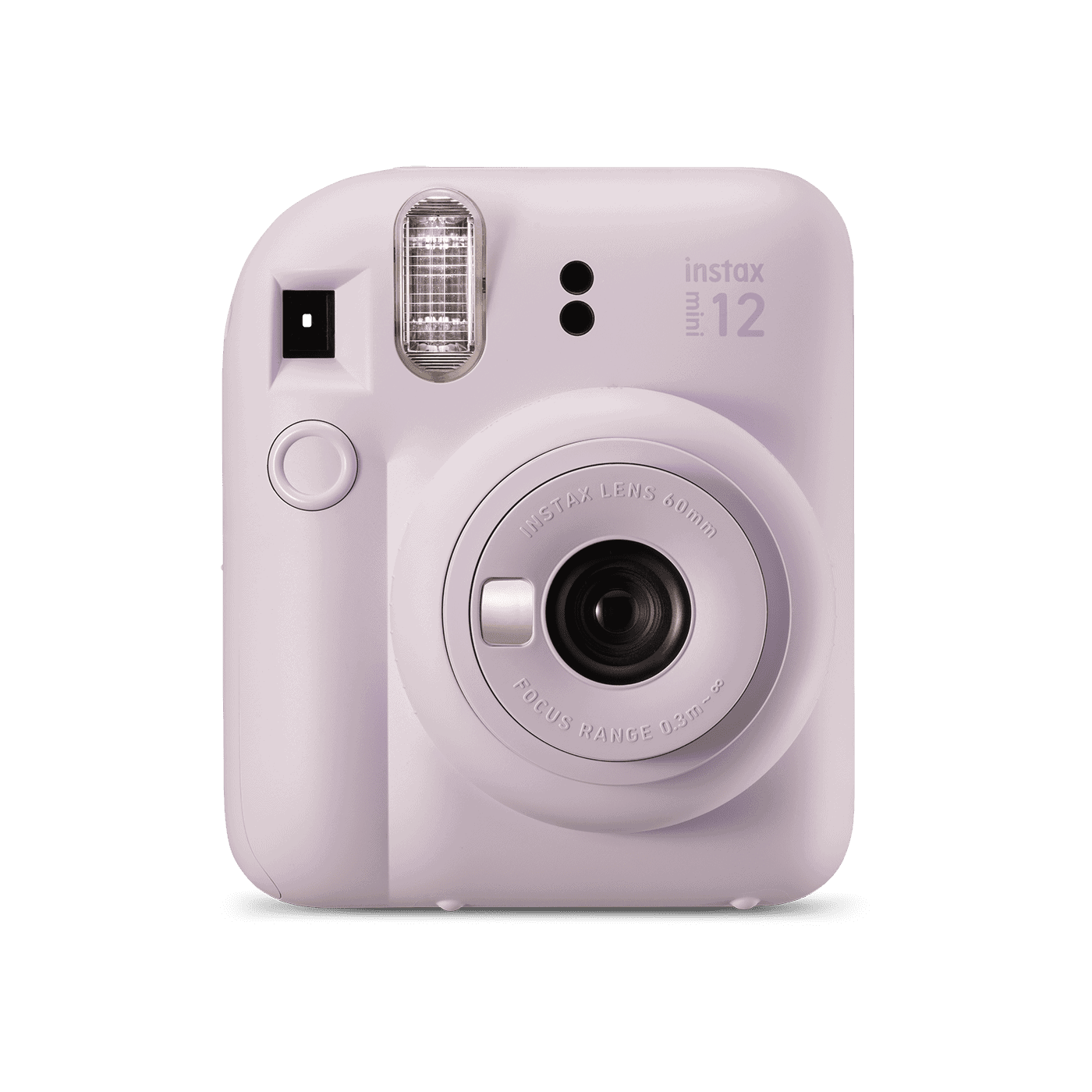
An instant camera is a printer that happens to have a lens, and its cost of ownership is dominated by what it prints on. The instax mini 12 lists at a $93.95 MSRP on Fujifilm's US instax site, and the plain mini twin film pack lists at $23.99 for 20 prints. Divide those and every photo out of the slot costs about $1.20, so the second hundred dollars arrives faster than the first.
That framing matters because the camera itself is deliberately simple. Twist the lens to turn it on, twist further for close-up mode, point and press. Fujifilm handles exposure, shutter speed and flash automatically, and nothing on the body lets you override any of it. What follows is a walk through the published specifications, the film math, and the two sibling cameras Fujifilm sells alongside it.
Our verdict
A simple, automatic instant camera at $93.95 whose true price is set by film: about $1.20 per print at Fujifilm's twin-pack MSRP. Fine as a party or gift camera if the per-shot cost is understood up front, and hard to justify over the newer mini 13, which lists for $4 less and adds a self timer.
- A good fit for
- A household that will shoot a pack or two a month and wants prints in hand with no settings to learn, and that has already priced the film.
- We would skip it if
- You expect to shoot in volume, you want any manual control over flash or exposure, or you have not compared it against the mini 13 and mini SE on the same site.
Reasons to consider it
- Fully automatic exposure across Lv 5.0 to 14.5 with a programmed shutter from 1/2 to 1/250 second, so there is no dial to get wrong
- Close-up mode from 0.3 to 0.5 m with parallax correction in the finder, plus a selfie mirror on the lens barrel
- Runs on two ordinary AA alkaline cells rated for roughly 100 exposures, with no charger or proprietary battery to lose
The compromises
- Film is $23.99 per 20 prints at MSRP, so 100 prints cost $119.95, more than the camera itself
- The flash fires on every shot with automatic light adjustment and Fujifilm lists no way to disable it
- The mini 13 on the same site lists at $89.95 and adds a self timer, which leaves the mini 12 as the pricier older model
What we have not verified: We have not shot with this camera, measured its exposure accuracy, or counted how many packs a set of batteries actually delivers. Fujifilm's US pages list no warranty term for the mini 12, and the MSRP shown may differ from retailer street prices. The per-print figure assumes the plain twin pack; patterned and bordered film lines are priced separately.
The things in this guide
A closer look at the products, who they may suit, and what to check before buying.
Instax Mini 12 Instant Camera
A settings-free camera with automatic exposure, a close-up mode and AA power, for people who will keep the shot count modest and want prints in hand within about 90 seconds.
Before you buy: At $1.20 per print the camera is the cheap part; five twin packs cost more than the body, and the newer mini 13 lists $4 lower with a self timer added.
Price checked September 11, 2026. Retailer prices can change.Work out the per-print cost before the camera price
Fujifilm lists the mini twin film pack at $23.99 for 20 prints, which comes to just under $1.20 per photo. The camera lists at $93.95. Five twin packs, or 100 prints, total $119.95, so the film bill overtakes the purchase price on roughly the hundredth shot. For a camera that will be handed around a table, that point can arrive in a single evening.
The math is worth doing in the other direction as well. A person who shoots one twin pack a month spends about $288 on film in a year, three times the cost of the body. Fujifilm also sells patterned, bordered and monochrome mini film lines from the same page, and those are priced separately, so the $1.20 figure is the floor for the plain white-border stock and not a ceiling.
Everything is automatic, including the flash
The specification table lists automatic exposure control across Lv 5.0 to 14.5 at ISO 800, a programmed electronic shutter from 1/2 to 1/250 second with slow synchro for low light, and a constant-firing flash with automatic light adjustment. The flash recycles in 7 seconds or less on fresh batteries and reaches from 0.3 to 2.2 m. No flash-off setting, exposure compensation or brightness dial appears anywhere in the published controls.
The lens is a two-element 60 mm at f/12.7 with a 0.37x real-image finder. Normal shooting starts at 0.3 m, and twisting the barrel into close-up mode covers 0.3 to 0.5 m with parallax correction so the finder frame lines up with the lens at arm's length. That covers selfies and tabletop shots; it does not cover anything a person would want to expose by hand, which is the trade the mini 12 makes on purpose.
Two AA cells, 306 grams, and a five-minute sleep timer
Power comes from two AA alkaline cells, rated by Fujifilm for approximately 10 packs of 10 exposures, which lines up with the support FAQ's figure of around 100 photos per set. The cells in the box are labeled as trial batteries, and Fujifilm states that manganese cells cannot be used, so a set of alkalines belongs on the shopping list with the film. The camera powers itself off after 5 minutes idle.
The body measures 104 x 66.6 x 122 mm and weighs 306 g before batteries, strap or film go in. Two AA cells and a film pack push the carried weight higher, though Fujifilm publishes no loaded figure. The FAQ carries a warning worth reading twice: opening the film door with a pack loaded resets the counter and exposes the remaining sheets to light, which is the most common route to a run of blank white prints.
The mini 13 lists for less and the mini SE for much less
On the same US site the newer instax mini 13 lists at an $89.95 MSRP, $4 below the mini 12, with the same 60 mm f/12.7 lens, the same 1/2 to 1/250 second shutter, the same Lv 5.0 to 14.5 exposure range, and the same two AA cells rated for 10 packs. It adds a self timer. It is slightly larger at 105.5 x 124.7 x 67.6 mm and heavier at approximately 327 g, and the color shown on its page is Candy Pink against the mini 12's five finishes.
Below both sits the instax mini SE at $69.00. Its design is older in character: a fixed 1/60 second shutter, a manual brightness dial with a switching system instead of automatic exposure, a 0.6 m minimum focus and no close-up mode, and four AA batteries rated for around 200 exposures. It is the camera for a person who prefers a dial to a decision made for them, and the $25 saved buys one twin pack of film.
When the camera is the wrong purchase
Skip it if the plan involves volume. At $23.99 per 20 prints the film cost compounds quickly, and a camera that ejects a print every time the shutter fires has no preview, no delete and no second chance. The pleasure of the format is the physical print; the cost of the format is that every mistake is a $1.20 sheet in the bin.
Move on as well if color choice is not the deciding factor, because the mini 13 lists $4 lower with an equivalent specification sheet and a self timer. The mini 12 makes sense when a specific finish among its five is the point, or when a retailer prices it below the MSRP shown here. Otherwise the newer model is the same camera for less.
How we put this together
Built from the product pages and listings below, without test scores or results we have not measured. Specifications and prices change, so check the original page for the exact model, current price, delivery, and returns.
- Fujifilm instax US: instax mini 12 camera page (opens in a new tab)
- Fujifilm instax global: instax mini 12 product specifications (opens in a new tab)
- Fujifilm instax US: mini Twin Film Pack (opens in a new tab)
- Fujifilm instax US: instax mini 13 camera page (opens in a new tab)
- Fujifilm instax US: instax mini SE camera page (opens in a new tab)
- Fujifilm instax US: support and FAQ (opens in a new tab)