Product image supplied by the brand
In this guide
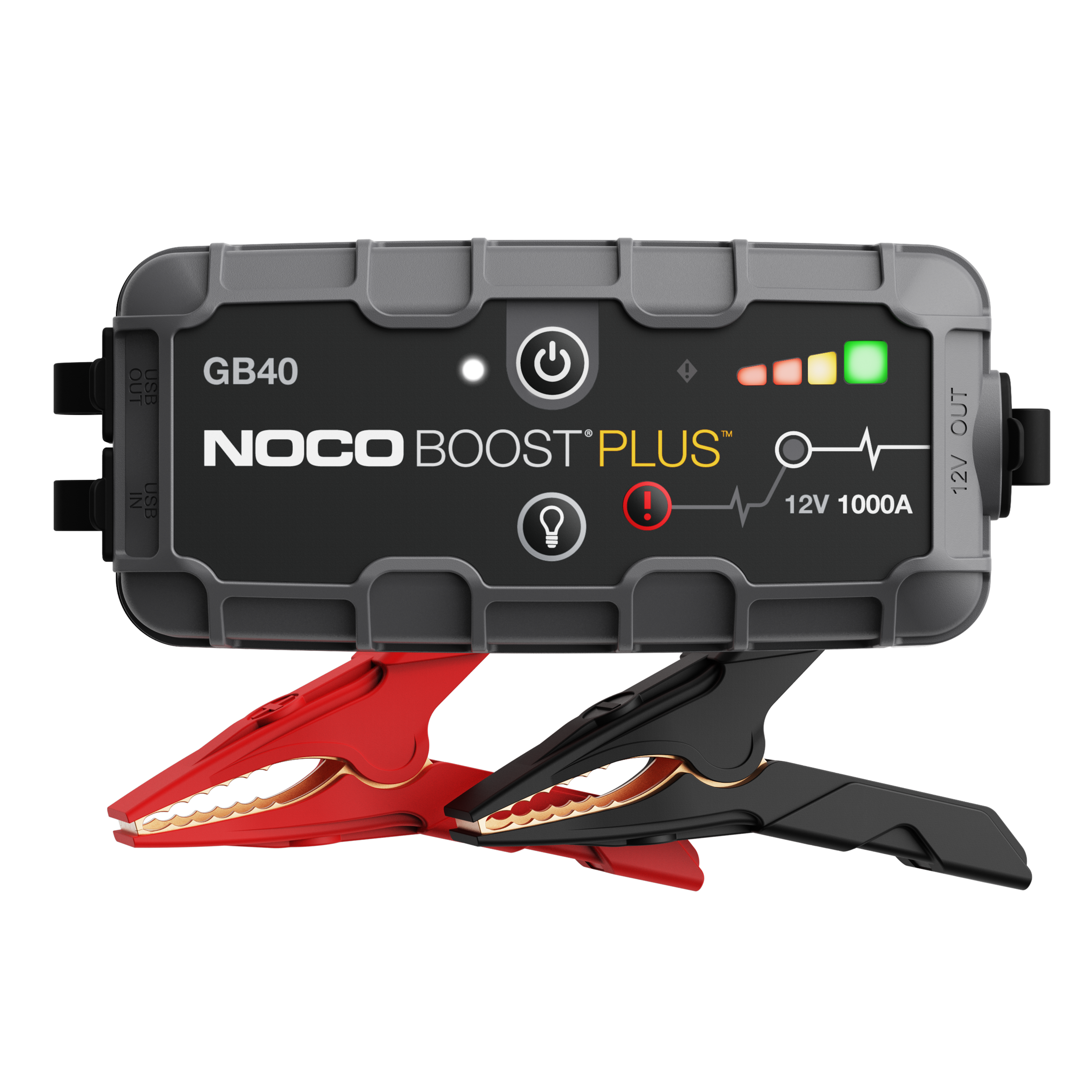
NOCO sells the Boost Plus GB40 at $99.95, in stock on 2026-09-15, in one color it calls Gray. The ratings: 1,000 peak amps into a 12-volt lead-acid battery, gas engines up to 6.0 liters, diesel up to 3.0, up to 20 jump starts per charge. Inside is a 24-watt-hour lithium-ion pack that recharges from USB-C in about three hours and, between emergencies, tops up phones at 5 volts and 2.1 amps. The clamps are spark-proof and reverse-polarity protected, and the US warranty is one year.
Two boundaries decide it, and both can be checked before the emergency. The first is displacement: past 6.0 liters of gas or 3.0 of diesel, NOCO's rating stops, and the company's ladder points up — the GBX45 at $124.95 covers 6.5-liter gas and 4.0-liter diesel, the GB50 at $149.95 covers 7.0 and 4.5. The second is upkeep: a lithium pack that must be recharged after use, stored indoors inside a -20 to +50 °C band, by someone who remembers it exists. A driver who will not run that schedule has older answers — jumper cables and a second car, or a call for a tow — that cost less up front and more in waiting.
Our verdict
Buy the $99.95 GB40 when your engine sits under its 6.0-liter gas / 3.0-liter diesel ceiling and you will recharge it after use; skip it above those limits, or when a lithium pack that needs periodic recharging would sit forgotten in a drawer.
- A good fit for
- A driver whose gas engine is 6.0 liters or less or diesel up to 3.0, who parks beyond the reach of friendly jumper cables, and who will recharge the pack after every start.
- We would skip it if
- Skip it with a gas engine over 6.0 liters or diesel over 3.0 — most full-size diesel pickups included — or if nobody in the house will keep a lithium pack charged between emergencies.
Reasons to consider it
- The fit list is explicit before money changes hands: 12-volt lead-acid batteries only, gas engines to 6.0 liters, diesel to 3.0, battery detection down to 2 volts, and a red error LED that lights when clamps land backwards
- NOCO publishes the numbers competitors round away: a 24-watt-hour internal battery, an IP65 housing with the ports closed, and a recharge table of 12, 6, and 3 hours at 0.5, 1, and 2 amps
- The secondary jobs are specified for real use: a 100-lumen flashlight with seven modes including SOS and strobe, and a 5-volt, 2.1-amp USB output NOCO rates at up to four smartphone recharges per charge
The compromises
- The pack is a maintenance obligation: the manual warns that an unused unit discharges and must be recharged before use, orders indoor storage, and confines operation to a -20 to +50 °C band with charging at 0 to +40 °C
- The rating stops hard: above 6.0 liters of gas or 3.0 of diesel NOCO's ladder points elsewhere, to the GBX45 at $124.95 or the GB50 at $149.95
- The USB output is 5 volts at 2.1 amps, phone-class only, NOCO advises against charging and discharging at the same time, and the US warranty runs one year, non-transferable, on a battery only NOCO can replace
What we have not verified: NOCO publishes no measured basis for the headline numbers: the 1,000 peak amps and the up-to-20-jumps-per-charge figure are ratings, with no test record behind either. The remaining gaps sit inside NOCO's own documents. The spec page puts the body at 7.72 inches across, 2.45 pounds, while the 2025 manual prints 6.7 x 3.2 x 1.7 inches and 2.4 pounds — a one-inch gap unreconciled across the NOCO documents checked. The support article on recharging still instructs a Micro-USB plug; the current spec page and box list say USB-C, and the manual names no connector at all. The page's three-hour recharge quote assumes a 2.1-amp source against the manual's 2-amp row.
The things in this guide
A closer look at the products, who they may suit, and what to check before buying.
Boost Plus GB40
1,000 peak amps, spark-proof clamps with a red error LED for reversed connections, battery detection down to 2 volts, and a 24-watt-hour pack that refills in three hours from USB-C; NOCO rates it for up to 20 starts per charge and up to 6.0 liters of gas / 3.0 of diesel.
Before you buy: The rating ends at 6.0 liters of gas and 3.0 of diesel; the pack needs a recharge after use and periodic top-ups in storage, indoors, inside a -20 to +50 °C band; the USB output is 5 volts at 2.1 amps only; and the US warranty is one year.
Price checked September 15, 2026. Retailer prices can change.What 1,000 peak amps covers, and where it stops
The GB40's ratings form a fit list rather than a rank. It works on 12-volt lead-acid batteries only — the manual's compatibility section names no other chemistry and tells owners to check the battery's voltage and type before connecting — with peak current of 1,000 amps and engine ratings of up to 6.0 liters for gas and 3.0 liters for diesel. Displacement is the number to match, and most sales listings and registration papers print it. A 5.3-liter V8 falls inside the rating; a 6.2-liter performance V8 sits outside it; and the common full-size diesel pickups, at 6.6 to 6.7 liters, sit at more than twice the 3.0-liter diesel ceiling.
The low-voltage floor is 2 volts: the GB40 detects and starts a 12-volt battery down to that reading, and below it the Boost LED stays off because it cannot see a battery. The only way forward is Manual Override, a three-second button hold that forces the boost on and disables the spark-proof and reverse-polarity protections. The manual sets its warning in capitals: never let the positive and negative clamps touch each other, for the product will generate sparks, and misusing the mode voids the warranty. The duty cycle has published limits, five consecutive jump starts in fifteen minutes then a fifteen-minute rest, and hard starters may need the clamps left connected for up to thirty seconds before the key turns.
Twenty starts per charge, on NOCO's count
The endurance headline is NOCO's rating, not a measured count: up to 20 jump starts per charge, and up to four smartphone recharges when the unit works as a power bank. The energy behind both figures is stated exactly — a 24-watt-hour lithium-ion battery — and the output side is modest: 5 volts at 2.1 amps maximum, enough for a phone, a tablet, or a watch, short of what a laptop wants. The manual imposes a sequencing rule: because the unit should not charge and discharge at the same time, the power-bank job and the jump-starter refill take turns.
Refill times are published per power source: twelve hours on a 0.5-amp port, six on 1 amp, three on 2 amps, per the manual's table, and the sales page quotes the same three hours at 2.1 amps. The unit ships partially charged and needs charging to full before its first use. While charging, the four indicator LEDs pulse until each turns solid, and a solid green 100% LED means the refill is done — with one nuance the manual documents: from time to time that green LED pulses again, signaling maintenance charging while the unit stays plugged in.
The upkeep is this product's second price tag
A jump starter spends nearly its whole life waiting, and the manual governs that life in detail. An unused unit self-discharges and must be recharged before use; the device is to be stored indoors, never left outdoors, in a storage band of -20 to +50 °C with a 0 to +25 °C daily average and an absolute ceiling of 80 °C. Charging happens at 0 to +40 °C, and the battery-life advice is to avoid leaving the product on a charger for more than a week at a time. Missing from both documents is a month count: the 2025 manual publishes no hold-a-charge-for-a-year figure, only the instruction to recharge before use.
That missing number becomes the owner's calendar. The workable routine is to charge the pack fully when it arrives, recharge it after every use, top it up on a recurring basis in storage, and keep it somewhere climate-controlled — not in the trunk of the car it exists to rescue, a place the manual's indoor-storage rule already excludes. Skip the routine and the pack drifts toward the exact failure the product was bought to prevent: a battery too low to detect on the morning the clamps come out. A buyer unwilling to run that schedule should count the $99.95 as drawer money and plan on cables and a tow instead.
IP65, 2.45 pounds, and two NOCO documents that disagree
The housing is IP65-rated with the ports closed — dust-tight and protected against water jets, though the manual still tells owners not to operate a wet unit and to store it dry — inside rubberized over-molding that keeps the case from marring paint. Operation runs from -20 to +50 °C with natural-convection cooling. The flashlight doubles as the roadside light: 100 lumens through seven modes listed as 100, 50, and 10 percent brightness, SOS, blink, strobe, and off. The spec page measures the body at 7.72 inches wide, 3.16 tall, and 1.71 deep, at 2.45 pounds, small enough for the boxed microfiber storage bag.
NOCO's own paperwork disagrees about that body in two places. The spec page says 7.72 inches wide; the user guide's technical block prints 6.7 x 3.2 x 1.7 inches and 2.4 pounds — a one-inch gap unreconciled across the NOCO documents checked. The support article on recharging still walks owners through a Micro-USB plug, while the current spec page and the box list say USB-C with a USB-C-to-USB-C cable included, and the 2025 manual names no connector at all. Neither gap touches the jump-start circuit, but both matter when matching a glovebox cutout or a spare cable, and they show how much drift NOCO lets stand between its own pages.
Against cables, against tow trucks, and up NOCO's ladder
The cheaper alternatives trade money for dependence. Jumper cables cost a fraction of $99.95 and start nothing on their own; they need a second vehicle close enough for the clamps to reach, and someone willing to open a hood. Roadside assistance needs no hardware or maintenance, and repays it with waiting: the engine a GB40 starts in seconds stays dead until a truck arrives, on a schedule the driver does not set. The GB40's case is self-service — clamps on, button pressed, engine running — and its costs are a recharge schedule and a one-year US warranty, two years minimum in the EU and UK, non-transferable, with proof of purchase required and the internal battery replaceable only by NOCO.
The step-up is concrete, and NOCO's ladder prices it. A gas engine above 6.0 liters or diesel above 3.0 needs the GBX45 at $124.95 — 1,250 peak amps, 6.5 liters of gas, 4.0 of diesel — or the GB50 at $149.95: 7.0 and 4.5 liters, 200 lumens. Inside the GB40's rating, the buy case is three boxes: displacement under the ceiling, someone willing to recharge the pack after use and top it up in storage, and a place to keep it indoors. All three hold, and $99.95 buys the shortest path between a dead battery and a running engine; any one fails, and the remaining options are a higher rung on the ladder or a tow bill.
How we put this together
Built from the product pages and listings below, without test scores or results we have not measured. Specifications and prices change, so check the original page for the exact model, current price, delivery, and returns.
- NOCO: Boost Plus GB40 product page (US) (opens in a new tab)
- NOCO: GB40 Tech Specs page (opens in a new tab)
- NOCO: GB40 User Guide & Warranty (PDF, 03.07.2025 edition) (opens in a new tab)
- NOCO support: How to Recharge GB40 (opens in a new tab)
- NOCO: GB50 Tech Specs page (opens in a new tab)
- NOCO: GBX45 Tech Specs page (opens in a new tab)