Product image supplied by the brand
In this guide
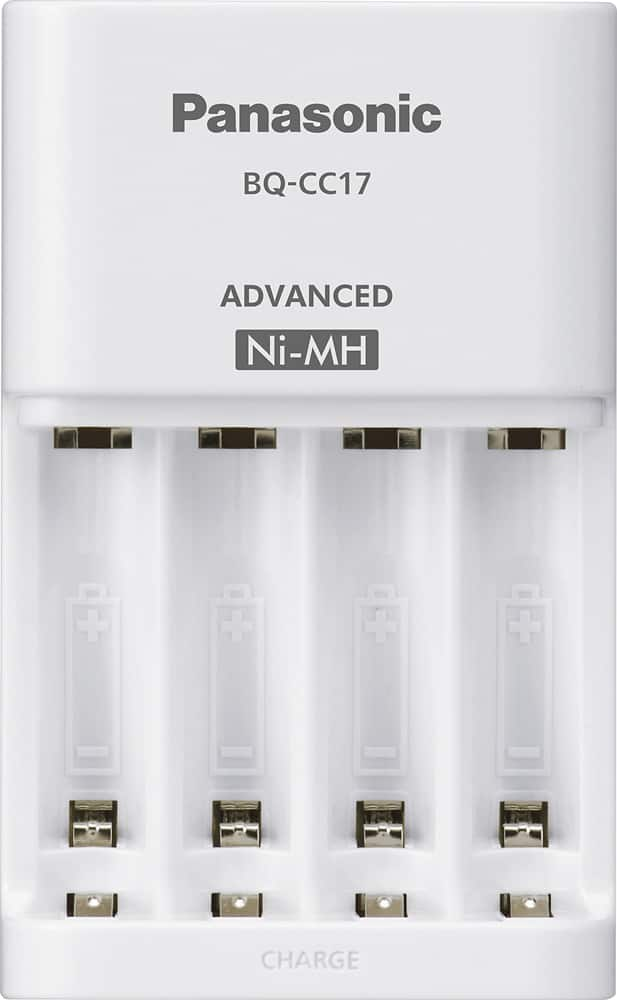
The K-KJ17MCA4BA bundle is Panasonic's entry-level eneloop starter: a BQ-CC17 four-slot charger with a retractable AC plug plus four standard AA eneloop cells, listed In Stock at $28.99 on 2026-09-17, shipped and sold by Amazon itself. The same ASIN branches into AAA kits, batteries-only packs of 4 to 24 cells, and bundles with a quick charger. Panasonic's own US store is a dead end for this SKU: shop.panasonic.com's eneloop search returns LUMIX camera batteries and a shaver, so Amazon is the only checked price.
Two numbers decide the kit. The first is $28.99 against the cells' 2,100 rated cycles — about 1.4 cents a four-cell fill before electricity, against Panasonic's own count of roughly $2 per four-pack of alkalines. The second is charging time: seven hours is the global page's figure for a standard AA at up to four cells, and every skip condition below traces back to it.
Our verdict
Buy this kit at Amazon's checked $28.99 if the house keeps eating AAs; the charger needs about seven hours per four-cell fill and the cells are rated for 2,100 of them. Skip it for daily AAA duty or pro capacity.
- A good fit for
- Households feeding wall clocks, remotes, controllers, and toys more than a four-pack of AAs a month, with a socket they can leave a charger plugged into overnight.
- We would skip it if
- You drain cells daily, need pro capacity for camera flashes, or hate waiting — Panasonic's BQ-CC65 tops two AAs in 1.5 hours, but that's another purchase.
Reasons to consider it
- The BQ-CC17 charges any mix of one to four eneloop or eneloop pro cells, AA or AAA, each slot with its own LED and Minus Delta V cutoff, plus dry-battery, short-circuit, overload, and reverse-polarity protection on a 100-240 V input
- The four AAs are made in Japan at up to 2000 mAh typical and 1900 mAh minimum (IEC 61951-2 2017), rated to hold 70% of charge after 10 years stored at 20°C, and arrive pre-charged from the factory
- At the checked $28.99 the kit runs about 1.4 cents per four-cell fill before electricity — 4.8 cents even on the stricter 2017 IEC cycle figure — with the buybox held by Amazon itself
The compromises
- Speed is the tax: about 7 hours for a four-AA fill on the global page (3.5 hours for two per the listing's table), 9 for pro, while Panasonic's BQ-CC65 does two AAs in 1.5 hours, as a separate accessory
- The 2,100-cycle headline is the 2011 IEC bench method; the same cells rate 600 cycles under the 2017 revision, and Amazon's listing inflates capacity to a '2100mAh typical' spec that appears on no Panasonic data sheet
- The 1.2 V nominal voltage and the airtight-compartment exclusion rule out sealed waterproof lights, and AAA households buy cells separately since the kit includes only four AAs
What we have not verified: Cycle life and shelf life are Panasonic bench claims — 2,100 or 600 cycles under two IEC methods, 70% after 10 years at 20°C as a Panasonic estimation against minimum capacity — and no household duty cycle reproduces those conditions. The charger identity rests on the listing naming the BQ-CC17; a retail kit contents change under the same ASIN would move the charge times. The 7-hour and 3.5-hour figures come from two maker-published tables that disagree in granularity; which one a two-cell household sees is unverified.
The things in this guide
A closer look at the products, who they may suit, and what to check before buying.
eneloop Charger Pack (BQ-CC17 + 4 AA)
At the $28.99 buybox checked 2026-09-17 (shipped and sold by Amazon), the kit pairs a BQ-CC17 that fills any mix of one to four AA or AAA cells on individual timers — about 7 hours per four-AA run, 9 for pro — with four Japan-made cells at 1900 mAh minimum, rated 2,100 cycles under the 2011 IEC method (600 under the 2017 revision) and 70% charge after 10 years at 20°C.
Before you buy: No fast charging in the box: about 7 hours per four-AA batch and 9 for pro, against 1.5 hours for two cells on Panasonic's separate BQ-CC65; AAA cells are not included; and the 2,100-cycle headline comes from the older IEC test method.
Price checked September 17, 2026. Retailer prices can change.What $28.99 buys, and what it leaves out
Inside, exactly two things: the BQ-CC17, a white four-slot charger that plugs straight into the wall on 100-240 V with a retractable plug, and four standard AA eneloop cells — no car cord, no USB cable, no adapter. Panasonic lists the same charger for Canada, Europe, India, Taiwan, and the US, and Amazon's variant menu on this ASIN stretches to AAA kits, batteries-only packs from 4 to 24 cells, and bundles that add the quick charger.
The naming needs one untangle. Amazon's variant menu calls this the standard-charger set; Panasonic files the BQ-CC17 under Advanced Charger, and its Basic class — the BQ-CC51 — charges only in pairs, ten hours for two or four eneloop AAs. The individual slots are why the kit's own title says Advanced Individual Cell: the CC17 takes any mix of one to four AA or AAA cells, even mixed capacities at once, which a pairs-only charger cannot.
Four slots, four clocks
Individual Charge Control is the CC17's whole argument. Each slot carries its own LED — green while that cell charges, dark when it's full — and its own Minus Delta V cutoff that stops the charge just after the cell peaks. On Panasonic's global page the printed time is about 7 hours for a standard eneloop AA and 9 for pro across one to four cells, and 5 to 7 for AAA by capacity. The listing's manufacturer table splits it finer, printing 3.5 hours for two AAs against 7 for four on the 2100 mAh cell. Feed it an alkaline or a reversed cell and the slot's LED flashes while power to that one slot cuts off.
The protection list runs longer than the price suggests: safety timer, hardware, overload, short-circuit, dry-battery, and reverse-polarity safeguards on a 100-240 V input in a 65 x 105 x 27 mm, 91 g body. What the kit lacks is speed, and Panasonic's own lineup shows the upgrade path: the BQ-CC65 refills one or two AAs in 1.5 hours and three or four in 3, while the eight-slot BQ-CC63 clears a full rack in about 5. A CPSC recall search on 2026-09-17 returns no hit for the CC17 or any Panasonic eneloop Ni-MH charger.
Where 2,100 comes from, and the 600 that replaces it
Panasonic's 2,100-cycle rating is real and conditional: it is the result under the IEC 61951-2 2011 test method, and the same page prints 600 cycles under the 2017 revision of that method. Both are bench-to-failure counts under the standard's fixed depth and rate, not household tallies. The cell is specified at up to 2000 mAh typical and 1900 mAh minimum under IEC 61951-2 2017, 27 g, made in Japan, and pre-charged at the factory with solar power; Panasonic rates the cell for use between -20°C and 50°C, and bars eneloop from airtight battery compartments such as waterproof flashlights.
The storage line carries its own fine print: 70% of charge after 10 years, measured at 20°C against minimum capacity, and marked on the page as Panasonic's estimation. Amazon's bullet, meanwhile, inflates the cell to '2100mAh typical, 2000mAh minimum' — a spec that exists on no Panasonic data sheet and reads like the cycle figure bleeding into the capacity field. Plan on the maker's numbers: 1900 mAh minimum and 1.2 V nominal, the voltage that some low-cutoff devices judge unfairly against a fresh 1.5 V alkaline.
What a fill costs against a throwaway
Divide it out: $28.99 spread over the four cells' 2,100 rated cycles is about 1.4 cents per four-cell fill before electricity, and even on the stricter 2017-method figure of 600 cycles it stays at 4.8 cents. Panasonic's own example prices the alternative: a game controller on four AAs, two hours a day, burns $48.70 a year in dry cells across 24.33 purchases, against $30.10 with eneloop counting a charger share and electricity — call it $20 a year back from one device.
eneloop pro is Panasonic's higher-draw sibling SKU: a min. 2,450 to 2,500 mAh cell depending on region, rated 500 cycles under the 2011 method or 150 under the 2017 revision, with an 85%-after-one-year storage claim. Pro exists for draw, not longevity — Panasonic pitches it at camera flashes, where a pro cell recovers in 3.3 seconds between shots against 76 for a competitive alkaline. A flash shooter should buy the pro bundle instead; the four cells in this box top out at 2000 mAh typical by design.
Marketplace fakes, the buybox, and the skip list
Counterfeit eneloops have a paper trail at Panasonic itself. The 2022 statement from Panasonic Malaysia reports counterfeit Panasonic batteries 'for sale to Malaysian consumers in online marketplaces' and a single raid that seized 5,969 fake batteries, closing with advice to buy only from certified authorized sellers. The enforcement action is Malaysian and from 2022, and it stands as the maker's on-record confirmation that marketplace fakes exist; no US enforcement action turns up in the checked sources. The buybox checked on 2026-09-17 reads Ships from and sold by Amazon.com, which keeps the supply chain inside one accountable retailer.
Skip this kit on any of four conditions: devices that drain AAAs daily, since cells cost extra and take 5 to 7 hours to refill; camera-flash duty that wants pro capacity; a need for charged cells in under two hours, which points at the BQ-CC65 route; or gear with airtight battery compartments, which Panasonic excludes outright. Everyone else feeding remotes, wall clocks, controllers, and toy drawers gets about 1.4 cents a fill — with the caveat that the price and the buybox are both snapshots of 2026-09-17.
How we put this together
Built from the product pages and listings below, without test scores or results we have not measured. Specifications and prices change, so check the original page for the exact model, current price, delivery, and returns.
- Amazon: eneloop K-KJ17MCA4BA charger pack listing (ASIN B00JHKSMJU) (opens in a new tab)
- Panasonic: BQ-CC17 charger product page (global EN) (opens in a new tab)
- Panasonic: eneloop AA battery product page (global EN) (opens in a new tab)
- Panasonic: eneloop lineup page (global EN) (opens in a new tab)
- Panasonic: eneloop pro battery product page (global EN) (opens in a new tab)
- Panasonic: counterfeit batteries notice (Malaysia, 2022) (opens in a new tab)
- CPSC: recall database search for eneloop (opens in a new tab)