Product image supplied by the brand
In this guide
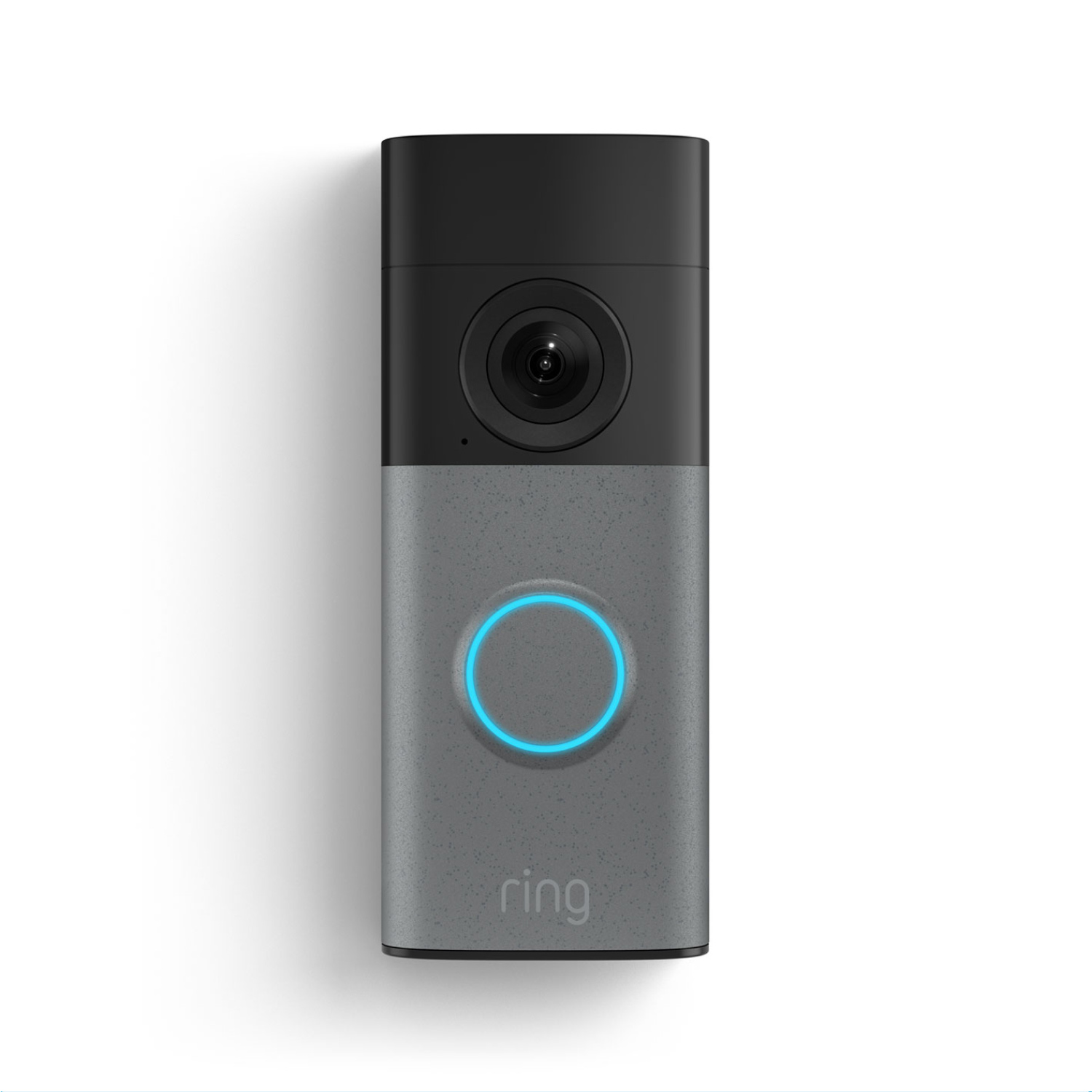
Ring sells the Wired Doorbell 2K direct at $79.99, in stock on 2026-09-14, in one color, Speckled Gray, under the full listing name Wired Doorbell 2K (Newest Model). The product is the Wired Doorbell (2nd Gen) wearing an August 2026 rename: Ring's support article maps the two names in a single table, and the listing's own FAQ confirms the company changed the name, but the features remain the same — so older reviews and listings describe this same hardware. The specification list includes Retinal 2K video — 1920x1920, per the FAQ's own resolution answer — with up to 6x Enhanced Zoom, a 140° horizontal by 140° vertical head-to-toe field of view, Two-Way Talk, motion detection out to 31 m, and hardwired power with no battery anywhere in the design. Connectivity is 2.4 GHz Wi-Fi with 10 Mbps recommended for Ring's 2K devices, the unit measures 2.1 x 5.2 x 1.02 in, and the warranty is a One-Year Limited term.
One split decides this purchase. Without a plan, the doorbell keeps its three live jobs — watch, talk, alert — while every recording, snapshot, and reviewable moment of history sits behind Ring Protect, starting at $4.99 a month or $49.99 a year for this single device. Wiring decides the rest: the FAQ blesses 8-24VAC on standard doorbell wiring, the same page's small type demands 12-24 VAC, 40VA max, 50/60Hz, and the install instructions deliberately bypass the home's mechanical chime, which goes quiet the day the doorbell goes in. Between a transformer that may need replacing, a $34.99 Ring Chime standing in for the silenced one, and the optional plan, the checkout price and the working-system price are two different numbers.
Our verdict
Install the $79.99 Wired Doorbell 2K on 12–24 VAC wiring for free live view, two-way talk, and alerts; every recording needs Solo at $4.99 a month. Skip it with no doorbell wiring or no budget for that plan.
- A good fit for
- A house with doorbell wiring on a 12–24 VAC, 40VA transformer — the band both of Ring's statements certify — whose owners want live view, two-way talk, and alerts without a monthly bill, and accept phone notifications or a $34.99 Ring Chime in place of the silenced mechanical one.
- We would skip it if
- No doorbell wiring, or a transformer below 12 VAC; a resident who cannot rewire a chime and flip a breaker; a household that needs missed visits on record but rejects Solo at $4.99 a month; or an indoor mechanical chime that has to keep ringing, since the install bypasses it.
Reasons to consider it
- The plan-free tier is genuinely usable: Ring's subscription article promises live video and responses to alerts as they happen at the no-cost level, so the doorbell's three live jobs — watch, talk, alert — carry no recurring cost
- The optics punch above $79.99: Retinal 2K with up to 6x Enhanced Zoom, a 140° horizontal by 140° vertical head-to-toe field of view that holds both a tall visitor and a package at the threshold, motion detection out to 31 m and face/object recognition out to 6.3 m
- A long and documented runway: software security updates committed through 31 December 2031, a One-Year Limited Warranty, one color and one price at checkout, and an on-the-record rename from Wired Doorbell (2nd Gen) with the page stating the features remain the same
The compromises
- Nothing records without a plan: events are only recorded after subscribing, snapshot history (14 days, maximum) requires a plan too, the doorbell has no card slot — the only local storage in the ecosystem is a microSD in a separate Alarm Pro base station — and a lapsed plan deletes stored videos permanently
- Ring's own page contradicts itself on power: the FAQ allows 8-24VAC, the small type demands 12-24 VAC, 40VA max, 50/60Hz, and the instruction book prints no electrical spec to break the tie, while the battery-free design means any power cut takes the doorbell offline
- The install silences the indoor chime on purpose — the instructions jumper the Front and Trans terminals to bypass it — and Ring states the doorbell does not activate the home's internal chime, so hearing the door indoors means phone alerts or a Ring Chime at $34.99 / Chime Plus at $59.99
What we have not verified: Ring's two published voltage ranges — 8-24VAC in the FAQ, 12-24 VAC in the small type — appear nowhere reconciled: the manual carries no electrical spec at all, so a transformer rated 8–11 VAC sits inside one documented range and below the other. The night-vision entry specifies range only, 'up to 10m,' and names no mode; the weather-resistance row reads 'Weather Resistant IPX' with the rating digit left off the page. The $24.99 Plug-In Adapter's compatibility list names twelve doorbells and omits this one without excluding it, and Ring documents nothing on whether Quick Replies work without a plan.
The things in this guide
A closer look at the products, who they may suit, and what to check before buying.
Wired Doorbell 2K
$79.99 direct buys Retinal 2K with up to 6x Enhanced Zoom, a 140° x 140° head-to-toe view, Two-Way Talk, motion detection to 31 m, and hardwired power off standard doorbell wiring at 12–24 VAC — the band both of Ring's published ranges share. Live view, real-time alerts, and the talk button work with no subscription, security updates run through 31 December 2031, and Solo at $4.99 a month or $49.99 a year stays optional for 180-day cloud recordings.
Before you buy: Nothing records without a plan, and a lapsed plan erases stored videos permanently; the install bypasses the existing mechanical chime, so indoor sound needs a $34.99 Ring Chime or phone alerts; there is no battery, so a power cut or a sub-12 VAC transformer takes it offline; and the radio is 2.4 GHz only, with 10 Mbps recommended.
Price checked September 14, 2026. Retailer prices can change.What still works the day the free trial ends
Ring's subscription article draws the free line in one sentence: without a subscription, you can view live video and respond to alerts as they happen. Live view, Two-Way Talk, and motion alerts pushed to the phone all live on that side of the line — and the page's own description sells exactly that set, a wired doorbell with 2K video, two-way talk, and motion alerts, hardwired — so the headline features and the no-plan tier are substantially the same list. The feature set adds Quick Replies for answering with a preset message when nobody can pick up; Ring publishes no statement either way on whether that survives without a plan, so the guaranteed trio is watch, talk, and alert. Month one also runs richer than the permanent state: a free 30-day Ring Protect trial starts immediately at setup, unless a plan already exists at the address, so every event records for thirty days. Judge the purchase on the permanent state, the day the trial ends.
Everything reviewable hides behind the same clause, and it is quoted directly from Ring: events are only recorded after you subscribe. No plan means no timeline, no clips, and no snapshots — Snapshot Capture requires a compatible Ring subscription per its own support article, and even subscribers cap snapshot history at 14 days. The consequence is worth spelling out with a scenario: a delivery at 2 p.m., a stranger at dusk, a missed notification because the phone was on silent — each visit exists only while it is happening, and once it passes, the doorbell holds nothing to look back on. A live-only doorbell answers who is at the door right now, competently and for free. It has no answer at all for who was at the door an hour ago, and that boundary, not the camera, is what the $79.99 buys first.
Ring Protect, tier by tier: what $4.99, $9.99, and $19.99 a month buy
The US plan sheet, prices before tax, reads like this: Solo covers one device at $4.99 a month or $49.99 a year; Multi covers every device at one address at $9.99 a month or $99.99 a year and adds an extended warranty; Pro at $19.99 a month or $199.99 a year stacks everything in Multi with Video Descriptions, the Familiar Faces beta, and 24/7 professional monitoring, while the Virtual Security Guard add-on runs $99.00 a month on top. For one doorbell, Solo is the line that matters, and its billing choice is real money: $4.99 a month comes to $59.88 across twelve bills against the $49.99 annual rate, so paying yearly saves $9.89 — an eighth of the doorbell's own price. Multi is a device-count question. Two cameras on two Solos is $9.98 a month against Multi's $9.99, effectively a tie, and a third Ring device tips it outright while adding the extended warranty on top of the standard one-year term.
Storage terms are uniform across the paid tiers: motion-event videos stay in Ring's cloud for up to 180 days, snapshots for up to 14 days, and the doorbell itself has no card slot — the plans page's only local-storage route is a microSD card seated in a separate Ring Alarm Pro base station, which is different hardware at a different price. The cancellation clause deserves the same scrutiny as the price list: on a lapsed plan, you will lose your stored video recordings, and they will not be retrievable. That sentence makes the subscription the sole keeper of anything the camera has ever recorded, since no copy exists anywhere else. Subscribers do get 10% off select products at Ring.com — a quiet discount on a second camera, which is precisely the step that argues for Multi.
Two voltage ranges on one page, and the chime that stops ringing
Can the house's existing wire take this doorbell? Ring's own page answers twice. The FAQ puts the requirement at an 8-24VAC power supply and is compatible with standard doorbell wiring; the same page, in small type, requires a standard doorbell system with a 12-24 VAC, 40VA max, 50/60Hz doorbell transformer. Both ranges are reproduced here exactly, because the gap is the buyer's problem: a transformer rated anywhere from 8 to 11 VAC falls inside the FAQ's range and below the small type's floor at the same time. The only band both statements certify is the overlap — 12–24 VAC, 50/60Hz, 40VA max — and that is the number to read off the transformer label before ordering. The manual breaks no tie; it prints no electrical spec at all, just a Phillips screwdriver, an optional 1/4 in masonry bit, and a breaker to shut off. A transformer outside the band means replacing it before the doorbell will run, hardware plus an electrician's visit for most people, and with no battery in the design, a power cut takes the doorbell offline until power returns.
The indoor chime is the casualty nobody budgets for. Ring's install article has the existing mechanical chime bypassed as a step of the procedure — loosen the Front and Trans terminals, connect them with the included bypass cable, and wire-nut the wires together outright when the house has multiple chimes — and Ring states flatly that the doorbell does not activate the home's internal doorbell chime. The hall chime goes quiet the day the doorbell goes in, by design. Hearing the door from inside then runs through phone notifications, or through a Ring Chime at $34.99 or a Chime Plus at $59.99 plugged in within Wi-Fi range — real money, added to a purchase that looked complete at $79.99. The install article draws one more hard boundary: the doorbell must not be wired to a DC-powered intercom system, which rules out that class of apartment hardware outright. Renters who cannot flip a breaker or rewire a chime sit outside this product's audience; the Wired Doorbell 2K assumes an owner's hands, or an electrician's invoice.
The camera half: 2K head-to-toe optics, and the numbers the spec leaves out
What the $79.99 buys on the image side is documented and, at this price, competitive: Retinal 2K video with up to 6x Enhanced Zoom, and a 140° horizontal by 140° vertical head-to-toe field of view — the square-ish frame that holds a visitor's face at the top and a package at the threshold in the same picture, which is the practical argument for a head-to-toe doorbell over a conventional 16:9 one. Motion detection reaches 31 m with face and object recognition out to 6.3 m, per the page's FAQ, and night vision is listed with an up-to-10 m range and advanced image processing. The spec has blank spots that deserve a look before the card comes out. The pixel count at least is pinned down — the FAQ's own resolution answer defines 2K as 1920x1920. What stays open is everything around it: no night-vision mode is named, infrared or otherwise, and the weather-resistance row reads, verbatim, 'Weather Resistant IPX,' with the rating digit left off. The listing makes no HDR claim for this doorbell anywhere, an omission worth remembering when a summary elsewhere says otherwise.
The rest of the support picture is unusually concrete. Connectivity is 2.4 GHz Wi-Fi only, with 10 Mbps recommended for Ring 2K devices and a note that video resolution varies with internet bandwidth — a dual-band router still broadcasting 2.4 GHz handles it, and most do. The operating range is -5°F to 120°F, the body is 2.1 x 5.2 x 1.02 in, the box carries a mounting bracket, installation hardware, and setup instructions, and the warranty is a One-Year Limited term — extendable only through a Multi or Pro plan, whose US extended warranty runs as an Allstate-administered service contract inside the manufacturer's one-year window. Ring commits to software security updates through 31 December 2031, a five-plus-year runway that outlasts the subscription decision. Privacy controls live in the Ring Control Center with the legal terms at ring.com/legal, for whoever wants the data-handling detail before a camera watches the front step.
Where the $79.99 makes sense, and the three cases that end it
The buy case has three preconditions, each verifiable in advance. First, a doorbell transformer reading 12–24 VAC, 50/60Hz, 40VA or under — the only band Ring's two published ranges share; the label on the existing transformer answers it. Second, acceptance of the no-plan tier's shape: live view, talk, and alerts for $0 a month, with Solo at $49.99 a year added if recordings turn out to matter — taken annually from the start, since the monthly rate costs $59.88 over the same twelve months. Third, a plan for indoor sound, meaning phone alerts that get heard, or the $34.99 Chime. The rename history actually helps here: the Wired Doorbell (2nd Gen) and the Wired Doorbell 2K are one product with features unchanged on Ring's own record, so an older review or spec sheet that says 2nd Gen describes this same hardware, sold in one Speckled Gray color, with support committed through 2031.
Three situations end the purchase, and each is concrete. A home with no doorbell wiring has no official path to this doorbell: the $24.99 Plug-In Adapter's compatibility list names twelve Ring doorbells, omits this one, and works by keeping a Quick Release Battery Pack charged — a part this battery-free doorbell does not take. A household set on having missed visits on record but against any monthly bill should stop at the subscription article's own sentence, events only recorded after subscribing, and buy hardware that records to a card instead. And whoever needs the existing mechanical chime to keep ringing, or who cannot legally rewire one, should pass: the install silences it on purpose. With those three cleared — wired door, checked transformer, tolerance for a live-only free tier — $79.99 is a defensible price for a 2K head-to-toe doorbell that answers the door without owing Ring a monthly fee.
How we put this together
Built from the product pages and listings below, without test scores or results we have not measured. Specifications and prices change, so check the original page for the exact model, current price, delivery, and returns.
- Ring: Wired Doorbell 2K product page (US) (opens in a new tab)
- Ring: Ring Protect plans page (US) (opens in a new tab)
- Ring Support: Understanding Ring Protect subscriptions (opens in a new tab)
- Ring Support: Installing Wired Doorbell 2K (opens in a new tab)
- Ring Support: Ring product name changes (opens in a new tab)
- Ring: Plug-In Adapter product page (US) (opens in a new tab)
- Ring Support: Ring devices software security updates (opens in a new tab)
- Ring Support: Timeline Security Snapshots Using Snapshot Capture (opens in a new tab)