Product image supplied by the brand
In this guide
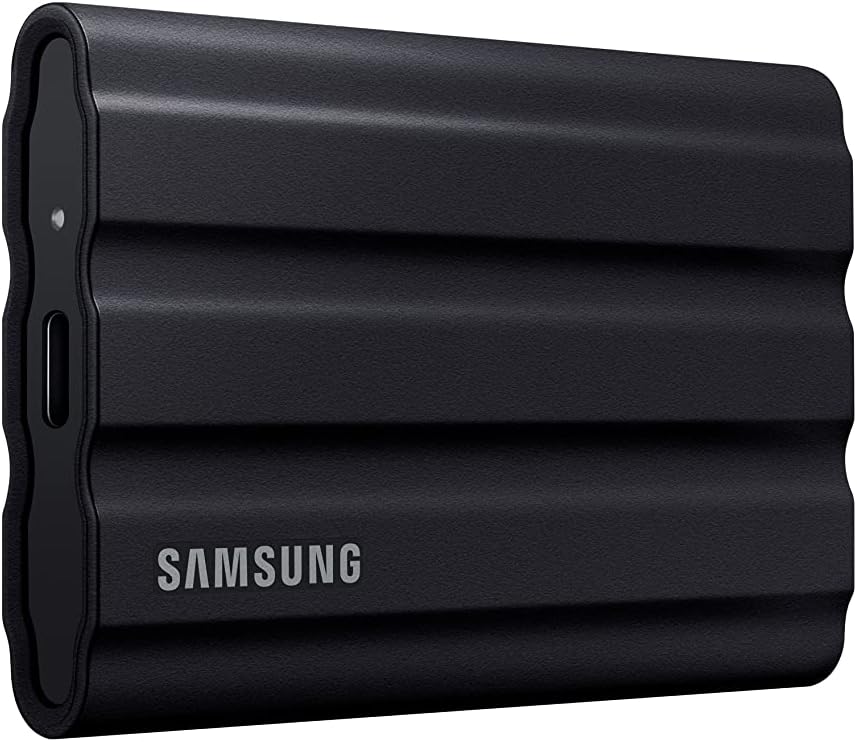
Samsung's T7 Shield is the rugged branch of its portable SSD line, and the black 1TB model, MU-PE1T0S/AM, listed at $287.99 in Samsung's US storefront, while Amazon itself sold it for $266.99 when checked on September 23, 2026. It promises up to 1,050 MB/s reads over USB 3.2 Gen 2, an IP65 rating with published test conditions, and a drop test the manual bothers to describe. Even the lower price is about 1.7 times its $159.99 launch MSRP, after TrendForce's 2026 outlooks put NAND flash contract prices up by half or more in each of the year's opening quarters.
The question here is narrow: at today's price, does the protection justify the premium over a plain portable SSD, and how does it stack up against its closest rival, the SanDisk Extreme Portable SSD 1TB, which carries five years of warranty against Samsung's three?
Our verdict
At $266.99 from Amazon, buy the T7 Shield 1TB if you carry backups through weather and drops and want the test methods on paper; for desk-bound storage, the same money buys far more capacity.
- A good fit for
- A photographer or traveler whose backup drive travels in a bag that gets dropped or rained on, and who wants the drop-test method and IP65 conditions published, not just claimed.
- We would skip it if
- Your machine has USB4 or Thunderbolt and you move huge files, you want the most terabytes per dollar, or you want beige or blue at 1TB, neither of which had a new unit on offer at Samsung or Amazon on September 23.
Reasons to consider it
- IP65 certified by KCTL, an ILAC-member lab, with the water and dust test conditions printed in the manual
- The drop rating comes with a method: four free falls from 3 meters onto a steel floor
- Both C-to-C and C-to-A cables in the box, and a password set on a computer can also unlock the drive on Android
The compromises
- $266.99 for 1TB is about 1.7 times the $159.99 MSRP from its 2022 launch, and no rugged successor has replaced it
- The three-year warranty is two years shorter than the SanDisk Extreme's five, and excludes liquid, dust, and drop damage
- A forgotten password has no recovery; the only reset is a PSID Revert that erases everything
What we have not verified: Sustained write speed once the cache fills, long-term wear of the rubber coating, and any restock date for new beige or blue 1TB units are all open questions; each one could shift the buy-now-or-wait answer.
The things in this guide
A closer look at the products, who they may suit, and what to check before buying.
Portable SSD T7 Shield · 1TB (Black)
A KCTL-certified IP65 rating with published conditions, a described 3-meter drop test, both cables in the box, and phone-side unlock for its password protection make it the low-surprise field drive.
Before you buy: $266.99 at Amazon is about 1.7 times the 2022 launch MSRP, the warranty runs three years against SanDisk's five, and drops or splashes that do damage are not covered by it.
Price checked September 23, 2026. Retailer prices can change.1,050 MB/s has a condition attached
Samsung rates the T7 Shield at up to 1,050 MB/s read and 1,000 MB/s write over USB 3.2 Gen 2, a 10 Gbps link. The manual's footnote names the requirement that storefront headlines leave out: the host and cable must support USB 3.2 Gen 2 and UASP mode must be enabled, or performance is, in Samsung's word, suboptimal. Both a C-to-C and a C-to-A cable ship with it, so the cable side is covered.
That 1,050 MB/s sits near the practical ceiling of 10 Gbps, which cuts two ways. On an ordinary USB 3.2 Gen 2 laptop port the drive is fully used; on a USB4 or Thunderbolt machine it still runs at 10 Gbps while most of the port idles. Samsung's T9 is rated at 2,000 MB/s, but only on a port and cable that support USB 3.2 Gen 2x2 — a mode a USB4 or Thunderbolt label does not promise by itself. Match the drive to the ports your machine actually has.
A drop test with a method, an IP65 with conditions
The manual describes the drop test outright: four free falls from 3 meters onto a steel floor, under controlled conditions, after which the drive worked with only limited surface damage. No formal standard is cited, but the height, surface, and drop count are all stated, which is more than most rugged claims give you. The IP65 rating carries more institutional weight: it was certified by KCTL, a lab whose accreditation is recognized across ILAC member countries.
The IP65 test conditions are printed too: fresh water projected from a 6.3 mm nozzle three meters away at 12.5 l/min for three minutes, and 2 kg/m² of dust at under 2 kPa for eight hours in a vacuum chamber. The same pages carry the limit that matters more than the rating itself: damage caused by liquid, dust, or impact is not covered under warranty. The shell protects the drive; it does not transfer any of the risk to Samsung.
Password protection with no way back
Security mode is set up through the Samsung Portable SSD Software on Windows or Mac, and a locked drive exposes only a 128 MB partition until the password is entered. Where the SanDisk Extreme's hardware encryption is desktop-only, Samsung's manual says a password stored on the drive from a computer can also unlock it through Samsung's Android app. If a lost bag means reaching for a phone, that difference is real.
The flip side is unforgiving. There is no password recovery: the only reset is a factory restore through a Samsung Service Center or Magician's PSID Revert, which erases everything on the drive, and Samsung disclaims liability for data lost to a forgotten password. A drive nobody can open is secure; a drive that must be wiped to be opened is a different kind of risk, so keep the password somewhere other than the drive itself.
What $287.99 buys in 2026
On September 23, 2026, the black 1TB was in stock at Samsung's US business store at $287.99, with blue and beige out of stock there. Amazon sold the same black model for $266.99, against the same $287.99 list price, from Amazon's own stock; the blue 1TB listing had only a used unit on offer that day, and the beige 1TB and 2TB listings were unavailable. For a new 1TB drive the choice is simple: black, from Amazon, at $266.99.
That is about 1.7 times the $159.99 MSRP Samsung announced at the T7 Shield's 2022 launch, and Samsung's own $287.99 is 1.8 times. The markup is not one store's: TrendForce's quarterly outlooks put NAND flash contract price increases at 55 to 60 percent quarter over quarter for the first quarter of 2026 and 70 to 75 percent for the second, and Samsung has not shipped a successor to discount the old stock, since the T9, launched in 2023 with its own rubber cover and a 3-meter drop rating but no IP rating, sits beside it rather than replacing it. If your backup drive can wait a few months, waiting is a defensible bet on prices easing; if you need rugged storage this week, $266.99 is what it costs this week.
Three years against SanDisk's five
Samsung's warranty list covers the T7 Shield at 1TB, 2TB, and 4TB for three years; the T9, on the same page, gets five. The SanDisk Extreme Portable SSD 1TB carries five years and a carabiner loop the Samsung lacks, while the T7 Shield answers with a published drop-test method, a certified IP65 rating, and Android-side unlock for its password protection. The two drives are the same idea with different paperwork.
For a backup drive, warranty length is not decoration: flash wears and ports loosen over years, and two extra years of coverage is the one concrete thing the SanDisk offers that this drive does not. Samsung's counterweight is documented testing and the phone-friendly unlock. Neither drive is wrong; they fail differently, and the warranty term is where that difference shows up first.
When to skip it
Skip the T7 Shield if your computer has USB4 or Thunderbolt and you routinely move hundreds of gigabytes, because a 10 Gbps drive wastes that port — though the T9 is only the faster pick if the port supports USB 3.2 Gen 2x2. Skip it if the drive will stay on a desk: the rubber shell and IP65 rating solve problems you do not have there, and a plain portable SSD buys more terabytes per dollar. Skip the 1TB today if you want beige or blue: beige is out of stock at Samsung and unavailable at Amazon, and Amazon's blue listing showed only a used unit on September 23.
Buy it when the drive travels in a bag near weather and concrete floors, and when unlocking from a phone matters. In that use, the certified IP65, the stated drop method, both included cables, and Samsung's three-year warranty are what the $266.99 is paying for. If you enable the password, write it down the same day, because the drive gives you exactly one way back and it erases your data.
How we put this together
Built from the product pages and listings below, without test scores or results we have not measured. Specifications and prices change, so check the original page for the exact model, current price, delivery, and returns.
- Samsung US Business: Portable SSD T7 Shield 1TB (Black), MU-PE1T0S/AM (opens in a new tab)
- Samsung: Portable SSD T7 Shield User Manual (English, ver 1.1) (opens in a new tab)
- Samsung Semiconductor: consumer storage warranty list (opens in a new tab)
- Amazon: Samsung T7 Shield 1TB (MU-PE1T0S/AM, Black) (opens in a new tab)
- Samsung Newsroom US: T7 Shield launch press release (2022-04-26) (opens in a new tab)
- TrendForce: 1Q26 memory price outlook (2026-02-02) (opens in a new tab)
- Samsung Newsroom US: Samsung Announces T9 Portable SSD (2023-10-03) (opens in a new tab)
- SanDisk US: SanDisk Extreme Portable SSD - 1TB (Black), SDSSDE61-1T00-G25 (opens in a new tab)