Product image supplied by the brand
In this guide
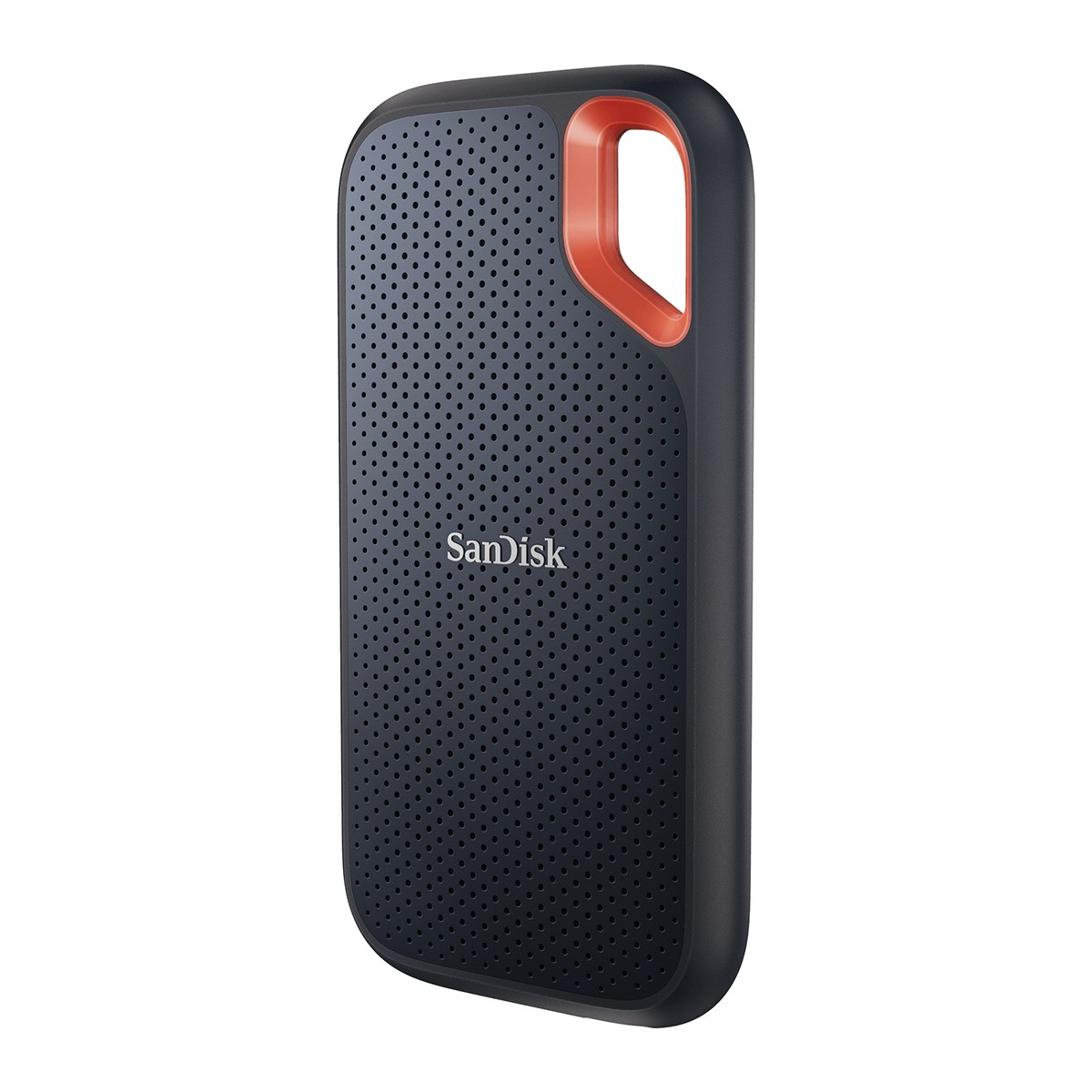
SanDisk's Extreme Portable SSD has been the default rugged pocket drive for years, and the 1TB black version, model SDSSDE61-1T00-G25, is still on SanDisk's US store at a $282.99 list price marked down to $219.99 at the time of writing. It connects over USB 3.2 Gen 2, a 10 Gbps link, and SanDisk rates it at up to 1050 MB/s reads and 1000 MB/s writes. The shell is silicone with a carabiner loop, the drive is rated IP65, and SanDisk claims drop protection up to three meters. The warranty term is five years.
This article stays on SanDisk's own pages and takes the claims apart footnote by footnote: which test produced the speed numbers, what IP65 was tested against, why the advertised encryption will not help on the phones the drive is marketed for, and how the price compares with the V3 revision SanDisk lists on the same page. A companion article on this site covers SanDisk's Ultra microSD card, a $32.99 product with a very different job; the two are not competitors, but the microSD's 10-year warranty is a useful reference point for what SanDisk is willing to promise on flash.
Our verdict
A well-documented rugged SSD whose speed, IP65, and drop claims are stated with test conditions and whose warranty term of five years is longer than most; the price on SanDisk's own store is high for a 10 Gbps drive, and the hardware encryption does not work with the phones SanDisk markets it for.
- A good fit for
- A photographer or videographer offloading cards in the field, or anyone who carries a backup drive in a bag and wants the water, dust, and drop ratings more than the last few hundred megabytes per second.
- We would skip it if
- You want a drive that stays encrypted when plugged into an Android phone or iPhone, your host has a USB4 or Thunderbolt port that could feed a much faster drive, or you are price-sensitive and the same-capacity V3 or a plain portable SSD is on sale.
Reasons to consider it
- IP65 water and dust resistance tested to IEC 60529 and up to three-meter drop protection, both from SanDisk's internal testing
- Up to 1050 MB/s read and 1000 MB/s write over USB 3.2 Gen 2, with the test rig named in the footnote
- A warranty term of five years, a C-to-C cable and a C-to-A adapter in the box, and compatibility listed down to iOS 13 and Android 11
The compromises
- 256-bit AES password protection is Windows and macOS only; SanDisk's footnote says it is not compatible with any Type-C phone, including Android
- $282.99 list and $219.99 sale on SanDisk's store for 1TB when the drive's 10 Gbps interface is the previous generation
- SanDisk's page lists no weight and no footnote for the three-meter drop claim, and the drop test method is not described
What we have not verified: No transfer, thermal, or drop testing was performed. Speed figures are SanDisk's internal results on a named desktop with an ASMedia USB 3.1 Gen 2 controller; sustained write speed after the cache fills is not published. Weight is not on SanDisk's page. The V3 model SanDisk lists beside this drive was not researched beyond its presence and its 500 GB price.
The things in this guide
A closer look at the products, who they may suit, and what to check before buying.
Extreme Portable SSD · 1TB (Black)
Stated IP65 and three-meter drop ratings, 1050 MB/s reads with a published test configuration, five years of warranty, and both cables in the box make it a low-surprise field drive.
Before you buy: At $219.99 on sale it is priced like a newer drive, the hardware encryption is desktop-only, and any USB4 host leaves most of its own bandwidth unused.
Price checked September 11, 2026. Retailer prices can change.1050 and 1000 MB/s, with the test rig named
SanDisk quotes up to 1050 MB/s read and up to 1000 MB/s write, and the footnote attached to both numbers is unusually complete: they come from internal testing on an ASUS ROG STRIX Z270E desktop using an ASMedia USB 3.1 Gen 2 controller, an Intel Core i7-7700, a WD_Black SN750 as the source drive, and 64-bit Windows 10 Professional, with the caveat that performance may be lower depending on host, interface, and usage. One megabyte is defined as 1,000,000 bytes.
Two things follow from that footnote. First, the numbers are sequential peaks on a desktop USB controller, so a laptop's port, a hub, or a phone will land lower, and SanDisk does not publish what happens to write speed once any cache is exhausted on a long copy. Second, USB 3.2 Gen 2 is a 10 Gbps link, and 1050 MB/s sits close to its practical ceiling. On a USB4 or Thunderbolt host this drive runs at the same 10 Gbps, while SanDisk's own Extreme PRO with USB4 on the same compare table is rated at 3800 MB/s. Choose by the port you own, not the port you might buy.
IP65 is tested to a standard; the drop rating is a sentence
The IP65 claim carries its own footnote: based on internal testing to IEC 60529, the drive withstood a 30 kPa water flow for three minutes, and limited dust contact does not interfere with operation. SanDisk adds that the drive must be clean and dry before use, which in practice means letting it dry before plugging the Type-C connection into anything. The silicone shell and the carabiner loop are described as a premium feel plus added exterior protection and a way to clip the drive to a belt loop or a bag.
The drop rating is stated as up to three-meter drop protection, three times in different sections, but no footnote defines the surface, the number of drops, or the orientation, and no standard is cited. Read it as SanDisk's own confidence level, not a certification. SanDisk's plain Portable SSD on the same compare table is rated to two meters and lacks the IP rating, which is the concrete difference the Extreme's higher price is buying. The overall dimensions are 3.97 by 2.07 by 0.38 inches; weight is not listed by TP-Link.
The encryption works on a computer, not on the phone SanDisk sells it for
SanDisk leads with iPhone 15 Plus, Pro, and Pro Max compatibility and lists iOS 13+, Android 11+, macOS 11+, and Windows 10+ as supported hosts, with a C-to-C cable and a C-to-A adapter in the box. A separate feature promises password protection with 256-bit AES hardware encryption. The footnote under that promise says the password feature is supported on Windows 8, Windows 10, and macOS 10.9 and later, requires a software download on a Mac, and is not compatible with Type-C smartphones, including Android devices.
So the two marketing points do not overlap. A drive that has been password-locked on a laptop cannot be unlocked on a phone, and a drive used mainly with a phone gets no benefit from the encryption feature. The Android SANDISK app, which SanDisk lists separately, handles unlocking, browsing, and automatic offloading of the phone's files to the drive, but it is a file manager, not a bridge to the hardware lock. Anyone whose threat model is a lost bag with the drive attached to a phone should plan on file-level encryption inside the phone instead.
Price, the V3 beside it, and the warranty term
SanDisk's store showed $282.99 as the list price and $219.99 as the offer price for the 1TB black drive, with Buy Direct, a free-returns line, and an authenticity guarantee in the purchase box. The same page offers 500GB, 2TB, 4TB, and 8TB capacities and Sky Blue and Monterey colors at 1TB through 4TB, each with its own model number. Set against the $32.99 Ultra microSD card reviewed on this site, the per-gigabyte cost is far higher, which is the price of NVMe speed, an enclosure, and the ratings above.
The compare table on SanDisk's page places a product called SanDisk Extreme Portable SSD (V3), model prefix SDSSDE70, next to this drive, with its 500GB option shown at $199.99 list and $159.99 sale and a headline of moving 1,000 high-resolution photos in under 60 seconds. SanDisk describes the V3 with the same IP65 and three-meter figures and the same 256-bit AES password protection, so the SDSSDE61 is now the older of two drives with the same name. On warranty, SanDisk states a limited term of five years on the model page and points to sandisk.com/wug for the conditions; five years on a drive is long, and it is the one specification here that costs SanDisk something to honor.
When to skip it
Skip this drive if the hardware encryption is the feature you are paying for and your host is a phone; SanDisk's footnote rules out every Type-C smartphone, and an unlocked drive in a lost bag is just a drive. Skip it if your laptop or desktop has a USB4 or Thunderbolt 4 port and you routinely move hundreds of gigabytes, because a 10 Gbps drive leaves most of that port idle and SanDisk's own USB4 Extreme PRO is rated more than three times faster. And skip it at $219.99 if a same-capacity V3 or a plain Portable SSD is on sale and you do not need the IP rating or the extra meter of drop protection.
Buy it if you shoot on cards and offload in the field, carry a backup drive in a bag that gets rained on, and connect to a laptop with an ordinary USB 3.2 Gen 2 port. In that use the documented IP65 test, the three-meter drop claim, the included cables, the five years of backing, and read speeds near the interface limit add up to a drive that will not surprise you. Just treat the 1050 and 1000 MB/s numbers as ceilings measured on a desktop, and check the V3 price on the same page first.
How we put this together
Built from the product pages and listings below, without test scores or results we have not measured. Specifications and prices change, so check the original page for the exact model, current price, delivery, and returns.
About our shopping links