Product image supplied by the brand
In this guide
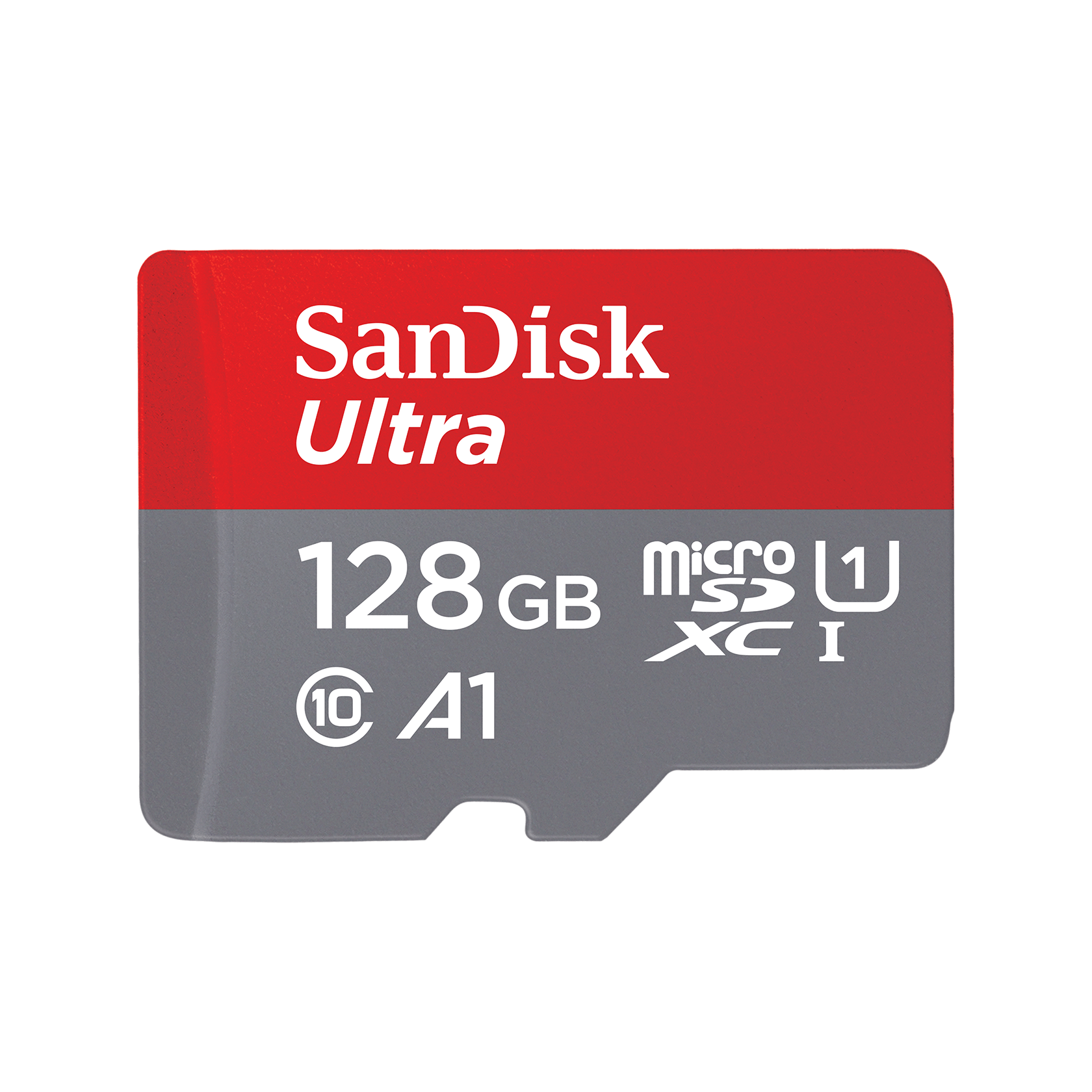
Three symbols attached to the SanDisk Ultra 128GB card, Class 10, U1, and A1, each correspond to a minimum defined by the SD Association, and those minimums are the only performance the card is obliged to deliver. The large number printed beside them, up to 140 MB/s, is a manufacturer read figure taken under conditions the buyer will probably not reproduce.
SanDisk's direct store listed model SDSQUAB-128G-GN6MA at $41.99 with a sale price of $32.99 on the day checked, and the same two figures were still printed on October 4, 2026 beside a Notify Me control rather than a cart button. Amazon had the same model in stock on October 5, 2026 at $35.64. The disclosures underneath the price and the SD Association's class definitions say what a buyer is actually being promised, and who should look for a different card.
Our verdict
A reasonable expansion card for a phone, tablet, or Chromebook at $35.64 on Amazon, provided the buyer treats the read speed as a ceiling and the speed classes as the only guaranteed floor.
- A good fit for
- A buyer adding space for photos, downloaded video, music, and apps to a device with a microSD slot.
- We would skip it if
- You plan to record 4K video, run a camera that asks for a V30 or U3 card, or expect writes anywhere near the read speed on the label.
Reasons to consider it
- Class 10, U1, and A1 markings that map to defined minimums
- SD adapter included, so the card fits full-size slots without an extra purchase
- 10-year limited-scope warranty on a low-priced part
The compromises
- The 140 MB/s read claim needs a compatible reader and describes reads only
- SanDisk states write speeds are lower without publishing a write figure
- No V-class mark appears on this card or in its listing, so video-class buyers have only U1 to rely on
What we have not verified: SanDisk publishes no write figure for this card, so how it behaves in a specific phone, camera or reader is something SanDisk leaves unstated. The published datasheet link returned a 404 when the listing was first read, and on October 4, 2026 the direct store offered the 128GB card with a Notify Me control and a Find a Reseller link rather than an add-to-cart button, so the card is bought from a retailer; on Amazon on October 5, 2026 it was $35.64 from a third-party seller, Direct Suppliers US, with Amazon shipping it.
The things in this guide
A closer look at the products, who they may suit, and what to check before buying.
Ultra microSDXC UHS-I Card with Adapter · 128GB
The A1 rating and 128GB capacity match the way most phones use a card: app data, photos, and downloaded media, with the read ceiling as a bonus when offloading through a fast reader.
Before you buy: The guaranteed sequential write floor is 10 MB/s, which rules it out as a confident choice for 4K recording or for any camera that lists U3 or V30 as a requirement.
Price checked October 5, 2026. Retailer prices can change.Three symbols, one write floor
The 128GB card carries two printed class marks, Speed Class 10 (C10) and UHS Speed Class 1 (U1), and SanDisk rates it Application Performance Class 1 (A1). SanDisk's table for that capacity gives interface, read performance, warranty and dimensions, and names the A1 rating in its feature copy rather than as a row of classes. The SD Association defines the first two as minimum sequential write speeds, and its overview states that Class 10, U1, and V10 all indicate the same 10 MB/s write floor under the standard's test conditions. The symbols differ by bus generation, not by the number they promise.
A1 is a different kind of promise. SanDisk's footnote defines it as 1500 read IOPS and 500 write IOPS, and the SD Association describes the class as a minimum average of random 4KB operations per second plus a minimum sustained sequential figure. Random small-block performance is what app loading depends on, so A1 is the marking that matters most for a card living inside a phone.
140 MB/s is a read ceiling with conditions attached
The headline number for the 64GB and 128GB capacities is up to 140 MB/s, and the disclosure states the conditions plainly: the card uses proprietary technology to exceed the 104 MB/s UHS-I bus limit, it requires a compatible device capable of reaching that speed, and write speeds are lower. SanDisk names its own MobileMate USB 3.0 reader, sold separately, as the way to reach the figure. A phone's internal slot is unlikely to be that device.
No write figure appears anywhere on the listing, so the only write number a buyer can hold SanDisk to is the 10 MB/s floor implied by C10 and U1. The distance between a 140 MB/s ceiling and a 10 MB/s floor is where most disappointment with memory cards comes from, and it is visible on the packaging for anyone who reads the footnotes.
Video buyers should notice what is missing
The SD Association's Video Speed Class exists so a camera can demand a specific sustained write rate, and its classes run from V6 to V90. Neither the marks printed on this card nor SanDisk's listing for the capacity carries a V-class symbol. A V10 card would promise nothing beyond what U1 already promises, so the omission changes little in practice, but a camera whose manual asks for a V-class marking has no matching symbol here to point at.
SanDisk describes the card as suitable for Full HD 1920x1080 video and qualifies even that with a note that support varies by host device and file attributes. Higher bitrates, 4K capture, and action cameras generally call for U3 or V30, which are a different product tier. Choosing this card for that job means accepting a spec sheet that never claimed to cover it.
Price, warranty, and what arrives in the package
The direct store listed the 128GB card at $41.99 with a sale price of $32.99 but showed only a Notify Me control on October 4, 2026; Amazon listed the adapter version, SDSQUAB-128G-GN6MA, at $35.64 the next day, shipped by Amazon and sold by Direct Suppliers US, returnable for 30 days. The box contains the microSD card and an SD adapter, which is the part that lets the same card feed a laptop's full-size slot or a camera. SanDisk lists dimensions as 0.04 by 0.59 by 0.43 inches, a weight of 0.26 g, and an operating temperature range of -25 to 85 °C.
SanDisk's table for the 128GB capacity states a 10-Year Limited Warranty, and the warranty policy linked from the listing's disclosures sets the conditions. Keep the receipt and the model number, because SDSQUAB-128G-GN6MA is the string a warranty claim will need.
When to skip it
Skip this card if your camera or drone lists U3 or V30 as a requirement, or if you intend to record 4K footage. The guaranteed write floor is 10 MB/s, the listing offers no higher write number, and no amount of read speed helps a recorder that is waiting on writes. A card from a higher tier costs more for a reason that is printed on its label.
Look elsewhere as well if the purchase is driven by the 140 MB/s figure. That number describes reads through a compatible reader, and a phone slot or a laptop's built-in reader may never approach it. For adding space to a phone, tablet, or Chromebook, the A1 rating and the sale price make it a defensible choice, with the understanding that the promise is modest and clearly stated.
How we put this together
Built from the product pages and listings below, without test scores or results we have not measured. Specifications and prices change, so check the original page for the exact model, current price, delivery, and returns.
- SanDisk: Ultra microSDXC UHS-I Card with Adapter, 128GB listing (opens in a new tab)
- SD Association: Speed Class overview (opens in a new tab)
- SD Association: Application Performance Class overview (opens in a new tab)
- Amazon: SanDisk 128GB Ultra microSD Card + Adapter, SDSQUAB-128G-GN6MA (ASIN B0B7NTY2S6) (opens in a new tab)