Product image supplied by the brand
In this guide
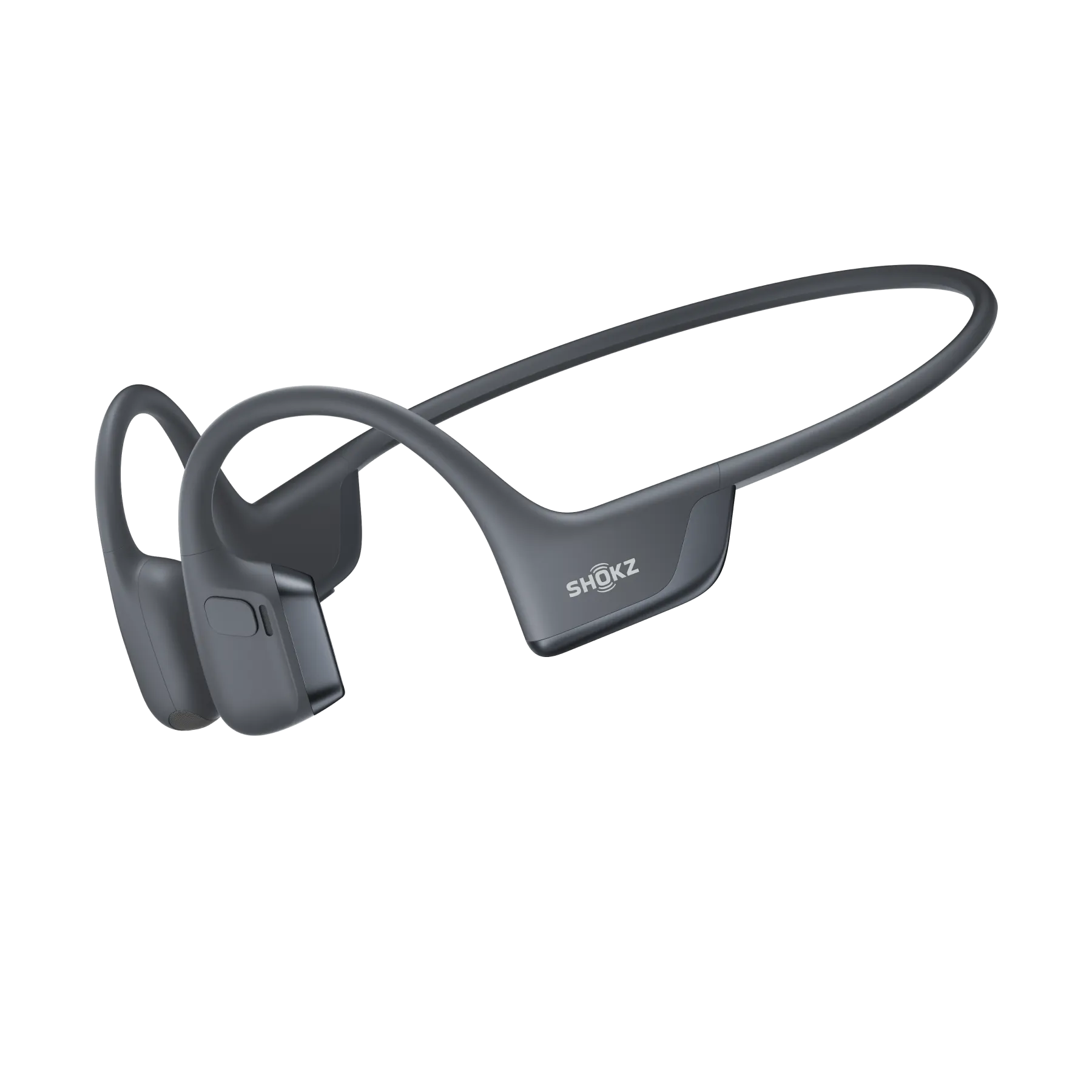
Shokz lists the OpenRun Pro 2 at $179.95 on its American store, in Black, Silver, Orange, Blue and Lunar White, in a Standard or a Mini band, and the Amazon listing sold by Shokz Official showed the same $179.95 in black on 5 November 2026. The product code is S820. Shokz's own store backs the purchase with 45-day returns and a two-year warranty, and a carrying case ships in the carton. The band weighs 30.3 g, and Shokz dates the model to August 2024.
The shape is the entire argument. A bone-conduction driver rests on the cheekbone in front of the ear and an air-conduction driver stops short of the canal, and neither one seals it, so the street keeps arriving while the music plays. Shokz prices that design in three steps: $129.95 for the OpenRun with 8 hours and IP67, $159.95 for the first-generation OpenRun Pro with 10 hours and IP55, $179.95 for this pair with 12 hours, IP55 and the second driver.
Our verdict
At $179.95 the OpenRun Pro 2 is for runners and riders who want the road in their ears: 12 hours a charge, IP55, a second driver for bass. It cannot make anything quiet.
- A good fit for
- A road runner, rider or hiker who wants music and traffic at once, sweats through rain and dust, and will wear a band across the head instead of an earbud.
- We would skip it if
- You want quiet on a plane, a train or an open-plan floor: an in-ear that seals the canal and cancels noise does that, and an open band cannot.
Reasons to consider it
- DualPitch puts a bone-conduction driver on the cheekbone and a separate air-conduction driver outside the ear for bass, and Classic mode turns the air driver off for the older bone-only sound
- 12 hours a charge, one hour to refill, and charging over USB-C where the OpenRun Pro still uses a magnetic cable, in a 30.3 g band
- Six EQ presets and two custom slots in the Shokz App, with a Volume Boost mode for loud streets; two-year warranty and 45-day returns bought from Shokz's own store
The compromises
- Nothing seals, so traffic, wind and gym music arrive with the track; raising the volume to beat them is what pushes the air driver's bass out to the person beside you
- IP55 lands level with the $159.95 OpenRun Pro and below the $129.95 OpenRun's IP67, and Shokz's own FAQ names showers, saunas and seawater as outside the rating
- Two fixed band sizes and no adjuster, and the USB-C port is closed by a rubber flap that Shokz says needs extra pressure to seat
What we have not verified: Shokz's US page gives no volume condition for the 12 hours; its UK page footnotes 75 percent volume in a 25±2°C room, which still leaves the maximum-volume runtime unpublished. Its page for the older OpenRun Pro rates that pair 10 hours at standard volume against 4 at maximum, the spread a loud street could open. No Shokz page gives a leakage measurement or a sound-pressure figure for the street noise that reaches the ear. If bass at street volume reaches the person next to you, the $50 over the OpenRun is buying battery and a case, not sound.
The things in this guide
A closer look at the products, who they may suit, and what to check before buying.
OpenRun Pro 2 Open-Ear Sport Headphones
$179.95 buys a bone-conduction driver plus an air-conduction driver for bass, 12 hours a charge from a one-hour USB-C fill, IP55, six EQ presets and two custom slots, in a 30.3 g band with a carrying case and a two-year warranty.
Before you buy: IP55, where the OpenRun manages IP67; nothing seals the ear, so on a loud street the music competes with traffic, and Shokz publishes no leakage figure.
Price checked November 6, 2026. Retailer prices can change.Two steps down: $159.95 and $129.95
$179.95 is the standing price on both channels, not a markdown: Shokz prints the same figure as regular and sale price, and the Shokz Official storefront on Amazon held the same figure with the pair in stock. Five standard colours and two band sizes are on the store, with co-branded editions listed beside them; Shokz's comparison table dates the pair to August 2024. The $20 below it is the first-generation OpenRun Pro at $159.95, still sold, with ninth-generation bone conduction, 10 hours and the same IP55.
Shokz packs a carrying case, a cord that ends in USB-C, a user guide, a product box, a legal statement, an app card and a warranty card. Nothing in that carton goes into a wall socket; Shokz's FAQ points buyers at any DC 5 V charger. The first-generation Pro ships with a carrying case and a magnetic charging cable; the OpenRun below that ships with a carrying bag.
An open ear buys the street and pays for it
There is no noise cancelling and no transparency mode to switch between, because nothing seals the canal. The room is always in the mix: a bus pulling away, a passing lorry, the gym's own speakers. The pair is doing its job, and the same openness is why it makes a poor choice for a flight.
The cost is a competition the music has to win. On a quiet path the 12-hour battery is the only limit; on a four-lane road the ambient noise dictates the volume, and Shokz ships Volume Boost for exactly that situation. The air driver never enters the canal, so no seal holds in the bass it produces, and the louder the street, the more bass escapes the head. Shokz's listing calls the result leak-free; no measurement backs that word.
What the second driver is for
Bone conduction moves the skull and reaches the inner ear that way, which is why it survives an ear canal full of water; bass is the harder half, and in this generation Shokz puts a second driver on it. DualPitch pairs two decoupled units: the bone driver on the cheekbone carries mids and highs, and an air-conduction driver outside the ear handles the bass. Shokz's own difference list against the first OpenRun Pro names this as the main change, along with the EQ modes and the switch to USB-C.
Classic mode is the tell. It shuts the air driver down and leaves the bone driver working, which lands close to the $159.95 first-generation Pro and the CoreCushion low-frequency unit it runs inside the bone driver. Switching between Classic and the other presets is the quickest demonstration of what the second driver bought, and the app holds six presets plus two custom slots for anyone who wants to tune it further. None of that turns it into a sealed pair: with nothing closing the ear, the bass has no enclosed space to build in.
Two band sizes, no adjustment
Shokz sells the pair in Standard and Mini and points buyers at a head-circumference guide, because the band is a fixed loop: a nickel-titanium memory wire inside a unibody frame, with no adjuster in the specification. The choice is made once, at checkout, and it decides where the bone driver lands on the cheekbone. That contact point is the whole acoustic coupling, so a band that is a size off is not a comfort problem alone.
Two things are worth checking inside the return window: 45 days from Shokz's store, Amazon's own policy on the Amazon listing. One is glasses: the hooks pass over the ear, where a spectacle temple already sits. The other is a helmet, whose rear cradle and chin straps share the space behind the head with the band. Shokz's page promises a secure, comfortable fit and says nothing about either case, so the return window is the only trial a rider gets.
IP55, a rubber flap, and one hour
IP55 is the rating Shokz prints here: protected against dust and low-pressure water splashes. Around it the $159.95 OpenRun Pro matches that IP55, the $129.95 OpenRun carries IP67 and the $229.95 OpenSwim Pro carries IP68 to two metres of fresh water. Shokz's FAQ is explicit that rain and sweat are the intended exposure and that seawater, a sauna and a shower are not; it also warns that the speaker mesh can clog and gives a routine of shaking the band, wiping the mesh and air-drying it for a few hours.
Charging is the better story. One hour refills the cell, the port is USB-C instead of the magnetic cable on the older Pro, and Shokz warns in its FAQ that the rubber cover over that port sometimes needs a firmer push to seat. That cover is the one part of the water rating a buyer can get wrong. The US page promises a Quick Charge without a figure; Shokz's UK page gives 5 minutes for 150 minutes of playback at 75 percent volume, where the older Pro's US page gives 10 minutes for up to 1.5 hours. The US page names no Bluetooth version; Amazon's attribute table and Shokz's UK spec block both give 5.3.
Calls, wind and the microphone
Call quality leans on a pair of wind-resistant microphones and an AI noise-reduction step that Shokz's Amazon listing says removes 96.5 percent of background noise, wind included, at speeds up to 15 mph. Fifteen miles an hour is a decent cycling pace and faster than most runners hold. Shokz's UK page footnotes the 96.5 percent as a simulated street-crossing test worth about 29 dB of signal-to-noise gain, and the wind claim as a rider at 25 km/h on a quiet closed road in still air; neither is a recording of a real ride.
The microphone also sits where sweat collects, which Shokz's FAQ concedes by listing a muffled mic as a known symptom and prescribing the same dry-and-air routine as for the speakers. Anyone who takes calls mid-run should expect the first minutes of a wet session to be the weak point, and should not expect the open design to keep a caller from hearing the road either.
When to buy the $129.95 pair, or nothing open
Quiet is the one thing no setting on this pair can deliver. A plane cabin, a train carriage or an open-plan floor needs an in-ear that seals the canal and cancels noise; that pair gives up the traffic awareness which makes the Shokz worth carrying. Covering both means two pairs, and no open band does the sealing half.
Owners of the $129.95 OpenRun should price the difference: four more hours a charge, the air driver and two generations of bone-conduction technology, against IP67 traded for IP55 and 3.9 g added. The $159.95 first-generation Pro is the cheaper step that matters, $20 for the second driver, two more hours and charging over USB-C, with the water rating unchanged. Swimmers should stop at the OpenSwim Pro, which is rated for two metres of water and holds 32 GB for underwater listening. Buyers who mostly listen indoors, where nothing competes with the music, are paying for an opening they will not use.
How we put this together
Built from the product pages and listings below, without test scores or results we have not measured. Specifications and prices change, so check the original page for the exact model, current price, delivery, and returns.
- Shokz: OpenRun Pro 2 product page (US store) (opens in a new tab)
- Amazon US: SHOKZ OpenRun Pro 2, Black (B0D2HKCMBP) (opens in a new tab)
- Shokz: OpenRun product page (US store) (opens in a new tab)
- Shokz: OpenSwim Pro product page (US store) (opens in a new tab)
- Shokz: OpenRun Pro product page (US store) (opens in a new tab)
- Shokz UK: OpenRun Pro 2 product page (opens in a new tab)