Product image supplied by the brand
In this guide
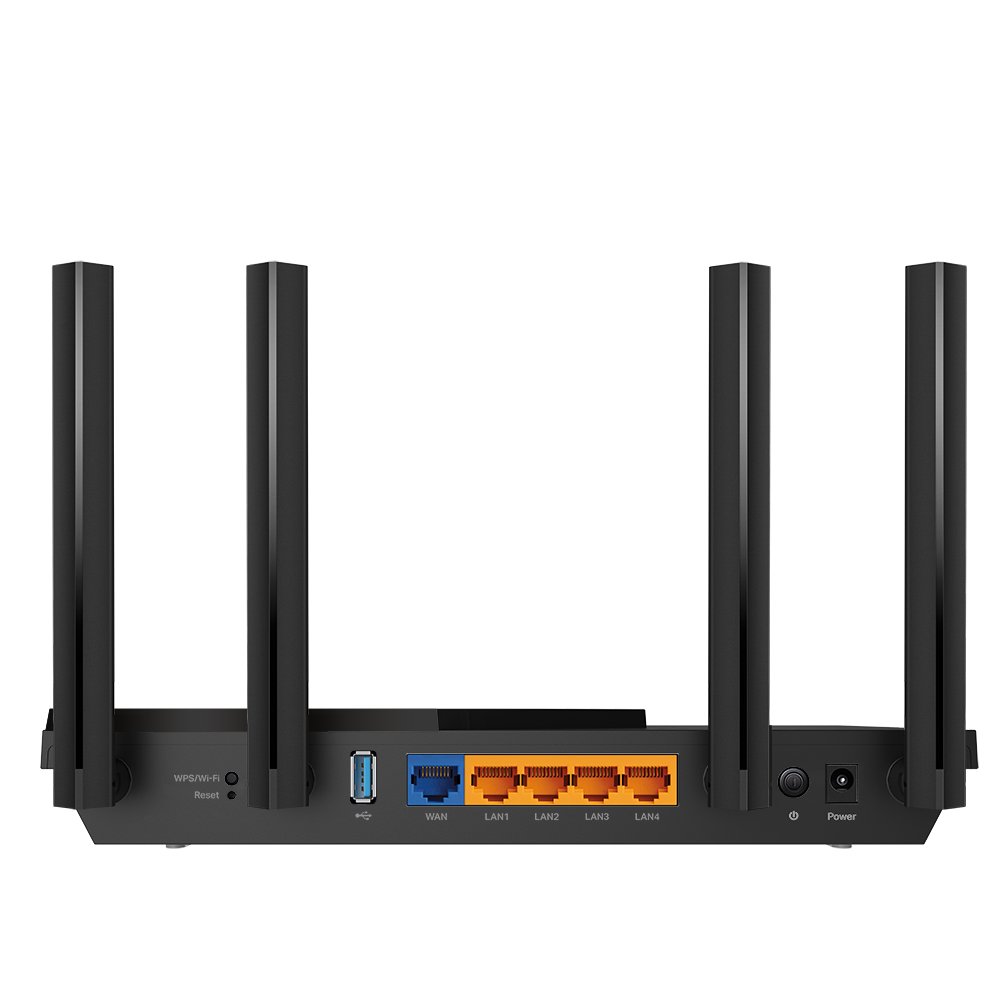
The Archer AX55 is TP-Link's AX3000-class Wi-Fi 6 router: 2402 Mbps on 5 GHz with a 160 MHz channel and 574 Mbps on 2.4 GHz, four fixed external antennas, one gigabit WAN port, four gigabit LAN ports, and a USB 3.0 socket. TP-Link's US page has no price and no cart; its Buy Now button opens an Amazon listing that showed $99.99, sold and shipped by Amazon.com, when checked. For comparison, the NETGEAR Nighthawk RAX43 reviewed earlier on this site lists at $249.99 direct from NETGEAR with the same port layout and the same 2.4 GHz rate.
The interesting part of this router is not the radio. It is that TP-Link's own documents describe two different products under one name. TP-Link's US listing is tagged hardware version V1 and advertises OneMesh alongside EasyMesh; the support page defaults to V4.60, its datasheet is titled for V4, and that datasheet drops OneMesh, adds WireGuard, and carries a 2023 copyright. What follows covers the radio math, the ports, the mesh and VPN differences between revisions, HomeShield's free and paid tiers, and the warranty term, then say who should skip it.
Our verdict
A sensible low-cost Wi-Fi 6 router for a gigabit-or-slower internet plan, with a spec that matches the NETGEAR RAX43 on ports and 2.4 GHz rate while costing well under half as much; confirm the hardware version on the box because TP-Link's pages disagree about which one is current.
- A good fit for
- A home on a 300 Mbps to 1 Gbps plan with a dozen or two mixed devices, where the buyer wants WPA3, a guest network, and a VPN server without paying for a security subscription.
- We would skip it if
- Your plan exceeds 1 Gbps, you need a single 5 GHz client to run faster than a two-stream link allows, or you plan to build a mesh with a specific TP-Link extender and cannot confirm which mesh scheme your hardware version supports.
Reasons to consider it
- Five gigabit Ethernet ports plus USB 3.0 with Time Machine, FTP, Samba, and media server support listed
- HE160 on 5 GHz, OFDMA, WPA3, DFS, and OpenVPN, PPTP, and L2TP server and client modes at a sub-$100 street price
- TP-Link's US warranty table gives Wi-Fi routers two years, double the term NETGEAR states for the RAX43
The compromises
- The 5 GHz radio is 2x2, so the 2402 Mbps figure needs a 160 MHz channel and drops to about 1200 Mbps on an 80 MHz channel
- TP-Link's US listing is tagged V1 and lists OneMesh; the datasheet and current firmware are for V4, which lists EasyMesh and WireGuard instead
- TP-Link publishes no price, so the $99.99 figure is Amazon's, and HomeShield's paid tiers renew automatically after a one-month trial
What we have not verified: No throughput, range, or stability testing was done. TP-Link's US page does not show a price and the Buy Now button opens Amazon, so the $99.99 figure is a third-party retail price. TP-Link's US listing is marked hardware version V1 while the support page defaults to V4.60 with a V4 datasheet; which revision ships from Amazon today was not confirmed. The processor is described only as a dual-core CPU on a Qualcomm chipset with no clock speed.
The things in this guide
A closer look at the products, who they may suit, and what to check before buying.
Archer AX55 AX3000 Dual Band Gigabit Wi-Fi 6 Router
Gigabit WAN and LAN, HE160 on 5 GHz, WPA3, DFS, a USB 3.0 port with NAS-style sharing, and warranty backing for two years at roughly $100 cover most homes on a 1 Gbps or slower plan.
Before you buy: A 2x2 5 GHz radio caps any single client at two streams, TP-Link publishes no price of its own, and the hardware revision you receive determines whether the mesh feature is OneMesh or EasyMesh and whether WireGuard is present.
Price checked September 11, 2026. Retailer prices can change.What AX3000 means with a 2x2 5 GHz radio
TP-Link rates the AX55 at 2402 Mbps on 5 GHz using 802.11ax with HE160, and 574 Mbps on 2.4 GHz, for a four-stream total the marketing rounds up to 3000. Both numbers are physical-layer maximums from the IEEE 802.11 specification, and TP-Link's footnote states that actual throughput, coverage, and device counts are not guaranteed. The 2402 figure requires a client with two spatial streams on a 160 MHz channel; on the more common 80 MHz channel width the same radio links at about 1200 Mbps, which is still more than a gigabit WAN port can deliver.
Compared with the NETGEAR RAX43, the AX55 gives up one 5 GHz stream: 2x2 against 3x3, 2402 against 3603 Mbps. For a phone or laptop with a two-stream adapter, which describes nearly all of them, that third stream is invisible to any single client, and the ceiling is set by the client's own radio and the channel width. TP-Link lists DFS channel access, OFDMA, airtime fairness, beamforming, and high-power front-end modules, and adds a second footnote that 160 MHz may be unavailable in some regions and that OFDMA, HE160, and Target Wake Time all require client support.
Gigabit everywhere, plus a USB port that does real work
The AX55 has one gigabit WAN port and four gigabit LAN ports. As with the RAX43, the WAN port is the hard limit: a 1 Gbps plan fits, and anything faster is wasted at the router. There is no 2.5 Gbps port and no link aggregation in the spec, so a multi-gig plan calls for a different class of hardware. The four LAN ports handle a desktop, a console, a TV, and one more wired device before a switch is needed.
The single USB 3.0 port is more fully specified than on many routers at this price. TP-Link lists NTFS, exFAT, HFS+, and FAT32 partition support and four functions: Apple Time Machine, an FTP server, a media server, and a Samba server. The overview text adds secure access from outside the home, with an asterisk. No transfer-rate figure is given for the USB port, so treat it as a convenient backup and media target, not a substitute for a NAS. Power is 12 V at 2 A, and the box holds the router, its adapter, an RJ45 cable, and a quick installation guide.
One model name, two hardware revisions, two feature lists
TP-Link's US listing is tagged with a data-version attribute of V1, and its specification block lists both OneMesh and EasyMesh under service kits, with OneMesh described as pairing the router with TP-Link's own OneMesh range extenders. The US support page for the same model defaults to hardware version V4.60, lists V1.60 as the other option, and links a datasheet titled for version 4.0 with a 2023 copyright. That datasheet lists EasyMesh as supported and does not mention OneMesh at all.
The VPN column changes too. The V1 page lists OpenVPN and PPTP server modes with OpenVPN, PPTP, and L2TP client modes; the V4 datasheet and TP-Link's global V4 page add a WireGuard server and client. Firmware for V4.6 reached build 1.2.1 in May 2026 and one release note warns that the upgrade cannot be reversed. None of this is visible in an Amazon listing that just says Archer AX55, so a buyer who cares about WireGuard or about matching a specific OneMesh extender should check the version printed on the box label, which TP-Link's own help article explains how to read.
HomeShield: the free tier is useful, the paid tiers auto-renew
The footnote on TP-Link's US model page reads, in full, that HomeShield includes the Free Basic Plan and that fees apply for the Pro Plan. TP-Link's own FAQ, updated in May 2026, is more specific and uses different names. The free Basic level covers a router security scan, a wireless security scan, IoT device identification, and basic parental controls with profiles, a URL content filter, bedtime, and a pause-the-internet switch. Quality of service by device and the comprehensive reports are also free.
Three paid plans sit above that. Advanced Parental Controls starts at $2.99 a month or $17.99 a year; Security+ (IoT protection, web protection, intrusion prevention) starts at $4.99 a month or $35.99 a year; and the Total Security Package, which adds third-party antivirus for up to five devices, starts at $69.99 for the first year and renews at $129.99. New users get a one-month trial of the first two, none for the third, and all plans renew automatically until canceled. Set against NETGEAR's $99.99-a-year Armor on the RAX43, the AX55's paid security is cheaper, and unlike Armor the free tier keeps a real network scanner.
Two years of warranty, and a price TP-Link does not state
TP-Link's US warranty policy publishes a table for products bought on or after September 1, 2023, and the Home category that includes Wi-Fi routers shows two years. Coverage starts when the original purchase is delivered, applies only to the original buyer, and excludes refurbished units and anything bought from an unauthorized reseller, which TP-Link treats as second-hand. Replacements are typically factory refurbished, and the policy states that it does not provide refunds or exchanges under most conditions. The model page itself is silent on warranty length.
On price, TP-Link's US page is silent: no figure, no cart, only a Buy Now button that opens an Amazon search pinned to ASIN B09G5W9R6R. That listing showed $99.99, sold and shipped by Amazon.com, when checked. TP-Link's own US web store sells Deco mesh kits and Tapo devices but did not list the Archer AX55, so there is no first-party price to quote. At $99.99 the AX55 costs 40 percent of the RAX43's direct price for the same port count, the same 2.4 GHz rate, one fewer 5 GHz stream, and a warranty term twice as long.
When to skip it
Skip the Archer AX55 if your internet plan is above 1 Gbps; the gigabit WAN port throttles everything past that point, and no Wi-Fi rating changes it. Skip it if you have a three-stream laptop or a workstation that pushes large files over 5 GHz and you want the extra headroom a 3x3 radio gives; the AX55's 2x2 radio tops out at two streams per client. And skip it if your home has needed a mesh before, because TP-Link's coverage claim is three-bedroom houses with no square-footage figure, and the mesh scheme you get depends on the hardware version in the box.
Also leave it if the WireGuard VPN or a specific OneMesh extender is the reason you chose this model, unless you can confirm the revision first, since V1 and V4 differ on both. For everyone else on a gigabit or slower plan with ordinary phones, laptops, a console, and a TV, the AX55 at about $100 delivers the features that matter on a Wi-Fi 6 router, a free security tier that does something, and two years of warranty backing, and the money saved against a $250 router buys a lot of Ethernet cable.
How we put this together
Built from the product pages and listings below, without test scores or results we have not measured. Specifications and prices change, so check the original page for the exact model, current price, delivery, and returns.
- TP-Link US: Archer AX55 AX3000 Dual Band Gigabit Wi-Fi 6 Router (product page, tagged V1) (opens in a new tab)
- TP-Link US: Archer AX55 support and download page (defaults to V4.60) (opens in a new tab)
- TP-Link: Archer AX55 4.0 datasheet (PDF) (opens in a new tab)
- TP-Link US: HomeShield plans, pricing, and how to subscribe (FAQ 3007, updated May 11, 2026) (opens in a new tab)
- TP-Link US: Replacement and warranty policy (opens in a new tab)
- Amazon: TP-Link Archer AX55 listing (ASIN B09G5W9R6R, the target of TP-Link's Buy Now button) (opens in a new tab)